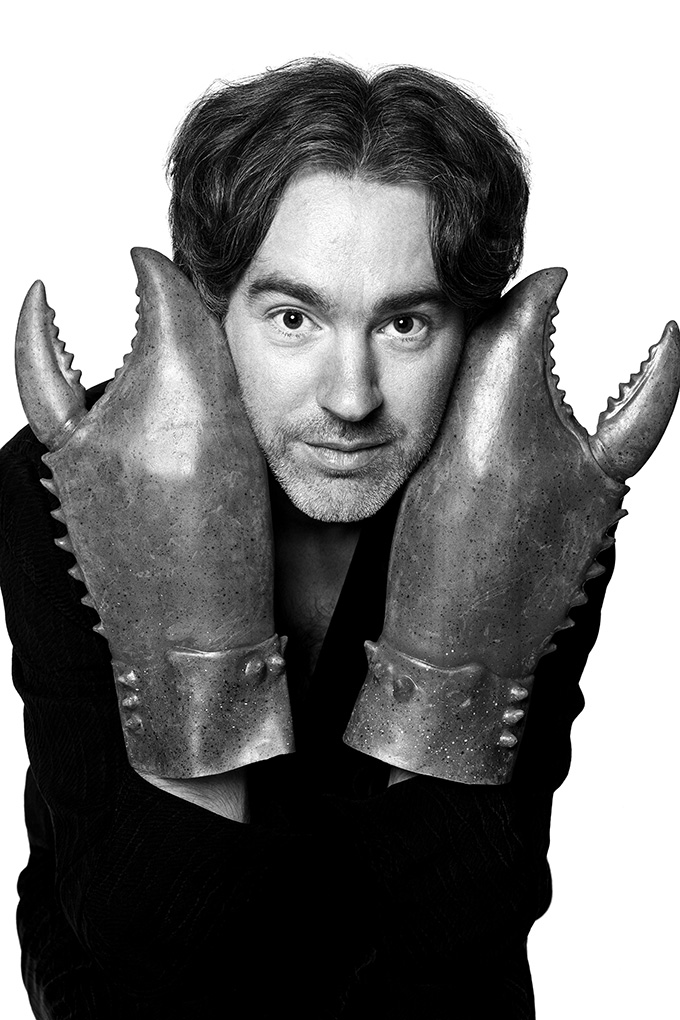
“I became an artist when I became a lobster.” Philip Colbert stands out in more ways than one. Known for his larger-than-life crustacean persona and rapidly touring global exhibitions, the Scotland-born, London-based artist creates work that rewards closer attention. His self-proclaimed identity hints at incisive wit, realised through hyperpop painting techniques and a keen understanding of art history and digital culture. Beneath the cartoonish exterior lies considerable experience and expertise.
Colbert is often hailed as the ‘godson of Andy Warhol’. Like the iconic American artist, he weaves narratives across time and space, linking art history and elevated themes with the familiar language of mass media. His blend of sharp commentary, playful satire and striking visuals has earned praise from figures such as Charles Saatchi and Simon de Pury.

Anchoring his practice is a master’s degree in philosophy from the University of St Andrews, which sharpened his appreciation of early pop figures like Richard Hamilton, Roy Lichtenstein and James Rosenquist, while providing the intellectual framework to stand out in a crowded art world. Some may view him as strange or surreal, but that quality is central to his edge and appeal; bold, brash painting is as intrinsic to his practice as his shell-clad identity.
To reveal what this crustacean persona signifies in his work, Vogue Singapore spoke with Colbert about his iconic alter ego, philosophy as ‘the love of wisdom’ and the evolution of art in a digital age.
I’m sure you get asked this question a lot, but why the lobster?
For me, lobsters feel like aliens on Earth, radiating an otherworldly energy. I love the spirit of surrealism and see the lobster as its ultimate protagonist. They also carry a rich cultural and art-historical legacy.
From Dalí’s lobster telephone to Gérard de Nerval walking one on a leash, the lobster has become a pop culture icon. Beyond that, I’m drawn to its deeper symbolism as a marker of mortality: it turns bright red in death, yet is often portrayed as alive, hinting at the tension between life and death—or even the possibility of life beyond death.
The symbolism stretches back centuries, from the mosaics of Pompeii to Dutch still-life table scenes. Mortality is the ultimate philosophical concern in art. When I say, “I became an artist when I became a lobster”, I mean that this persona lets me fully explore surrealism and symbolism in a way that feels instinctive and true to my identity.

The lobster acts as both sign and symbol, carrying its own distinct identity while pointing to meanings beyond itself. How does it help you connect and comment on the intersection of mass digital culture and art’s broader historical context?
Studying philosophy deeply attuned me to a pop philosophy of aesthetics, especially the democratisation of art and the meaningful impact of everyday pop culture. If life was ‘pop’ in the ’60s, today it’s hyperpop, fuelled by digital media and our voracious consumption of images.
I have always been interested in the relationship between artistic identity and the physical work of art. And by becoming a lobster, I was leaning into this transformative freedom of artistic identity and its then direct relationship to my artwork. To productise my creative self as a continuation of Warholian pop art product in this time of hyperconsumption.
Philosophy is an invaluable complement to any discipline, grounding creative practice in reflection and critical inquiry. How has your pursuit of ‘the love of wisdom’ shaped the way you make art?
Philosophy has shaped how I see the world. I was drawn to Nietzsche’s passion and individualism and Hegel’s sweeping systems, and I’ve been fortunate to have the time to question and form my own perspective. The key lesson I took was humour—a way to challenge empty, stuffy pretension. Humans build grand, serious cages, and humour helps shake them open to reveal true meaning.
Your work has a vibrant energy and strong technical command. How has your fusion of high art and the everyday evolved over time?
A cornerstone of my work is my love of bright primary colours, inspired by Fernand Léger and Alexander Calder. I see art as a transmitter of empowering energy, often saying the greatest achievement is to honour the power of the sunflower.

You’ve been dubbed the ‘godson of Andy Warhol’. Is that a legacy you’ve embraced and has it helped shape your creative perspective?
I’ve always admired Marcel Duchamp and later Andy Warhol for how they questioned and redefined art. Warhol’s performative genius, embracing his factory-style production, perfectly captured the spirit of the age—branding and consumption, which have only grown since.
Warhol’s idea of 15 minutes of fame has been overtaken by everyone having their own media platform—the hyperpop age. I love that creating meaningful art requires inventing a new language, staking your flag in new territory. I’ve embraced technology—whether it’s robotics or the metaverse, or battling with AI—as a way to generate fresh artistic phenomena.
How do you see your art and its impact evolving beyond 2026?
Time is central to my current thinking. I’m fascinated by how art can span eras, from ancient ruins to visions of the future, occupying a grey zone where realities converge. I admire how the artist de Chirico captured daily life amid metaphorical ruins—we carry history in our language and perception. I’ve loved placing my lobster battle sculptures in ancient sites, bringing my imagined scenes into reality, as in my installation at the Greek and Trojan temple of Segesta and my upcoming Pompeii takeover.
In recent years, you’ve shown your work across Asia, from China and Japan to South Korea, Taiwan and Singapore. What is it about this region that keeps drawing you back?
I love the energy, the people and the ancient spiritual cultures of Asia. I feel a strong connection across the region and have been fortunate to share my work and connect with so many—it’s been vital to my artistic growth. Lately, I’ve shown a lot in South Korea, and Seoul is an incredible city—a true volcano of creative energy.

Being a visual artist today can be a risky path. What guidance would you offer to emerging creatives aiming to carve out their own space?
Be bold, follow your own path and don’t chase the crowd. Take risks, avoid perfectionism and remember that in art, failure can lead to success.
Have you seen The Lobster and did it play any role in shaping your fascination with the creature?
Yes, it’s a great film! Though I was disappointed there weren’t any real lobsters. To remedy that, I’m making my own autobiographical documentary, The Lobster. Lobster lovers won’t be disappointed.