Speculative fiction is an open-ended canvas. As a literary genre, it is arguably the most versatile. In this format where reality is sometimes unnecessary (and often overrated), the once niche subgenre of ‘grimdark’ has enjoyed a resurgence in recent years. Because grimdark denotes a distinct tone more than anything else, it’s a perfect fit for all things speculative-fiction-adjacent—whether that’s fantasy, science fiction, or anything in-between.
The term is directly inspired by the tagline of the tabletop strategy game, Warhammer 40,000: “In the grim darkness of the far future there is only war.” Instead of J. R. R. Tolkien’s The Lord of the Rings, think George R. R. Martin’s A Game of Thrones. While the former built the foundation of fantasy as we know it, the HBO television adaptation of the latter’s epic series, A Song of Ice and Fire, helped catapult the concept of grimdark writing to the top of everyone’s minds (regardless of how you feel about the last season).
Unsurprisingly, standout qualities of grimdark include, but are hardly limited to: world-building that is grim and dark (you saw this coming, surely); pervasive nihilism in characters who resist clear moral alignment (the ‘right’ action is never obvious and rarely taken); and political machinations that dominate and suffocate most opportunities for hope and triumph.
Grimdark does not often make for the happiest of times. However, because the contrast between the low and high points of these stories can be extreme, those highs that do exist tend to be exceptional. Additionally, the morally grey realm the subgenre calls home enables a certain texture in characterisation, intricacy in plotting, and immersion in world-building that many find intoxicating.
Anti-heroes can be inspiring. Dry, despairing wit can be philosophical. Chaos can be fun.
The hottest, latest example of grimdark’s rise to power comes courtesy of Joe Abercrombie, whose most recent book, The Devils, was published earlier this May by Tor Books. The British author has had an outsized influence on the subgenre over his twenty-year career. This parallels the recent flourishing of nerddom in the cultural zeitgeist, especially in the realm of science fiction and fantasy.
Praised by critics, peers, and readers as one of grimdark’s leading men—he’s wholeheartedly embraced the nickname given to him by fans, ‘Lord Grimdark,’ even making that his handle on social media—Abercrombie had had more than five million copies of his books sold. So when it comes to The Devils, no one’s really surprised by its overwhelming success. Its opening week was his best-selling to date, a clear and welcome signal to readers everywhere that this slice of speculative fiction isn’t going anywhere. (Fun fact: James Cameron liked the story so much he purchased the rights to a film adaptation, with Abercrombie set to co-write.)
If you want to take a trip to the grimdark side of fiction, sink your teeth into the books below and step into beautiful, brutal worlds that straddle science fiction, fantasy, and science fantasy.

1 / 4
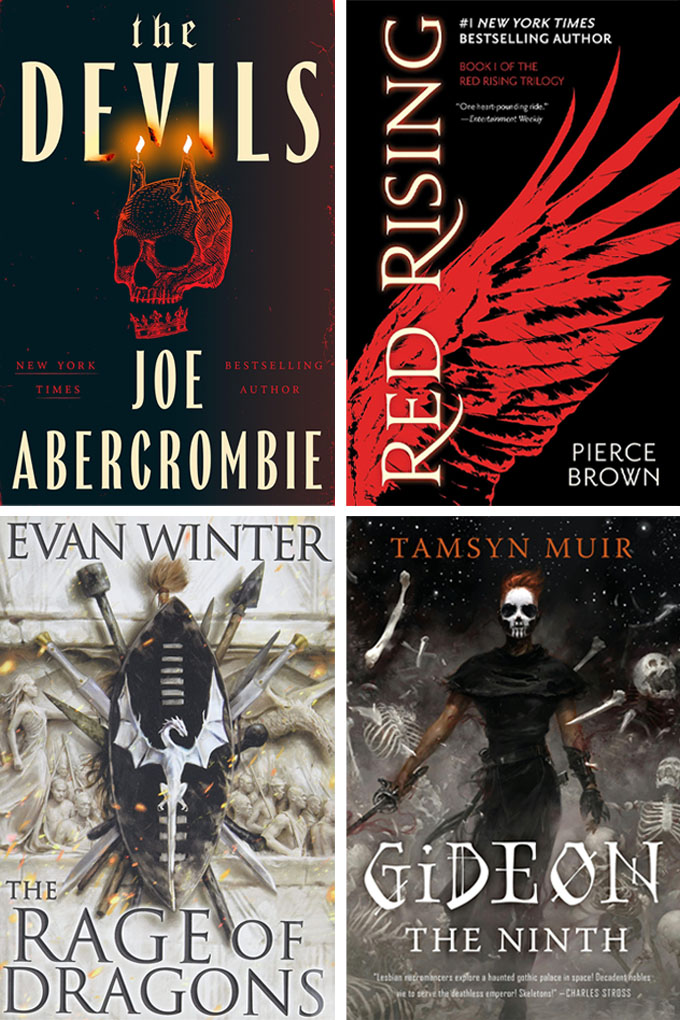
The Devils by Joe Abercrombie
The Devils proves that sometimes it pays to fight fire with fire. The tale is a riotous take on the age-old setup: a monk, knight, pirate, werewolf, vampire, necromancer, and elf walk into a bar… Except this bar is a captivating alternate reality Europe and the patrons are all ‘devils’ employed by the Church—a sick and twisted (and often hilarious) gang of misfits who always leave a trail of costly mistakes and chaotic destruction in their wake.

2 / 4
Red Rising by Pierce Brown
On its face, Red Rising reads like classic dystopian science fiction, a la The Hunger Games, even down to the first-person point of view. However, it swiftly evolves into a revenge-fuelled epic framed by a depth of political intrigue and backstabbing that would make George R. R. Martin proud. What’s remarkable is how deftly Brown juggles themes of class struggle and political consciousness alongside intense personal stakes and cinematic set pieces, all on a galactic scale.

3 / 4
The Rage of Dragons by Evan Winter
Everyone loves dragons. They’re as familiar to fantasy as sword-swinging knights and spell-slinging wizards. What makes The Rage of Dragons stand out from the crowd is the fact that it was fully independently published by Winter. Oh, and the setting is a Bronze Age, African-inspired civilisation bathed in endless conflict. It’s a bloody proving ground, made all the deadlier by the harsh realities of rigid caste systems and nightmares beyond comprehension that roam in dark, vivid dreamscapes.

4 / 4
Gideon the Ninth by Tamsyn Muir
“Lesbian necromancers in space.” This shallow tagline, bestowed upon this book by many online denizens, might be purposefully clickbait-y, but it’s not untrue. Gideon the Ninth is essentially a murder mystery, chock full of body horror, emo angst, and, predictably, plenty of skeletons. The book’s true strength lies in how Muir presents the protagonist’s voice–the character of Gideon speaks with singular style, overflowing with irreverent humour and defiant, vulgar brashness.