When I was eight, my happiest place on Earth was a small, volunteer-run library in the void deck of an HDB block five minutes away from my house. I would make weekly visits after school, spending at least an hour each time while my mother, a still new immigrant to Singapore, chatted politely with the librarian and other adults who were also waiting around.
She would rush me along in practised whisper shouts that I would coolly ignore as I rummaged through rows and boxes of books, looking for the hidden gem I knew I would likely uncover. And gems there certainly were, even if only because they had carelessly been thrown in by a parent donating their children’s hand-me-downs. A thick anthology of Sir Arthur Conan Doyle’s Sherlock Holmes stories, I believe, had been my most treasured find.
The specific architecture of the space is now fuzzy in my mind, but one thing I remember clearly is the way it exuded pure warmth. It hardly felt like a real library, especially in contrast to the Tampines Regional Library—a nearby and vastly more formal building that felt too intimidating to enter until I got older, even if it held the bigger collection of more advanced books that I wanted to read.

My community library, meanwhile, had a modest offering. There were only a handful of shelves, mostly filled with picture books I quickly outgrew. But it did have one special feature: a carpeted kid’s corner where a few carefully positioned bean bags sat in various stages of deflation. Here, the library’s already-tenuous silence rule was lifted and children were allowed to read aloud or make conversation. As a slightly anxious child desperate to get lost in books, I felt content spending time here—even if all I did was pore over the same titles I already knew until I had committed them to memory.
By the time my family moved away to a different part of Singapore, my community library had disappeared. I had moved on to fancier institutions at this point, such as the multi-storied Central Library in Bugis or the futuristic Library@orchard. But eventually I stopped frequenting them too. I could no longer commit to reading full novels in three week-cycles and it was more efficient to order books online or pick them up in rushed trips to Kinokuniya between errands. Libraries, slowly but surely, went from being the highlight of my week to having no place in my life.
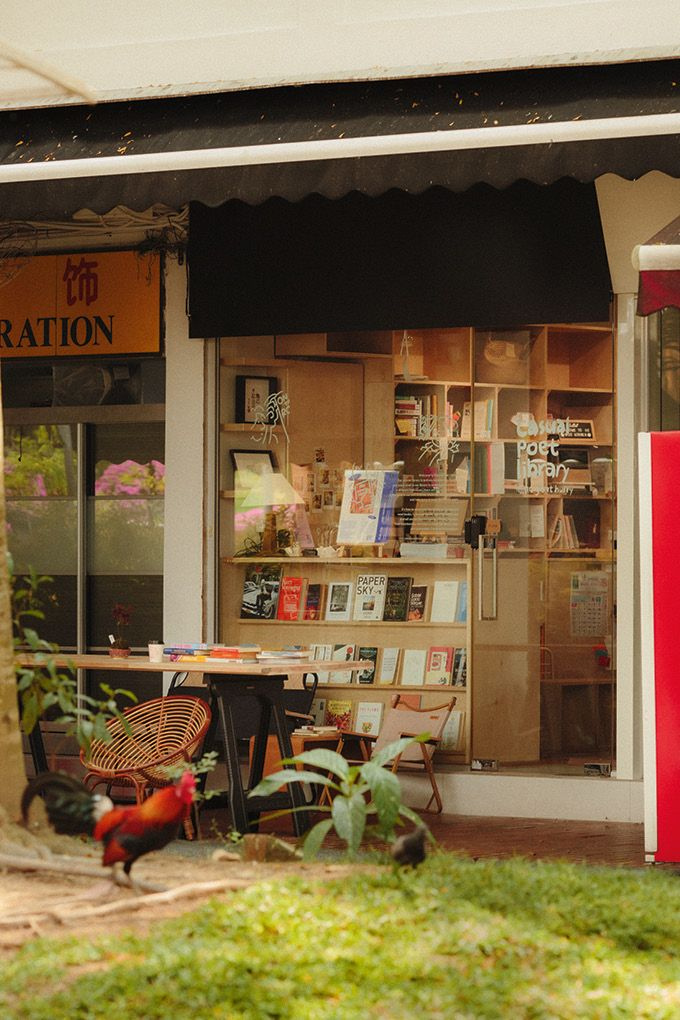
It’s like muscle memory then, when warmth floods my body as I step into Casual Poet Library on a Tuesday morning. The space is endearingly tiny, lined wall to wall with irregular wooden shelves, each stocked with a seemingly random assortment of books alongside plants, pottery and various trinkets. A slender table in the middle is accompanied by two chairs, and a step-stool sits conveniently close by, in case one needs to reach any of the higher shelves that would be out of reach of most adults. I am transfixed as I walk in and stub my toe softly on a small step at the entrance.
“Someone told us the other day that it feels like we’ve been here forever. To me, that’s the biggest compliment because it means that we are part of the neighbourhood”
“Oh! I should have warned you about that,” Rebecca Toh, the founder of Casual Poet Library, exclaims as she walks over to greet me. I assure her that it was my own carelessness, explaining that I had been distracted thanks to the flurry of emotions I was overcome with upon seeing the library in real life.
Toh, a Singaporean photographer who works across Asia, seems to understand my sentiment. Like many book lovers, she had long dreamt of owning her own bookstore or library. But in land-scarce Singapore, eyewatering rental prices would likely turn that fantasy into a financial burden quicker than her first visitor could check out their first book.

It was on a solo trip to Japan that Toh found an answer she didn’t know she had been searching for. In a little fishing town called Yaizu, she stumbled upon a library run by the local community. By renting out to individuals who would then stock the library with their own books, the space became a collective literary hub that would sustain itself.
“It’s such a universal idea. It turns out that the guy who started it in Japan had first seen it in Germany. Now that we’re up and running in Singapore, I’m getting DMs from people in India or Australia or New York City, saying they want to start something similar in their neighbourhood.”
Like its predecessor that inspired it, Casual Poet Library’s eclectic collection is owed to the nearly 200 individuals who have stocked its shelves. Each shelf is rented out to a different person, who is free to bring in titles of their choice. Not only does this ensure a vast diversity of reading material for visitors to explore—I spotted everything from Chinese literature to manifestos written by African-American feminist scholars to a sizeable stack of Tintin comics in enviably pristine condition—it also means that Toh and her community are able to sustain rental and operational costs without burning a hole in their pockets.
Toh describes the moment of finding Casual Poet Library’s location as a “cosmic coincidence”, having stumbled across the Bukit Merah neighbourhood by a stroke of luck six months before the library opened. Located inconspicuously along a string of industrial shops, minimarts and bakeries, the storefront blends in so well with its surroundings that I nearly miss it as I walk past. A few roosters that live in the area gather on a nearby patch of grass—it’s almost unbearably quaint.
Toh and I agree that a big part of the library’s charm is how seamlessly it fits into its neighbourhood. Casual Poet Library is a community space; owing to its very nature, it first needed to be accepted by the heartland community it had taken root in. She says: “Often, when young people start something, they focus on bringing the design and the vibes. But that can cause a certain amount of gentrification in the neighbourhood. We’ve tried really hard not to do that.”
“The tradition of community libraries will always exist here, softening our edges and breathing life back into concrete”
Toh shares that the older folk living and working in the surrounding area have given Casual Poet Library their stamp of approval. They may not all be literary enthusiasts, but Toh describes ‘aunties’ and ‘uncles’ often peering in and remarking that it’s nice for young people to find a way to share their books. She beams: “Someone told us the other day that it feels like we’ve been here forever. To me, that’s the biggest compliment because it means that we are part of the neighbourhood.”
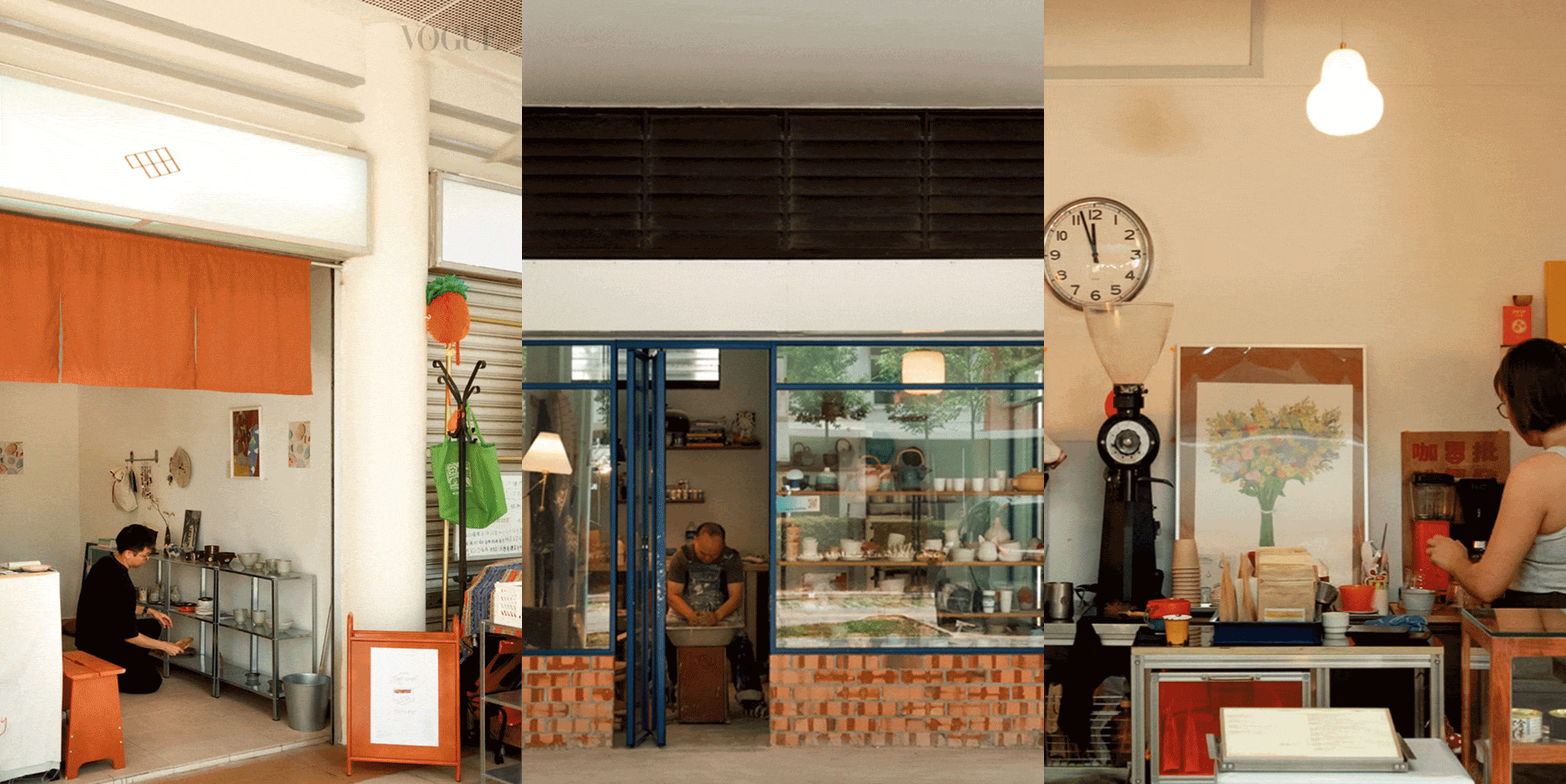
As with many libraries, Toh’s vision for Casual Poet Library is for it to function as a friendly third space for visitors from all walks of life. “We want to welcome people to come as they are and stay all day if they like. You don’t need to pay to come in or even buy a drink—though we always recommend our next-door neighbour, Rookie’s Coffee Shop, if you need a pick-me-up.”

With Casual Poet Library’s inventory evolving fluidly, it owes its daily management to voluntary shift librarians who come in on rotation to assist visitors and catalogue the collection, pasting stickers on the spines because it makes the books easier to keep track of—and the space feel more like a genuine library.
Izyanti Asa’ari, an art director and poet, is one such part time voluntary librarian and proud shelf owner. Aside from a collection of books, she leaves slim cards of handwritten poetry on her shelf—inviting anyone browsing to take one if it resonates with them. “I was so excited when people started taking them home that I didn’t even realise that some of them were writing little bits of poetry back,” she says.
Other shelf owners have found a myriad of ways to contribute to keeping the space running. They chip in to projects big and small—one volunteer taught the group how to install the library’s wooden flooring from scratch—and everyone has a stake in how Casual Poet Library ultimately takes shape. I notice that no matter whom I am speaking to, they always refer to decisions surrounding the library with a collective ‘we’, never attributing them to a single person, not even Toh.
It feels almost naive to believe that a not-for-profit, collectively run hub like this could survive in Singapore today. But like the team behind Casual Poet Library, who dedicate hours, weeks and months of their own time to this shared dream, I am convinced that in our hyper-practical city, a space like this is not only a superficial desire, but a deep-seated craving.
In fact, this makes me think that the tradition of community libraries will always exist here, softening our edges and breathing life back into concrete. As I prepare to leave, I notice an especially low shelf in a sheltered nook of the library, stocked with picture books, a plush toy and a small wooden stool at its foot. Above it, a colourful sign proclaims proudly, Kid’s Korner.
Photography Sayher Heffernan
Styling Jasmine Ashvinkumar
The October anniversary ‘Community’ issue of Vogue Singapore is available for sale online and in-store from 4 October 2024.