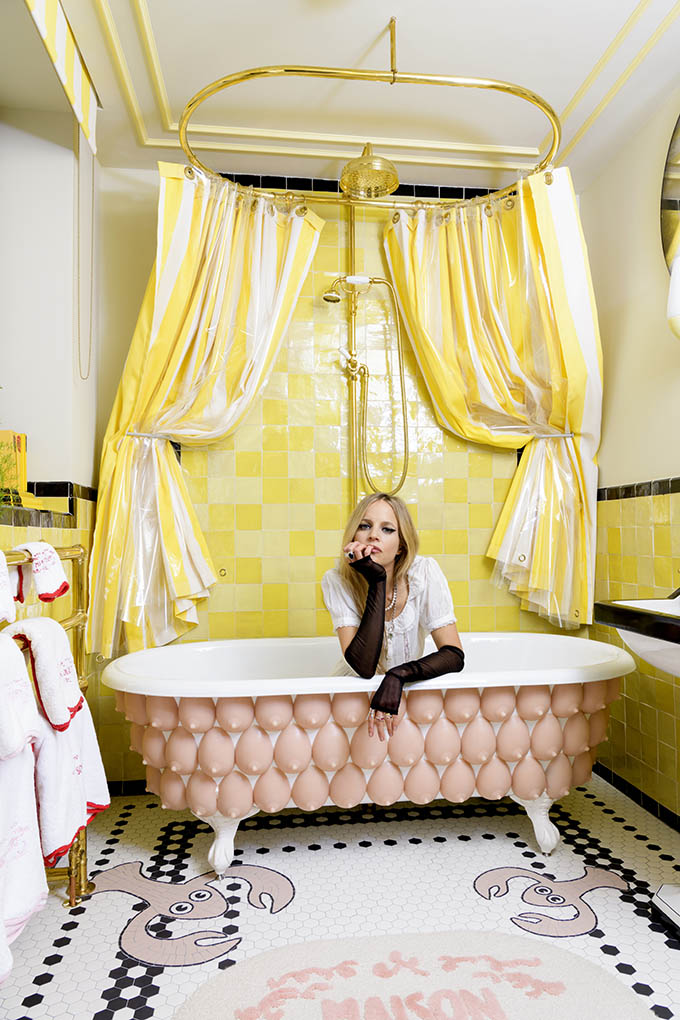
What does it mean to possess a body—to live life as an embodied individual? While that question has become infinitely harder to parse in the last few years (thank you, social media; thank you, generative AI) there are some, like British-French filmmaker and multimedia artist Charlotte Colbert, who refuse to back down from the challenge.
Colbert, partner to lobster-loving artist Philip Colbert, has made it her life’s work to seek enlightenment in the physical, mental and emotional spaces surrounding notions of bodily consciousness and perception. Dubbed ‘a natural-born magician’ by The London Standard, her art—from her work in film to her ceramic homeware and monumental sculptural installations—feels as if it were conjured from the ether, inspired by the very best components of an overly active imagination.

“I’m an overthinker and an over-feeler,” she confesses. “I guess my practice is a buoy that allows me not to drown and explore hidden nooks of mind and world with purpose. All the mediums I work within are connected by my fascination with story and narrative—the realities and fictions that define us and make us who we are.”
On this front, Colbert has a foot firmly planted in both worlds, fully cognisant of the fact that, beyond the veil of physical phenomena, lies a universe fuelled by the fantastical and the surreal. “We live in imagined structures,” she remarks. “Everything human-made around us was invented by someone before, from our computers and cups to our political systems. Everything we imagine today becomes our reality tomorrow. In that sense we are all magicians. Our imaginations can shape the world, especially when the imagining is collective.”

The body is a strange, often frail thing, but Colbert is better equipped than most to navigate its transience. She grew up on the move attending 12 different schools, which had a profound effect on her creative approach. Her resting state is one of inquiry. “Bureaucracy, illogical questions, questionnaires with binary options, unfounded opinions, certitudes—all beg to be questioned, poked fun at, rebelled against.”
Unsurprisingly, like her husband, she also studied philosophy, drawn to the simple, stirring fact that it is, at its core, ‘the love of wisdom’. Her appreciation of the discipline comes from a healthy dose of tongue-in-cheek self-awareness, as she jokes: “I have no wisdom, so I strive for any droplets of it anywhere. I question everything, doubt everything.”

This playful understanding of the world and her place in it serves as a cornerstone of her ongoing study of the body. In her mind, it is “the anchor of history and experience. The survivor. The scar bearer. The life holder. I’m so grateful to have a body. To carry memory, to feel wind, to smell grass, to see the sky, to manifest excitement, to connect, to hold, to be held, to love. Each infinitely small cell is a mirror to the shapes of stars and galaxies. Like a game of mirrors that reminds us we are stardust—quite literally as creatures formed from the Big Bang.”
Much like her ruminations on the subject, her work is a poetic exercise in subjectivity. Delicate glass structures formed as fallopian tubes. Layers of stoneware set to shock and invoke sympathy, arrayed as fanning breasts. Plush pillows in the shape of wildly flaring eyes.

The latter holds a particularly special place in Colbert’s heart. “For me, the eye has come to symbolise the power of collective imagination,” she observes. “I think it’s so important for us to reclaim this power of collective imagination in order to build futures we actually want to live in. The version of the future they are presenting is just one among millions. The more impossible it seems to reimagine our futures, the more essential it becomes.”
Like any good philosopher, she has not forgotten the significance of a subject’s telos, or end. All the art in the world does no one any good if it does not point to a truth that helps lead to a better life. In that regard, Colbert has thoughts aplenty. In an age shaped by algorithms, she resists that which is taken for granted and poses an important question: “Where do our bodies begin and end in the digital age? How does it affect our sense of self? What new senses are available to a human who is such a concentrated blend of matter and media? In what space does ‘the other’ exist: in their physical presence or in the ‘nowhere’ space?”

One of her past shows, Ordinary Madness, wrestled with this subject. The idea for it came to her in a moment of serendipity. “I was having a drink with a friend one day. A butterfly landed on the window and her mesmerised two-year-old reached over, pressed her fingers against the glass and tried to zoom into the creature to make it bigger. It was such a simple gesture, yet in an instant it collapsed the physical 3D world and the digital 4D world.”
It seems like Colbert has her work cut out for her. Navigating the vast, swiftly shifting seas of the 3D and 4D worlds is no easy task. But conviction, hard work and a love for community go a long way in sustaining the career of an artist.

Not one to back down from a good fight, Colbert’s artistic ethos is one that thrives in a state of constant contemplation—sometimes quiet and very often loud, but always on the lookout for points of resistance to tease open and toy with. “The tech visionaries of today are recreating the dystopian worlds they grew up on while reading comic books and watching cartoons, so I have moved towards stories and work that can hopefully anchor us in togetherness and shared experience,” she muses.
“As the world seems in a phase of glorifying the violent, the narrow-minded, the selfish, the basest of our natures, I long for kindness, for decency, for poetry, the romanticism of rain on a pane of glass, of beauty. Anything that can break the algorithms that control us, facilitate conversations between strangers, thought, critical thinking, independence, free thinking, reimagining.”
The June 2026 ‘Embody’ edition of Vogue Singapore is available online and on newsstands.