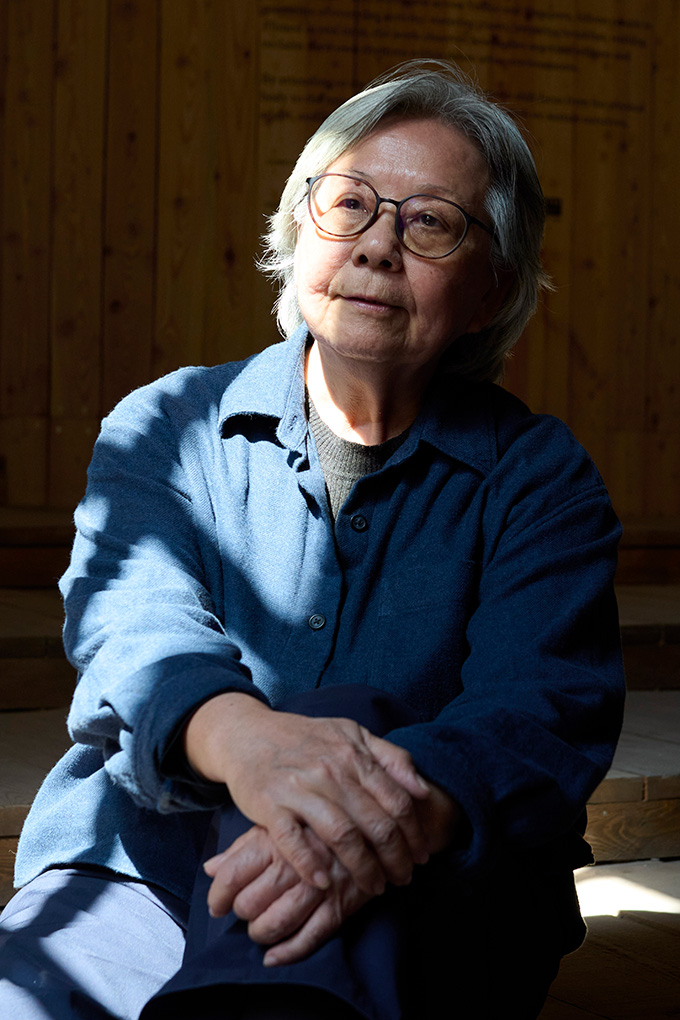
None have defined Singapore’s art scene quite like Amanda Heng. She first made her mark in the ’80s, when her prolific work was among the first to examine gender roles and identity in a rapidly modernising Singapore. Spanning interactive performance, installation and photography, Heng lent inspiration from her everyday experiences, using her body as the subject.


Through the years, the audience became a dynamic part of her artworks, investigating the body through movement. ‘Let’s Chat’ (1996) was a live, participatory performance where the artist created organic social encounters with the audience through intimate domestic rituals, such as drinking tea and picking taugeh. ‘Let’s Walk’ (1999) involved Heng and ordinary civilians walking backwards on the street with a high-heeled shoe in their mouths. This response to the 1997 Asian financial crisis spawned several editions abroad, in countries like Indonesia, Japan, Poland and Sweden, sparking a global dialogue between art and life.
Now at 75, Heng reflects on what it means to rest. Her newest body of work is being presented at the 61st Biennale Arte, which runs from 9 May to 22 November in Venice. Titled ‘A Pause’, Heng observes how simple, everyday acts like sitting, waiting and watching gradually produce endurance and self-determination, soldered through the quiet rhythms of life. “‘A Pause’ looks at rest as something necessary and familiar to all of us. Moving beyond the physical forms, our bodies look inward to find the inner strength and stillness for resilience and renewal,” the artist explains. Ahead of Biennale Arte 2026, Heng discusses presenting her work on a global stage, her creative process and her relationship with the body.

This year’s Biennale Arte theme is ‘In Minor Keys’. What does that mean to you?
I believe every existing thing has its own meaning in the world. Making judgements on things and people based on economic and productive values is problematic. I do not subscribe to the ‘either-or’ approach to developing my life. We are all different and unique individuals, and we should be proud of it because these make our lives rich and colourful. I deeply believe we have the wisdom, strength and resources to sustain this belief and a diverse and inclusive world. I see ‘In Minor Keys’ as a celebration of this ethos—one that gives respect and acknowledgement to differences, and highlights practices and expressions that deviate from the politics of economy and productivity, yet remains meaningful, uplifting and creative on its own terms. This brings choice and diversity and makes the world exciting and hopeful.

Take us through ‘A Pause’.
‘A Pause’ is a multidisciplinary project comprising various components: two architectural elements, black-and- white photographs of body parts, a video featuring six participants in their daily moments of rest, and a durational live performance
that unfolds as viewers enter and experience the open space within the pavilion. The architectural elements comprise steps and a half-curved, pillar-like structure that blend in with the Pavilion’s windows and walls. Together with the photographs and video, these components suggest the idea of rest.

Research has always been an essential part of my process, where ideas are developed through notes, thought processes and visual materials. Different forms of collaboration and participation were also involved in developing the work. The video includes footage of moments of rest specific to the participants in Venice and me in Singapore. This process involved deeper exchanges, engagements and commitments, as well as the generosity of the participants, who believed in the idea and were willing to share parts of their everyday lives. Together, these different elements transform the entire gallery space of the Singapore Pavilion into an environment that offers a quiet and inviting space to breathe, contemplate and participate in an ongoing live work, with the viewers’ presence and interaction forming a part of the process and shaping the outcome of the work.

With ‘A Pause’, I would like to transform the Pavilion into an open space and offer viewers a moment to be with themselves. There are no chairs or seats, only simple steps and a curved enclosure for viewing the video. There are no rules or instructions. We are all unique individuals with different make-ups and builds. I encourage the audience to take their time, get comfortable in their own ways, and decide whether to stay and watch, walk on the steps, or simply linger and wonder what it means to pause.
Your previous work focused on walking and exploring the body through movement. What led you to turn to rest and stillness in ‘A Pause’?
The idea of rest is the continuation of my ongoing interest in the body, when it moves beyond the physical form and looks inward to explore the strength from within for renewal. It was also partly from the experience of being my mother’s caregiver in the last stage of her life. At the same time, I also became conscious of the changing body as I aged.

What does the word ‘body’ mean to you?
The body is an organic existence, like all other living beings in this world. The physical body is a form that, together with the mind and soul, makes a life. The physical body changes and ages naturally, while the mind and soul mature through experience, developing knowledge and wisdom that continue to be valued by future generations and sustain the continuity of life, traditions and civilisations.
The May 2026 ‘Nomad’ edition of Vogue Singapore is available online and on newsstands.