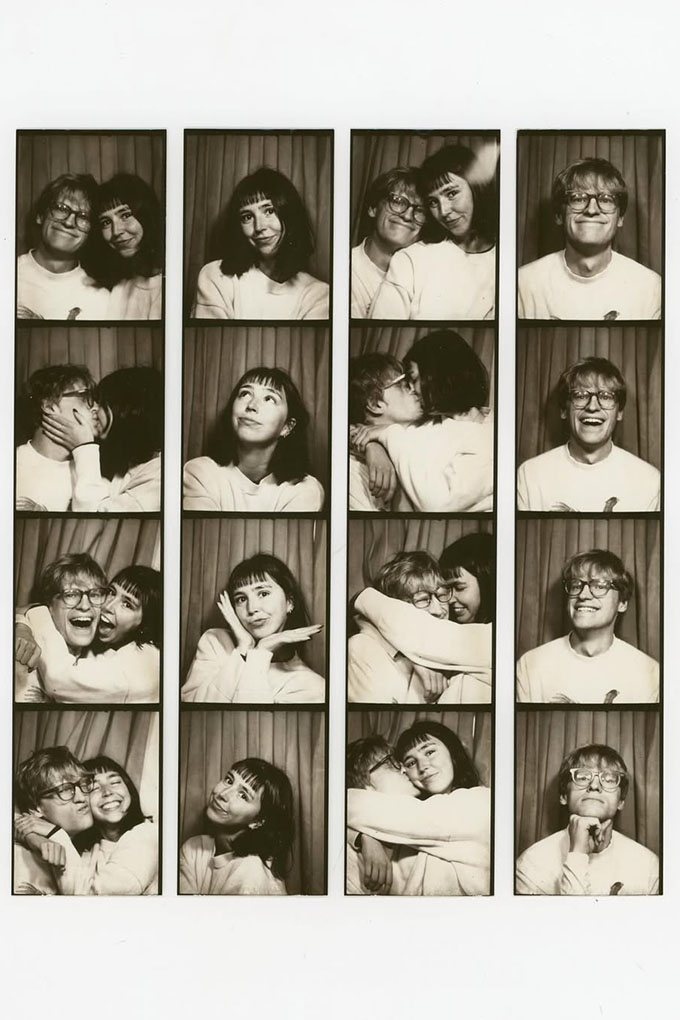
If 2026 has acquired a nickname, it is this: the year of analogue. Across social media, amid the churn of reels and AI-generated posts, a different kind of image has begun to circulate. Compact film cameras appear at dinners, new photo booths keep popping up along Haji Lane, and contact sheets are printed and slipped into books or pinned above desks. For Generation Z and younger millennials raised almost entirely online, tools used in the past are being reclaimed for the unrepeatable quality they lend to the images they produce.
View this post on Instagram
It would be easy to consider this as another cycle that is destined to dissolve into a preset filter. Instead, the movement feels cumulative, shaped by a broader fatigue with a frictionless digital life. When even the simplest task demands completing two-step authentication, the appeal of something tactile begins to read like relief. The evidence is most visible in the steady return to analogue modes of image-making, from hobbyists in their 20s and professional photographers in their 40s to people of all ages stepping into photo booths for a physical keepsake. The attraction is not only the look of film grain or the romance of a contact sheet, it is also the friction that is embedded in older processes. Few contemporary photographers articulate this tension more clearly than Nguan, the Singapore-born documentary photographer who is known for his raw and cinematic images of urban landscapes and everyday life.

When he began photographing seriously in the early 2000s, he worked with digital cameras, including a 3.3-megapixel Canon PowerShot G1 and later a 6.3-megapixel Canon EOS 10D. He notes the dissatisfaction he felt at the time, recalling how frustrated he was by “how real reality appeared” in the images he made with them. In 2006, at a moment when most photographers were accelerating towards higher resolutions and cleaner files, he moved in the opposite direction and switched to film. The decision was not an exercise in nostalgia but an attempt to bring his pictures closer to the images he carried in his head. He continues to use film, adding that it’s for “the layer of unreality it organically adds” to his work.

That desire for a degree of removal feels newly relevant. Nguan expresses his intention of making pictures that are “honest yet mythical, dreamlike but true.” Film’s softness and grain allow for precisely that ambiguity. The resurgence of photo booths reflects a similar recalibration. Ian Thio, of The Weare Photobooth, a digital vintage-themed photo booth company, who was a regular patron of The Projector’s photo booth, has watched the appetite for such experiences grow steadily in Singapore. He does not frame it as a rejection of social media; rather, he sees it as a parallel impulse. People continue to post and share, but there is a desire for something more contained. A photo booth strip offers only a handful of frames and no post-production, and it must be accepted as it is. “It is not one or the other,” he says. “Social media is still a huge part of how we live. People will keep posting and sharing. That is not going away.” What he has observed instead is that people want to step away from the performance of it all.

Performance is the operative word. Online, even casual images are filtered through an imagined audience. “It is easy to post a photo and immediately wonder how it will land with everyone scrolling by,” Thio notes. A photo booth strip operates differently. “A physical photo feels different,” he says. “It feels like this is my moment and I do not need to run it past the internet first.” The constraint is part of the appeal, but it is distinct from photography at large because it is immediate and fixed. There are four frames, no edits, no archive to refine later. “We live in a time when we take thousands of photos,” Thio explains. “When everything is captured, it can start to feel less special. Scrolling past image after image makes even meaningful moments feel light.” By contrast, the strip demands attention because it cannot be expanded or endlessly revisited. This emphasis on constraint extends beyond analogue photo booths.
Designer Nico Tangara, an award-winning creative specialising in the intersection of art and technology, developed a digital Polaroid-style camera with an e-ink screen and finite storage that mimics the limitations of older technology. Users must decide whether to keep an image or replace it, introducing consequence into a process that has otherwise become limitless.“I was curious about what would happen if a digital device behaved more like film,” Tangara explains. “With a film camera, every frame has a cost. You pay for the roll, for developing, for printing. Because of that, you naturally become more selective.”

His camera imports that sense of consequence into a digital format, narrowing the question to something deceptively simple: keep this image, or replace it. For Tangara, the appeal of constraint is not about retreating into the past. “More is not always better. Sometimes fewer choices make the experience clearer,” he says. “The project is not trying to go backwards. It is about reminding us that each photo can have weight.” In a landscape that is defined by infinite storage and infinite edits, that small act of commitment alters the way a moment is approached and remembered. This could be dismissed as another instance of the past being mined for visual texture.
Yet the psychological undercurrent runs deeper. Many of those drawn to film cameras and photo booths did not grow up developing rolls at neighbourhood labs. Their attachment is less about returning to a lived past than about recovering a sense of weight in the present. Nguan offers a striking explanation for why film continues to hold such appeal. When you photograph on film, he notes, you are capturing heat in the form of light onto the emulsion. To hold a negative or slide made in someone’s presence is to hold something chemically transformed by his or her warmth. The strip of film becomes tangible proof that a life once stood before the lens. In a digital environment where images exist primarily as data, stored invisibly in the cloud, that material trace carries a different resonance.

This is not to suggest that digital photography is disappearing or that online sharing will recede. Instagram and its successors remain central to how we communicate and archive our lives. What appears to be shifting is our threshold for meaning. The early 2010s were defined by aspiration and polish, by the pursuit of immaculate feeds. The mid-2020s feel more ambivalent. There is fatigue with constant visibility and a growing scepticism towards images that appear too perfect. Friction, once engineered from our tools, is being tentatively reintroduced. If 2026 marks a renewed interest in analogue practices, it also signals a broader cultural adjustment. We are not taking fewer photographs, nor are we abandoning the digital platforms that structure contemporary life. We are, however, seeking images that feel less like disposable content and more like proof that we were physically present, that light once touched a surface and left a trace. In the warmth impressed upon a strip of film, or the simple act of choosing which frame to keep, there is an insistence that we want some moments to last forever.
This story appears in Vogue Singapore’s April ‘Retrofuture’ issue, available online.