Being a first-time homeowner can feel overwhelming, to say the least. Between the financial stressors, endless stacks of paperwork and the reality that creating your dream home doesn’t happen overnight, the process can be a lot to take in.
Still, for many of us, the most exciting part of owning our own space lies in the design process. We’ve all been there: romanticising our forever homes through quick-fire BuzzFeed quizzes or window-shopping furniture and décor during an Ikea run. But when it comes to actually deciding what you want your home to look like, the real challenge often lies in defining its overall energy. After all, our homes are where we retreat to rest, reset and recover—whether after long days at the office or late nights out with friends.

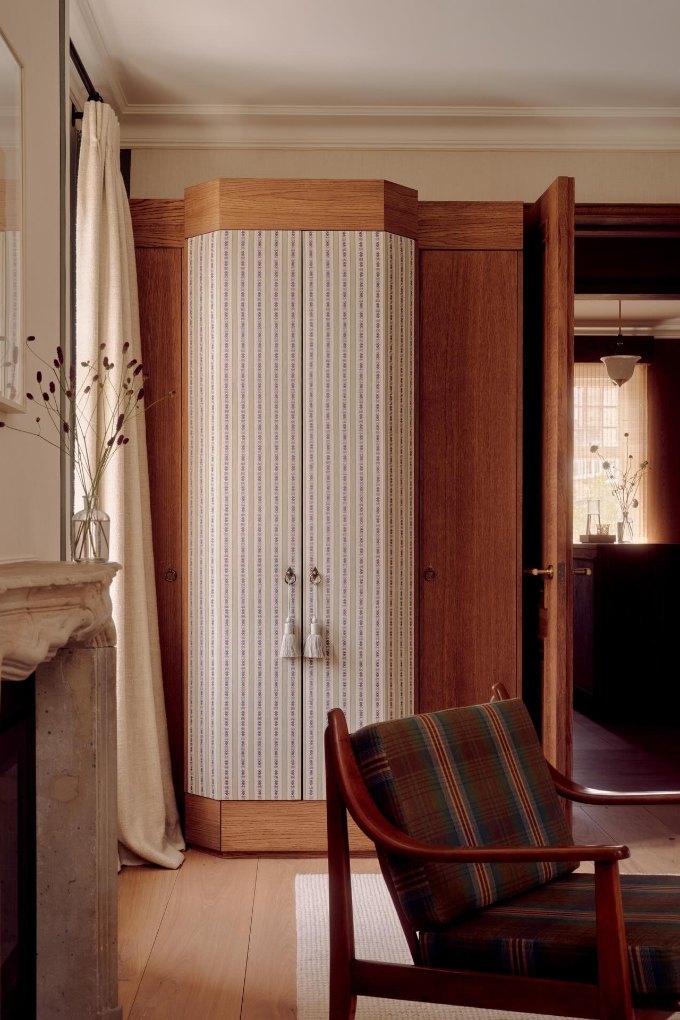
Perhaps that’s why wood has long been a foundational design element in so many homes. Incorporating wood into a living space has a way of making us feel calm, grounded and at ease. According to Singapore-based interior designer Natalie Cheung, wood quite literally brings us back down to earth. “Wood, unlike brick or concrete, was once alive and you can still feel that in a room,” she shares. “Because it’s natural, no two boards are identical. You get these unique grains and little quirks, which gives the eye something organic to rest on. That’s why we instinctively drop our shoulders and exhale when we walk into a timber-filled or timber-lined space.”
She goes on to share, “ I am drawn to wood because of the subtle ways in which it bears the imprint of time. Each encounter with it leaves an imperceptible mark that only reveals itself through the passing of time.”
Still, no one ever said that a home—or even one part of it—needs to feature only a single tone of wood. In fact, Cheung, who is also the founding partner and design director of interior design studio Medium Specific, notes that the “rigid and old-school” idea of sticking to one wood colour can leave a room feeling flat. “Mixing different tones—like placing a dark, rich walnut chair on a pale birch floor—creates contrast and depth,” she says. “It makes a space feel layered, as though it was naturally gathered over time.”
While it may seem daunting at first, fret not. Ahead, Cheung breaks down her best practical tips for mixing wood tones in a space—especially in warm, tropical climates like Singapore.
View this post on Instagram
Wood’s forgiving nature
If you’ve been hesitant so far to work wood into your homescape, consider this your sign. Wood, at first glance, may appear hard and unwavering—a material that feels resolute and unforgiving. But Cheung wants to prove you wrong, noting, “The best part is that wood doesn’t demand perfection from you. It actually ages alongside you.
“Any natural wood flooring may get scuffed from daily life, the kitchen counter darkens right where you always make your coffee, and the timber softens in the afternoon sun. It develops this beautiful patina over the years. You don’t have to tip-toe around it. Those little signs of wear are what transform a sterile box into a space that feels authentically lived-in,” she remarks.
Embrace the quirks
Years of growth, moulded by the environment, allow each tree—and therefore its resulting wood panels—to be one of a kind. To Cheung, this is the greatest strength of wood, purporting, “The best way to foreground the use of wood is to enhance its inherently unique qualities. Lately, we [at Medium Specific] have been experimenting with different ways of highlighting the grain patterns and edges of the wood surfaces we’ve been working with.”

Given its absorption abilities, there are endless ways to highlight the intricacies of wood—working with the material and not against it, to see how it may fit into your home aesthetic. “Together with our team of skilled carpenters, we have been dabbling with hand-staining woods with colourants—soft seafoam blue and forest green, for instance. Catching the grains, the dye simultaneously lifts the texture of the wood, while adding a playful and unexpected twist.”
Don’t fear scuffs and scars
When weaving wood pieces into the home, one of the biggest worries homeowners have is its durability and hardiness. While these practical woes are not uncommon or unfounded, Cheung makes the case for natural signs of wear.
View this post on Instagram
According to the interior design pro, wood—contrary to popular belief—is not an incredibly precious or high-maintenance material, going on to share, “Wood, to me, isn’t a museum piece, but a resilient, living material. It will scuff and change, but I feel that could be the whole point. It’s one of the very few materials that actually looks better (and feels more like home) once a bit of life is worn into it—an idea that a lot of us are probably not accustomed to.”
Best wood options for the tropics
Beyond the aesthetic considerations for mixing woods in the home, it’s key to think about how wooden furnishings work in Singapore’s humidity-laden environment. After all, it can’t be denied that moisture and wooden surfaces are a recipe for disaster. To tackle this, Cheung says, “For Singapore’s climate, you need woods that inherently understand humidity. Teak is the gold standard because it’s packed with its own natural oils. It basically waterproofs itself from the inside out, and ages beautifully without needing to be babied.”
Looking past the classic teak options, she suggests regional heavyweights such as Chengal or Balau, which are hardy, moisture-resistant and perfect for homes in Singapore. She also goes on to recommend high-quality marine plywood, stating, “Because it’s built from cross-directional layers, it physically won’t warp or twist the way a raw plank might, making it a brilliant, stable canvas for the tropics.”
Given the higher price points of wood, Cheung doesn’t shy away from more cost-effective alternatives. These include fast-growing local woods, like Suar and Acacia. According to her, “They give you the same rich, organic character and resilience without emptying (too much) of your wallet.”

Matching undertones
Just as we look towards matching and complementary undertones in broader facets of design (and even in make-up and fashion), Cheung says that folks newer to interior design can begin playing with mixed woods by keeping to the same tones across the home. “Pairing woods by their tonal “temperature”—keeping warm undertones with warm, and cool with cool—is akin to making sure they’re speaking the same language. When the undertones are aligned, different grains or finishes won’t compete with each other other.”
Dress the space up
When designing a space, it’s the details that can make a world of a difference. If a room feels too wood-heavy, consider adding a visual buffer. Cheung observes, “It’s important to give the wood room to breathe. Something as simple as a rug beneath a table, or introducing stone or metal nearby, can act as a pause in the composition.” She continues, “In that moment of restraint, the wood’s natural depth—its grain, warmth and quiet irregularities—become more pronounced.”
Forget timeless, lean into lived-in
Many first-time homeowners want their space to move beyond trends. But this search for the timeless is an unending task. When deciding how to let wood—or any major material, for that matter—move through a space in the long-term, Cheung advises, “Rather than chasing an elusive notion of timeless perfection, it is much more significant for space to possess the capacity to grow, and be moulded by passing of time.

“The most enduring, beautiful homes I’ve been in feel like living archives. They comfortably absorb the changing tastes, the accumulated books, the inherited chair, and the shifting daily routines. I think it is much more meaningful to design for adaptability; that the space you create and materials you choose will age gracefully with you.”
And wood has the delightful ability to be subtly shaped over time, depending on how we treat our space, and how we grow in it. These markings are what precisely allow our space to become a living, breathing collection of our memories.
New ways of using wood
When asked about the future of interior design, Cheung doesn’t hesitate, sharing, “There seems to be a greater desire for spaces with depth and character. There has been a noticeable shift towards experimentations with wood, like staining or air-brushing, to make bolder statements.” She continues, “In general, I sense a craving for tactility. I think we will be seeing more colour-treated woods as well as other innovative and engineered solutions that offer an environmentally-friendly option.”
View this post on Instagram
In the local interiors scene, these options are already abound. Sharing from her personal work experience, she reveals, “Panelogue is a local company, which offers a great selection of sustainable, high-performance wood surfaces, and whom we worked with on a recent project where we used cork panels.” It seems that, in the world of interior design, there already are countless ways to weave wood into a vibrant living space—it’s just a matter of getting started.