Above the bed of Aditi Mayer’s new home hangs a tapestry that once belonged to her grandmother. Over 80 years ago, Mayer’s grandmother had grown the cotton, picked it, turned it into yarn, dyed it and woven it by herself— and then taken it with her when she migrated to India from Pakistan during the partition of India. “It’s a relic of not just South Asia’s history, but family history as well. It reminds me of so many different things, like my family’s relationship to the land and how ancestral craft is a part of our history,” reflects Mayer. “Traditionally, tapestry is something we would put over a cot to sit on or place on the floor. To have it as a work of art on the wall is really special to me.”

Born and raised in Los Angeles, Mayer is a trailblazing Punjabi-American creative redefining what it means to advocate for sustainability. Working at the intersection between fashion, craft, culture and climate, her latest venture takes the form of The Artisan Archive, a platform and agency that examines how culture is the key to unlocking and understanding sustainability.

Having moved in a year ago, her new home—and the first, she shares, that she can call fully her own—has been a way of laying down roots, something that she deeply craved. “I travel so much for work and it’s nice, but I think there was a level of burnout that I started to experience. I wanted to be more connected to my community and to my family who are also in LA,” she shares. “As someone who works in sustainability and is always talking about our relationship to the land, I was learning so much from the places I was going, but I needed a space to channel those lessons in a tactile way. This home has been that, in many ways.”
“I want to ground myself in the fact that in my bloodline, and in so many people’s, we all have a culture that goes back to stewarding the earth.”
The roots she speaks of aren’t just figurative either. Drawn to the amount of open space the property had when she first saw it—the house has gardens in the front and at the back—one of her first projects was to clear out the front lawn and plant only flora that was native to California. “It was a special opportunity to get my hands dirty, learn about the ecology of the land and plant roots in a literal way.”

Inside, her home is airy and spacious. An open floor plan means that the living room, dining room and kitchen fall into one—creating an inviting communal space when Mayer hosts, which she loves to do.
An eclectic hodgepodge of items fills the house, curated with the same approach that Mayer takes to fashion. Just as her wardrobe comprises investment ensembles, second-hand clothing and up-cycled pieces, her home is dotted with treasures discovered in local thrift stores and estate sales. In every corner, Mayer’s dedication to sustainability and love for craft is evident.

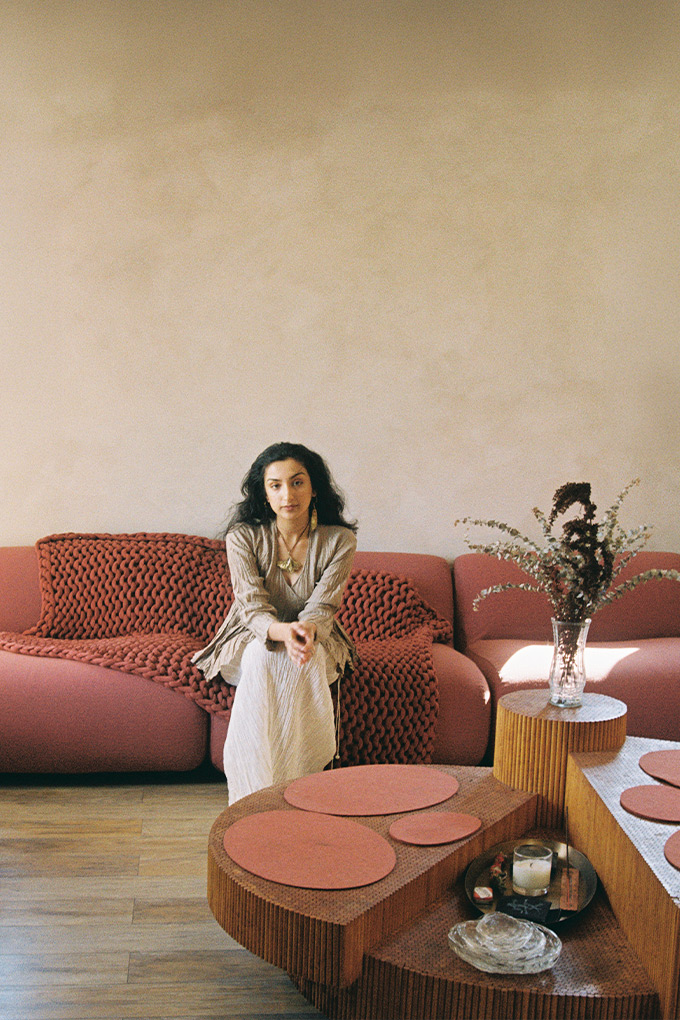
One of her favourite pieces, for instance, is an antique coffee table that she found on a second-hand furniture website and contemplated for six months. Segmented into three tiers that come together to form a circle, its unique shape is reminiscent of a ladybug with its wings spread. “I’ve never seen a coffee table like this. I didn’t know if it would be the most practical because it looked so atypical, but eventually, I thought, I need it,” she laughs. The table’s unique structure, she explains, turned out to be perfect for hosting, with plates going on one layer and snacks on another.
“We want sculptural, unique pieces, but I also don’t want my home to feel like an art gallery, where you’re not sure if you can touch or sit on items. I don’t want it to feel sterile. There’s visual interest, but it’s also livable, which is important.”

In the dining room, a dash of vibrant colour comes in the form of woven chairs with burgundy and cobalt blue accents. While contemplating how to bring out those same shades elsewhere in her home, she discovered that a friend had blue tiles left over from opening a grocery store in the neighbourhood, and thus used them to create a gorgeous backsplash in the guest restroom. “To tap into community and to think not of buying new, but of making the most of things that would have otherwise gone to waste is a cool way to approach design,” explains Mayer.

All through the home are marks of Mayer’s travels, from keepsakes collected over the years to influences from the design ethos of various parts of the world. A trip to Kyoto, Japan, brought home matcha cups repaired using the traditional kintsugi process and paper lanterns embedded with leaves that now sit in Mayer’s office—both of which she had a hand in crafting herself. Beyond that, the Japanese philosophy of wabi-sabi—or the appreciation of beauty in imperfection, simplicity and transience—has become a big point of inspiration, entirely in line with the way Mayer thinks of design.

Visiting Bali, Indonesia, was one of the things that influenced the use of reclaimed wood in her furniture—of various types, colours and textures— that tie her home together. “They have a lot of reclaimed teak trunks that are turned into side tables or stools. It’s an antidote to things that are mass-produced because each looks different. You can see where each tree has been excavated, where their roots once were,” she recalls. In Mayer’s living and dining rooms are live-edge shelves acquired from a lumber yard in Los Angeles that uses only naturally fallen trees. Her shelves in particular, she shares, were made from trees that used to grow in the Los Angeles Memorial Coliseum. In another corner stands a thrifted armoire—its doors a checkerboard of different woods.

Finally, there are hints of the rich textile traditions of Punjab, India, where Mayer’s family is from. A chunky knitted throw lies over the living room sofa, linen curtains add texture to the space, and of course, there is the tapestry that hangs over Mayer’s bed. “When you look at cultures around the world, a lot of them have been upcycling and honouring the earth in their own way. Maybe they were not using the language, but I believe their design philosophies showcase that,” Mayer explains. “I want to ground myself in the fact that in my bloodline, and in so many people’s bloodlines, we all have a culture that, in some ways, goes back to stewarding the earth. In so many of our family histories, if you go far back enough, you’ll find that relationship.”

A living archive is how Mayer describes her home—and it certainly encapsulates the way her home seems to authentically reflect who she is and all that she believes in as a person. “Sometimes, when it comes to a home, we feel this pressure to immediately fill the space, but I think there’s something really special in taking your time with it and seeing all the things you collect over the years,” she concludes. “To me, home is a living, breathing entity that will always be in a state of evolution as you take stock of what you value and what you choose to put on display. It is an archive of who you are as a person, the things you’ve seen and how you’ve grown.”
The May ‘Sonder’ issue of Vogue Singapore is now available online and on newsstands.