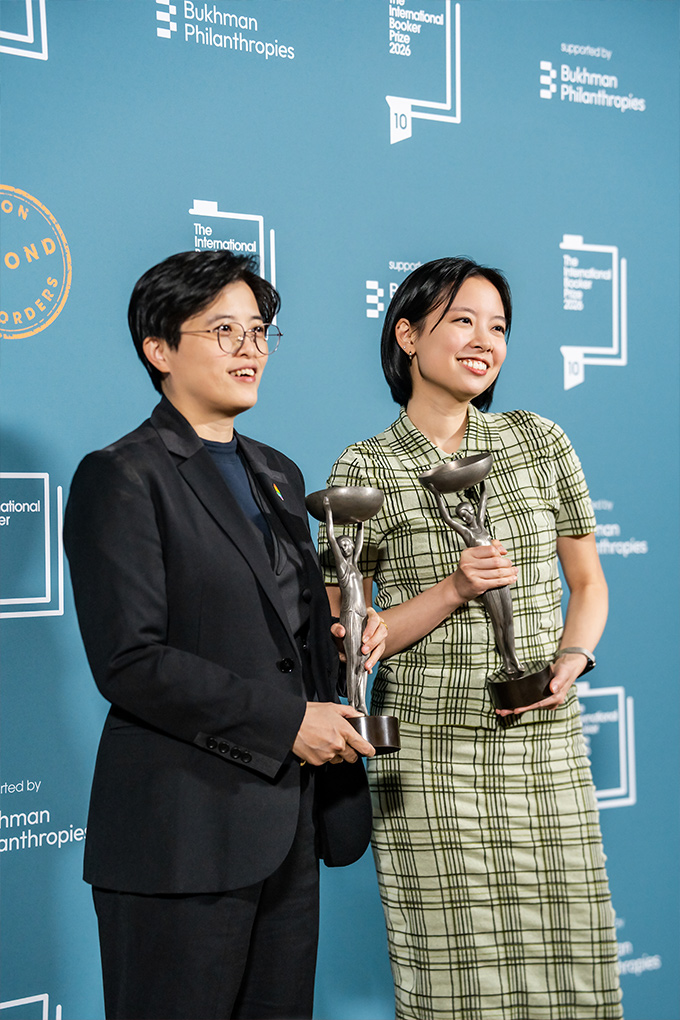
This year, the International Booker Prize is celebrating its 10th anniversary—10 years of international fiction, 10 years of spotlighting books written in non-English languages, and 10 years of treating translation as both an art and a mechanism to transcend cultural boundaries.
Taiwan Travelogue is the prize’s 2026 winner, documenting a story of queer love found on a culinary tour through Taiwan in the 1930s, an era under Japanese colonial rule. Originally written in Mandarin, the story in itself crosses linguistic and cultural lines between Taiwan and Japan. Though Yáng Shuāng-zǐ’s Taiwan Travelogue was published in 2020, it was only six years later that it became the winner of the International Booker Prize—and in part, it had to do with its translation from Mandarin to English by Lin King.
For many English-language readers, translated fiction may be their first sustained encounter with another culture. It draws attention to the ways in which an interpreter and a translator cannot be treated as synonyms. Where interpretation relies on language in the literal sense, translation is a balancing act—one that articulates not just based on meaning but emotion; and in many ways, enriches the story with textures that may not have originally existed, lacing in nuances that may not naturally exist in a foreign language. There is a “universal” relatability that must be relayed, without sacrificing cultural specificity; a rhythm that must be understood by both local and international audiences.

This balancing act is one that King herself has long understood, as a writer in addition to being a translator. Food, in Taiwan Travelogue, plays a monumental role in tracing both colonialism and community; one of many moments where King’s translation is as instrumental as its original text.
“The English language recognises certain imported words we all know—like “kimchi” or “pho”—and we build all of our food-related vocabularies off of these things that have pierced through the surface of the English dictionary,” says King. “My general idea was that everyone should receive the same treatment: having their original names pronounced in their original language, their pronunciation written out, and a hand-holding walkthrough of what the food is. I wanted to level the playing field.”
In King’s translation of Taiwan Travelogue, food becomes equally flattened to descriptor, rather than relying on foreign imported concepts as a proxy. The characters living in 1930s Taiwan do not speak Japanese, despite living under colonial rule. Sashimi becomes raw, sliced fish. Nigri sushi, in turn, becomes raw fish over rice. There are no replacements for udon, or sushi, or pho, that capture the quintessence of the meal without borrowing the cultural terminology it was derived from. It draws attention to the ways colonialism has shaped language, and continues to do so at present.
In conversation with King, we discuss the possibility of international works existing without being a cultural moment, the pressure of making stories feel seamless, and the erasure of translators.

Having won the International Booker Prize, how do you feel receiving the spotlight as a translator?
I know there are many translators who don’t want to take up space, and enter this line of work because they like being behind-the-scenes, but I think it’s important to have that be an opt-out option for translators.
For a long time—and it’s still ongoing—there was no option for translators to be speaking for themselves: to be speaking as a co-creator, a co-writer. In many venues, publishers continue to try to hide the fact that books are translated. There’s this sense that it will damage sales if readers or booksellers find out that this book is translated: which seems really outdated as a notion.
I’m glad things are changing. In Japan, it is by law that everybody who is responsible for creating a book needs to be on the cover, so that people know where they’re getting their information from. I find it strange to think that if you were to buy a recording of the Fifth Symphony, it doesn’t say which orchestra performed it or which conductor directed it, because they want you to think that it is like Beethoven’s creation, and it just appeared out of nowhere for your ears. The erasure of translators feels like that, which is kind of silly when you think about it.
What shifts have you noticed in what readers are expecting from translated works? Are they expecting to have this cultural moment, or can they just exist as just a text?
In the US nowadays, when you walk into a bookstore, there are so many Japanese books in translation with cats, and it’s totally become a massive sub-genre. Similar things are happening with Korean fiction, it’s always a cafe book, a bookstore book, or, you know, a tucked away library book. If you’re reading Nordic stuff, maybe it’s Nordic noir, or a cozy Frederick Backman—certain writers or series came into the spotlight earlier on. Weirdly, it has led to different languages and countries being responsible for certain genres, which is an interesting phenomenon. It is something that publishers, translators, and writers have to navigate.
For example, if you’re a writer and want to be published more widely in other languages, but your country is specifically known for magical realism, and you don’t write that genre, then what? What is that doing for global readership? What are our expectations and why do we impose them on people? I don’t know if that’s the right answer, so I think it’s really interesting.
I don’t think there is necessarily a right answer, but it is interesting to think of how countries play into these categories and these genres, and how that feeds into our own cultural biases around them. Does it then subvert the whole point of translated fiction, which is to cross these cultural boundaries and to experience these places in a new way?
Literature in Mandarin is curious in that it hasn’t really been categorised. For a while, there was a craze around The Three-Body Problem [the trilogy by Liu Cixin], and a question of whether Mandarin is the new sci-fi generator. In Taiwan specifically, we have a lot of queer fiction, just because same-sex marriage has been legalised here for so long, and it does feel like we would think, oh, we should put out more queer Taiwanese fiction in translation, because that’s where we can differentiate ourselves from other Asian literary spheres.
It’s strange that we’re always labelling things and trying to group things together, but I guess maybe it’s just easier for our human brains to categorise things in these buckets.
View this post on Instagram
As translated works become more common, do you personally still feel a pressure for stories to feel seamless or easily legible to an English-speaking audience?
I think it really depends on what the goal of the book was, to shift how the translation should be read. If it’s supposed to be an easy read and you make it really difficult, I don’t think that’s a great translation, but if it’s supposed to be full of tension, and you make it totally smooth, that seems very wrong, too.
With fiction, they’re supposed to unsettle you—like, for example, all the other books on the [International Booker Prize] shortlist this year. It shouldn’t be read as slowly nor seamlessly, because then you’re learning nothing new, and you’ve chosen this book that was originally written to challenge.
How was it in the case of Taiwan Travelogue?
I think I did make it less accessible than its original. It was not a calculated choice, but it was definitely premeditated. My publisher and I knew that in bringing this work to English, if we wanted to maintain the historical accuracy—it was, by default, going to be more complicated in English. We made that active choice to preserve nuance, which makes it more difficult for the English reader, because they have to process a lot more information than the original that was written for a Taiwanese reader.
People who can read both the original and translated works have told me that the English version is way harder and they can’t follow it; and on the other hand, there are people who said that the Mandarin feels almost too accessible.
View this post on Instagram
Taiwan Travelogue centres around food—how did you approach this in your translation? What did the translation of food reveal about language?
One time, I was in Milan as a tourist. We decided to go to a Japanese restaurant and I saw that they had udon listed as “Japanese linguine”, soba as “Japanese spaghetti”. Of course that is what they would do—that’s genius!—it’s all about perspective. I realised how much of English food description relies on French, Spanish, Italian.
In Taiwan Travelogue, I wanted to level the playing field, and treat everyone as equally foreign. One of the things we have in Taiwan is run bing (潤餅). When I search it up, they accredit it more to Southeast Asia than Taiwan, because it falls into that family of food. It says to think of it as an East Asian burrito with rice instead of corn tortilla, wrapped around braised pork belly or whatever. Well, these characters are not going to say “rice burrito”. It showed me how limited English really is, and how it relies on foreign imported concepts to even function.
View this post on Instagram
Are there any specific literary structures you love, but cannot be directly translated?
In Mandarin, you don’t need a subject or pronoun, which has led me to getting lost when reading, and asking the author because I genuinely could not understand. Sometimes it even takes the author a second to realise what they had originally meant, and they’ll say it was more of a general mood, or the moment doing its thing. I’m like, well, we can’t do that; and then I need to stylise and purposely obscure the language in a way that translates this ambiguity. Mandarin allows for a lot more ambiguity in terms of who’s doing what at what moment.
Another one that’s tough for me is quantifiability. In Mandarin, writers often mention number units, like ‘thousands’ (千) or ‘tens of thousands’ (萬) without specifying how many. Does ‘百年老店’ mean the store is 100 years old or several centuries old? Does ‘數十’ mean around 30 or greater than 50? Is it a couple, or a few? You need to make a decision. There’s a lot more grey area things that are passable in Mandarin that require a lot more specificity in English. If I just read it as a reader, maybe I wouldn’t even notice that.
How else has translation changed the way you experience language, in ways that writing and reading couldn’t?
When I read translated works from languages that I don’t speak, sometimes I am on the lookout for techniques; and I just think, oh, I bet something really complicated happened here, but they made it so that I can process all these nuances just from one story. You read a lot more closely, a lot slower as a translator, for better and worse: you notice more flaws, but I think you also marvel with even more awe when something is done really well.
Now, when I read books in Mandarin, sometimes I find myself immediately and involuntarily thinking, well, what would it be in English? Maybe it’s an interesting sentence, but there’s no good way to do it. I’m definitely texting translator friends on what they think.
I think translators are always the closest readers of a work, maybe more so than writing the work itself—a translator can’t skip anything. They can’t just move on. I do feel like it makes me think a lot more about choosing words, and the economy of storytelling. You notice repetition a lot more, you also notice missing information a lot more: what is the necessary connective tissue to get a story from one place to another?