I was in Toronto by happenstance when Montreal, My Beautiful premiered at the Toronto Asian Reel Film Festival. It became, almost immediately, the topic of conversation in every queue I stood in—this new, independent film arriving from Montreal. It was to my pleasant surprise to find that it had arrived, again, to Singapore at PinkScreen, a collaboration between NBCUniversal and Filmhouse.
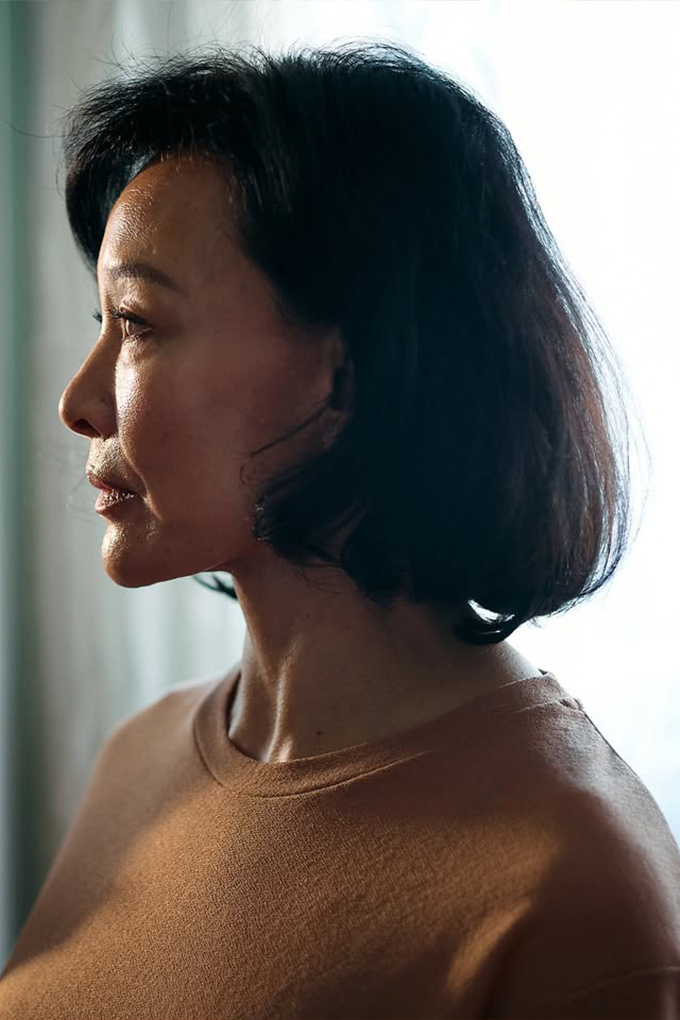
The premise of the story is rather simple. Feng Xia is a mother, a wife, and a Chinese woman in her 50s. Trapped in a loveless marriage, and, faced with the realisation of her sexuality, Xia is confronted with the possibility of choosing herself for the first time. In some ways, the film’s most crucial proposition is its challenge to ageism: reaffirming the endurance of desire and, more importantly, reinvention.
When I meet the film’s director Xiaodan He, her smile is megawatt. There is an immense joy about her that surpasses the conflicts that have shaped her life. It is the same vivacious energy that seeps into her films, even through the layers of tension she constructs within them. Having immigrated from Kunming to Montreal in 2002, the director has spent the last 24 years immersed in the Québécois community—which has also meant 24 years navigating life between cultures. This dilemma is etched into the makings of this film.

He and I are alike as we are not. Both of us are of the Chinese-Canadian diaspora, both of us have learnt French as a second language, and both of us share an affection for Montreal summers. In her words: “This movie is my love letter to Montreal.” Despite being separated by multiple generations, there is a shared camaraderie of language and community; the cliched understanding of not quite belonging to any one world. This understanding is both a struggle and a choice.
“It is a topic that we cannot avoid. We made a choice to leave our roots and come into a new culture, and live within it,” laments He. “Inside us, there will always be a conflict between the two.”
Following its selection for the Cannes Film Market and a win for Outstanding Lead Performance in a Canadian Film at the Toronto Film Critics Association Awards, Montreal, My Beautiful joins a growing body of work expanding the image of Asian identity, outside the more familiar framing—that of recent Wasian meetup discourse, curated visibility, and tokenism—but of the lived nuances within the diaspora. In conversation with He, she speaks on language affecting our way of experiencing the world, the diasporic identity, and spotlighting middle-aged queer narratives.
You’ve mentioned before that there is symbolic meaning behind the original title Montréal, ma belle (Montreal, My Beautiful). Could you expand on its significance?
There are two layers. The first is related directly to two lovers that live in this beautiful city, right? The freedom to be yourself, the freedom of difference, the freedom of love. I would like to attribute all these values to this city, Montreal: because I really feel that this city carries all the values that make me able to call this city ‘my beautiful’.
Secondly, in French we say ma belle, right? To show your appreciation to a woman—no matter whether it is man to woman, or woman to woman—there is affection and respect there. This point of meeting carries all these values. I found that quite important. This is kind of my salute to this meeting.
“I didn’t want to hide her desire. I wanted to showcase it, alongside her struggle, hesitation, fear and shame—everything together within her.”
The middle-aged, Chinese queer woman: this is an archetype that has rarely been portrayed on the big screen. Were there particular dimensions of that experience you felt compelled to explore?
Absolutely. For a Chinese, middle-aged, repressed queer woman to be a protagonist on the big screen—this is a story that has never been told. I wanted to give her a voice. It was my original motivation. I felt it was important to give a voice to this group, because, as we know, the queer community does not only refer to young people.
We often ignore the middle-aged homosexual group, especially the repressed, homosexual community—because they have had no chance to leave their sexuality, to be themselves. For a long time, I have felt deeply sympathetic to this reality, especially within the Chinese homosexual community, because I know how heavy the burden is on their shoulders.
When I thought of writing a story about a lesbian woman, very quickly I decided to choose a middle-aged, queer woman—and most of all, a repressed one. I want to let people understand their struggle better and respect their reality.
View this post on Instagram
The dynamic between a quintessential Québécoise woman and a more traditional Chinese woman carries so many cultural nuances—from family expectations to generational values. How did you approach building that relationship on-screen?
Sometimes when you create a character, you don’t know exactly the logic behind why. But something felt right. I found it charming. The two women are of different ages, but there is one thing the very same—that they are both at a turning point in their lives.
I have lived my 30s. I know that at the age of 30, to a woman, it is a very special time, perhaps a little bit tricky. You’re mature, but at the same time, you are questioning the direction of your life—if it’s the real direction you want. For Feng Xia, she’s 53 and a woman in her menopause, and very clearly in a mid-life crisis. She’s stuck in her own way. She’s figuring out how to continue, and how to break out of this situation. They are two different ages, but both are looking for an exit. For me, it was important to create two women with different cultural backgrounds.
There are a few layers: the age, the cultural background, the personality. Camille is a very liberal, queer woman. Feng Xia is a repressed queer woman. There is [inherently] a conflict between them.

The film touches on themes that are still considered taboo in many parts of Chinese culture. How did you navigate portraying that stigma?
I wanted to do an honest movie. I didn’t want to hide her desire. I wanted to showcase it, alongside her struggle, hesitation, fear and shame—everything together within her.
Feng Xia is not a hero here. It’s not that she suddenly realises that she can do everything she wants. You can feel all this on her, and she knows it’s a taboo. At the scene in the lesbian bar, when another girl asks Xia about her experience of the homosexual community, she denies it—because she knows it is taboo, and maybe there’s even a fear within her to touch this taboo. She hides [her homosexuality] very deep within herself.
The scene in the massage salon was another nod to this, to suggest that [Xia] is a woman simply looking for pleasure with a woman’s touch. It is a secret moment of pleasure that only she herself knows. Even the masseuse doesn’t know, for she treats her like a good client. But Xia knows the real reason why she’s here. With all these details, I want to make her a real person. I didn’t want to hide the realness of her desire.
The film navigates the intersection of French and Mandarin within the Chinese diasporic experience. Have you found that different languages unlock certain emotions?
In an immigrant family, this is a typical phenomenon to speak in different languages—English, Chinese, or French—while living under the same roof. Within many families, I’ve observed that there is a gap between the parents and the kids with the difference in language. This is something that they cannot avoid. This is their truth. The gap is there, and they know it on both sides. But they also don’t know how to cross that gap to meet each other—and so they just live with this reality. I found that this language barrier between children and parents creates a very subtle, silent gap between these two generations.
When they speak different languages, you can feel their identity change. This is the case for the older generations as much as it is the children, and this is the case for Feng Xia. We can feel how much she likes Montreal. [Xia] becomes who she is deep down. When she speaks French—you can feel that she’s more free, more herself. This language takes her away from her everyday traditions; a passport to another reality, another dream.

So, in a way, French is unlocking a new way of experiencing the world for her. Was this a similar experience for you?
This is totally from my personal life experience from living in Montreal. I have been here for 24 years, and I switch constantly from French to Chinese to English. My second language is French now. When I wrote this story, I naturally treated it in the principal languages that I use.
When I speak Chinese, the language brings me back to my roots. I enjoy the switch. It is my reality, and I know this is a reality that I cannot avoid. I choose to live with it, in a positive way. I still have this feeling when I speak French, of becoming Quebecois—and now, I almost have more Quebecois than Chinese in me. With time, language allows you to embody a new identity.
“We often ignore the middle-aged homosexual group, especially the repressed, homosexual community—because they have had no chance to leave their sexuality, to be themselves.”
The conflict of immigration is certainly a layered one. Was there a particular dimension within this experience you wanted to portray?
If I could choose one word to describe my core vision of immigrant life in this film, it would be a dilemma. The dilemma of immigrant life. After this movie came out, I had so many young immigrants tell me how they are not sure about their choices, and they are living their own dilemma. You often are put in the position to choose which side, and to decide whether you are doing the right thing.
As you can see in this movie, the husband is more uncertain of his choices compared to Feng Xia. He’s not happy, he’s stuck between here and China. He’s always thinking of going back, but he knows it’s not possible—impossible, even, to go back again.
I think this impossibility—of forever being caught between two worlds—is quite central to the Chinese diaspora, or more broadly the diasporic identity.
Joan Chen, my fabulous actress, said that choosing to be an immigrant, you have to pay a price. It’s not a question about being successful or not, even for someone who has found success, like Chen. This is not about money or social position—it’s about the root, the bird flying from its nest. Something will always be calling you back. It’s always there, but how you deal with it is the difference. If you cannot deal with it well, then it can become very heavy, very negative.
Montreal, My Beautiful is now showing at Filmhouse.