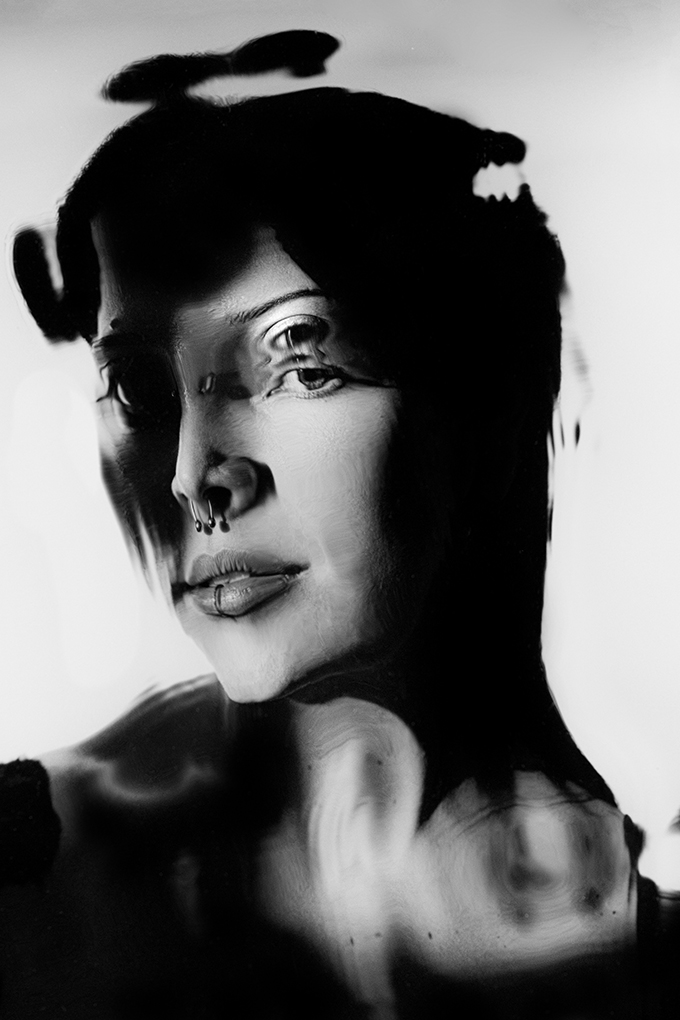
You’ve heard this many times: that when you smell the scent of jasmine flowers on a quiet evening, it can only mean one thing. That a certain beautiful woman is nearby, clad in a billowy white dress with her long, jet-black locks draped over it. You’ll feel entranced enough to follow her—then she’ll part her hair to reveal a paper-white complexion. Her black-rimmed eyes will be the last thing you see as she digs her long claws into your flesh. In Thailand, it’s a floating woman’s head you should fear, especially if it’s attached to dripping entrails. The Filipino version severs herself before sprouting bat-like wings and fangs. They go by different names—pontianak, phi krasue, manananggal—but the horror is the same. That there is something uncanny about the beauty of a woman and it threatens to tear us apart. And this preoccupation doesn’t just haunt us from the paranormal sphere.
To identify as a woman is to inherit the idea that your body cannot be trusted on its own terms—that it must be corrected, tweaked, perfected. Not by health metrics, but by aesthetics. Having the ideal body has become synonymous with abs and a trim waist. And while it used to be attainable by way of restriction and deprivation—intermittent fasting, crash diets, juice cleanses and the like—diet culture is now moving in the direction of optimisation. Calories are counted and allocated to protein over carbohydrates. Ozempic can help curb food cravings, which translates to weight loss over time. The body is treated with clinical precision, which means perfection feels closer than before.
But what happens when we attain perfection?
Beauty hurts
Enter: body horror in television and film. In the 2024 film The Substance, Demi Moore’s character, Elisabeth Sparkle, finds the solution for ageing out of Hollywood in a small vial of bile-green activator. “Younger. More beautiful. More perfect” is the promise. Seconds after the injection, her spine splits open in a bloodied, visceral sequence that births a younger, refined version of herself: Sue. Her skin is impeccable, her body toned and taut, and she’s able to do everything that Elisabeth could not. Similarly in the 2026 FX series The Beauty, a potent new form of viral RNA technology offers to remodel your physical self at the cellular level. A spine-cracking spasm later, a perfected version of yourself emerges from a heaving membrane—equipped with golden-ratio body composition and a poreless mien. The results are undeniably gorgeous, but sitting through the violence of their transformations is enough to give me whiplash. That’s not to say that violence is a stranger. I’ve never been able to commit to a diet or calorie-counting, but at 15 I convinced myself that I needed to work out every day on an empty stomach to achieve a six-pack. I’ve been taught to see my soft belly as the enemy, so to feel its protrusion every time I sit down is a stab to my esteem. Whenever angry boils appeared on my face, they were picked at with a disproportionate vengeance. Yet, seeing what it costs to achieve the peak of beauty standards stirred something in me. The blood and viscera may have been unnerving at times, but it also felt like catharsis. As it turns out, the scrutiny I direct towards myself is a symptom of a larger infection, which everyone suffers from but hides well. Not anymore.
View this post on Instagram
Imploding the myth
To quote Naomi Wolf’s book The Beauty Myth, “[o]lder women fear young ones, young women fear old, and the beauty myth truncates for all the female life span”. Women have been taught our whole lives that when we get fat, or age, or both, we fail. Coralie Fargeat pushes Elisabeth and Sue head-to-head to disrupt that notion—the result of which leads to the birth of Monstro Elisasue. Where skin is supposed to appear on a human body, there is only wet viscera with mismatched openings and two half-formed faces. Instead of hiding away in obscurity, Monstro Elisasue finds a way to curl her two strands of hair and pierce a diamond earring through her flesh before appearing on stage. As chaos ensues, she spurts gallons of blood all over the audience, imploding the spectacle of her beauty and issuing a crimson-red warning to the leering male gaze. The bodies of Elisabeth and Sue break out of their confines and erupt into something truly formidable and terror-inducing. In The Beauty, a post-transformation Franny—played at first by Isabella Rossellini, who famously portrayed the eternally youthful temptress in the 1992 film Death Becomes Her—proclaims that “I feel like a prisoner trapped in a body that is not mine. Everything that I had worked for, everything that I had earned—my scars, my stretch marks, the age I owned—taken from me. Their value and their beauty comes from their age.” In an act of total disavowal, she slits her slender neck with a piece of porcelain.
View this post on Instagram
The ‘beauty is pain’ adage has held us captive within our bodies for so long. But who are we suffering for? Insecurity has coiled up in my stomach like a many-fanged snake, constricting my appetite and leaking poison that goes straight to my brain. I want to rip it out of my body with my hands, so I get to feel my flesh again and the protection of a body that sustains me. I feel a strange tenderness for Monstro Elisasue because I want teeth to cover my body so every part of me bites back. Being a woman in a body is a grotesque thing and so I no longer want to be beautiful in the traditional sense. As the body horror genre shatters my hypocrisies, I know now that I want to be real. And if it means being monstrous, I am here for it.
Get your copy of the June ‘Embody’ issue of Vogue Singapore online.