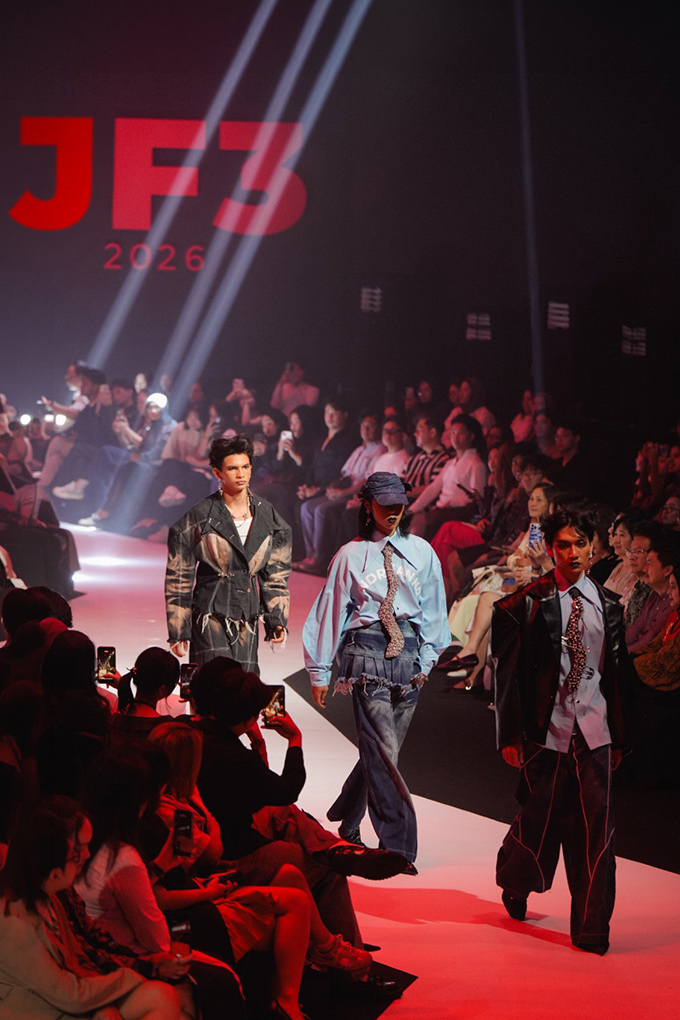
Coming back to BRI JF3 Fashion Festival in 2026, the difference could really be felt in the details, from the greater precision of the models to presentations shaped more closely around the character of each collection. The curation across the programme felt noticeably sharper, too, and for Thresia Mareta, advisor to JF3 and founder of Lakon Indonesia, and co-initiator of Pintu incubator, that sense of progression was deliberate. A platform that remains comfortable, she believes, risks allowing its designers to remain in the same place. It is an idea that sits at the heart of this year’s theme, Recrafted: Shaping the Future, expressed through new treatments of traditional textiles and familiar forms, as well as the way the festival continues to refine the structure surrounding Indonesian fashion.
Having watched JF3 develop from a fashion and food event in Jakarta into a national platform with widening relationships overseas, chairman Soegianto Nagaria and co-initiator of Pintu incubator, has seen its focus move steadily towards preparing designers for what happens after international exposure. A successful show may attract attention, but reaching another market requires a stronger grasp of production. “If we keep supporting these designers, one day there will be many homegrown designers ready to go global,” he says. That long-term thinking now feeds directly into the Pintu Incubator, initiated by JF3, Lakon Indonesia and the French Embassy through the Institut Français Indonesia (IFI).

Over six months, the programme introduces emerging brands to the mechanics of running a fashion business, from accounting and merchandising to communications. The breadth of the programme reflects how much young founders are often expected to handle themselves, particularly during the earliest stages of building a label. “They don’t have to do everything alone forever, but they have to understand the basics,” says Mareta. “They need a strong foundation to grow.” In her view, that foundation begins with understanding how clothing is made, because while many young creatives may arrive with strong ideas, far fewer can execute a garment from its earliest stage through to completion. Technical knowledge allows them to communicate more clearly with the people bringing those ideas to life and to recognise what is possible before a design moves into production.
“What they need most is chances,” Mareta says. “That is very rare and very expensive.” At JF3, those chances can mean presenting a collection, working with international mentors or entering a wider network, but she is equally concerned with whether designers have the knowledge to make use of them. That becomes especially important when their work involves traditional craftsmanship, where the relationship between designer and artisan can easily become transactional. Discussions around scaling craft often centre on producing greater volume, yet Mareta warns that conventional commercial logic can erode the knowledge that gives the work its value. Growth might instead come through improving an artisan’s skills, widening the range of what they can create or increasing the value of the final product.
“They don’t have to do everything alone forever, but they have to understand the basics”
At Lakon Indonesia, the relationship begins with discussion and experimentation, with the design team and artisans developing each idea together. “That is when craftsmanship really becomes alive,” Mareta says. “The knowledge of the craftsman becomes part of your creation.” The same thinking carries into Teras Lakon, where archival fabrics and cultural objects are studied through the materials and techniques embedded within them. Artisans are then invited to revisit knowledge that may no longer be widely practised, with the results feeding into Lakon Indonesia’s collections and opening new commercial possibilities. As Mareta puts it, “You don’t create something new for nothing. There is something you need to solve.”
And it can also be seen through this year’s Pintu Residency, which brought international creatives together with Indonesian artisans and materials. The resulting collections offered a broader range of design perspectives and moved away from the narrow visual language often attached to heritage fashion. That shift matters because one perception continues to frustrate Mareta: “Indonesia is not only ethnic.” Her point is not a rejection of Indonesian heritage, but a response to the way the country’s fashion is frequently reduced to a singular aesthetic, with brands often presenting traditional textiles through near-identical styling. This sameness helped prompt her to establish her brand eight years ago, after she found herself unable to find batik clothing that reflected how she wanted to dress. The brand has since continued working with traditional patterns while developing ready-to-wear collections for a changing market.

As these programmes develop, both Mareta and Nagaria remain clear that appearing overseas is only one measure of progress. Mareta points to an incubator graduate whose business grew within Indonesia before building relationships with distributors in international markets, while other brands have doubled their domestic sales after completing the programme. That longer-term approach also shapes JF3’s designer exchange with Busan Fashion Week, which has created a two-way platform between Indonesia and South Korea, bringing Korean designers to the JF3 runway while selected Indonesian designers will present at Busan Fashion Week and the HiSeoul Showroom in October. Nagaria takes a similarly patient view, believing that repeated waves of designers will eventually produce more talents capable of maintaining an international presence. “The result of being able to send people into the world is what excites me,” he says. “At least they see that it is possible. It is not impossible.”
That belief in gradual progress also explains why Mareta remains wary of the desire for instant success, which she compares to believing that life contains a “skip intro” button. The difficult stages cannot be bypassed because they teach designers how to make decisions, respond when an idea fails and keep building over time. “You have to have the bravery to choose one thing and do it consistently,” she says. “One option means you have no options. You have to open more for yourself.”
Seen through that lens, JF3’s vision after 22 years is clearly being built intentionally, through stronger foundations and the willingness to revise what no longer works, giving Indonesian designers something more valuable than a shortcut: the chance to build a future they are equipped to sustain.