There are certain ways of life that are intangible; things you can feel but can’t see. A moment caught in time, woven into memory, immortalised in material. The craft form has always spoken this language—tales that go from heart to hand, passed down over generations, and transcend time, space and borders.
This language is what Bottega Veneta understands to a tee. The concept of Intreccio—the art of weaving—sits at the heart of the maison. Its signature Intrecciato pattern sees the sophisticated interweaving of leather strips done entirely by hand, seen across their icons and collections. Ever since its inception in 1966, Bottega Veneta has celebrated the expression of dialogue, exchange and connection through craft and weaving.

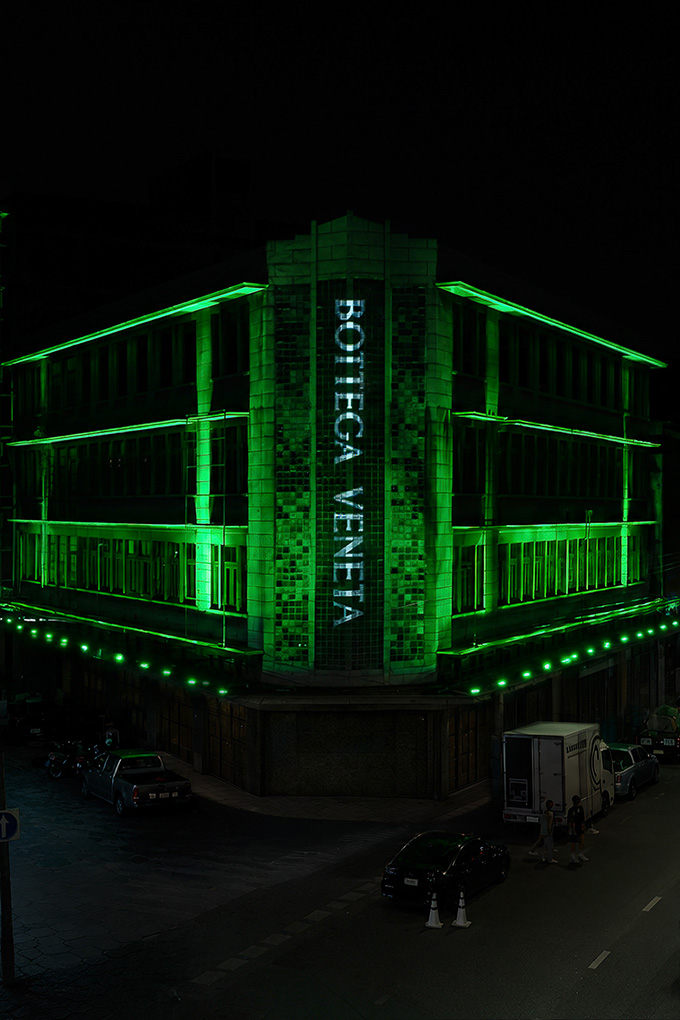
Its latest efforts in an ode to craft arrives in the form of Weaving Matter and Memory, a contemporary art exhibition in collaboration with Bangkok Kunsthalle. Curated by Louise Trotter and Somsuda Piamsumrit, the exhibition features the works of four Thai artists exploring the notions of weaving: Jakkai Siributr, Imhathai Suwatthanasilp, Supawich Weesapen and Teerapon Sisung. Here, weaving goes beyond its craft language but is also seen as a way of thought. Spanning diverse mediums, techniques and methods of assembly, their works blur the lines of tangibility and memory.

The exhibition opens with works of woven human hair by Suwatthanasilp. In 2019, she experienced one of the world’s most severe PM2.5 air pollution crises right in her hometown in Northern Thailand. Birds would fall, and her surroundings were shrouded in ash and smoke. Seeking solace in native foliage that resiliently grew around her artist studio, she referenced their shape and structure to create ‘Ash Flowers’, a collection of small-scale sculptures crafted with donated human hair. A signature style of hers, strands of hair are gathered and crocheted together, memorialising remnants of the charred landscape.

Similarly, ‘We Are Family’ transforms hair into plants and flowers, microscopic organisms and skeletal forms of creatures. Its dark, blackened forms are a nod to forest fires, a prevalent issue in the northern region. Displayed within a light box shaped like a house, “it represents that we are all in the same family, breathing in the same air,” Suwatthanasilp shares.


Titled ‘Despatch’, Siributr’s large-scale textile work reflects stories of the elderly residents on the islands of Japan’s Seto Inland Sea. Using donated garments from the ageing population, each layer, repetition and patchwork repair tells a narrative of the people who constructed them. “I invited these residents to write a message they want to leave for the next generation,” the renowned contemporary artist adds. The garments are mended using the fading Japanese boro technique, before deconstructing and re-assembling them into a vast textile piece. “For me, putting layers upon layers on top of [the artwork], it’s as if the memories are being built over a lifetime.”


Known for his works that touch on the rapidly evolving digital age and its irreversible consequences, next on display is Weesapen’s work. ‘The Super Massive Finger Trap’ lends inspiration from the traditional Chinese finger trap game. In Weesapen’s eyes, it mirrors the entrapped relationship between the user and digital device: inescapable once lured in. Snap an image with your camera flash on and you’ll realise it emits and retains a glow in your picture, revealing how digital tools continue to shape our experiences of the world. Meanwhile, the complementary oil painting ‘Notification’ depicts life through the split second when notifications instinctively collide with the body through the screen.


At the end of the hall, fine threads hang from the ceiling, a series of intricate sculptures suspended in the air. A closer look and you’ll find they’re copper wires woven into symbols rooted in ancient Buddhist cosmology. Titled ‘Weaving of the Divine Form’, Sisung’s delicate work reimagines mythical tales of the past through his perspective, knitting, weaving, coiling and binding them into realised forms of the narrative. “Stories like these are very meaningful because it’s so deeply embedded in our culture. We grew up hearing them, so they bring a sense of familiarity. I want to bring them back and remind people of what might have been forgotten,” Sisung muses. The installation arrives in two parts: the ancient symbol whole and deconstructed. While one provides a holistic portrayal, the other reveals elements of the story one might miss when seen in its entirety.
Running until 5 July, Weaving Matter and Memory is a testament to the versatility, longevity and endurance of craft. Weaving traditional techniques with contemporary dialogue, each artwork on display traces stories close to the heart, preserving a piece of culture that is threatened to fade in time.