As time and technology march relentlessly on, the slower, analog things in life have started to take on a new shine. Look at the resurgence of books and reading, an embrace of printed matter and the written word. The popularity of wired headphones for music, a trend that moves purposefully away from wireless connectivity and its convenience. At Montblanc, the German luxury brand founded is championing a similar spirit when it comes to writing.
You’ll know Montblanc, of course, for its famous pens. Before it introduced the Meisterstück in 1924 or took on the angle of luxury, the brand was breaking ground by making useful, reliable fountain pens that didn’t leak. They were called safety pens at first, and it was a time when cutting edge mechanical or technological utility was, in its way, a true luxury. Times have naturally changed, and these days luxury can often be the inverse—meaning returning to old ways.

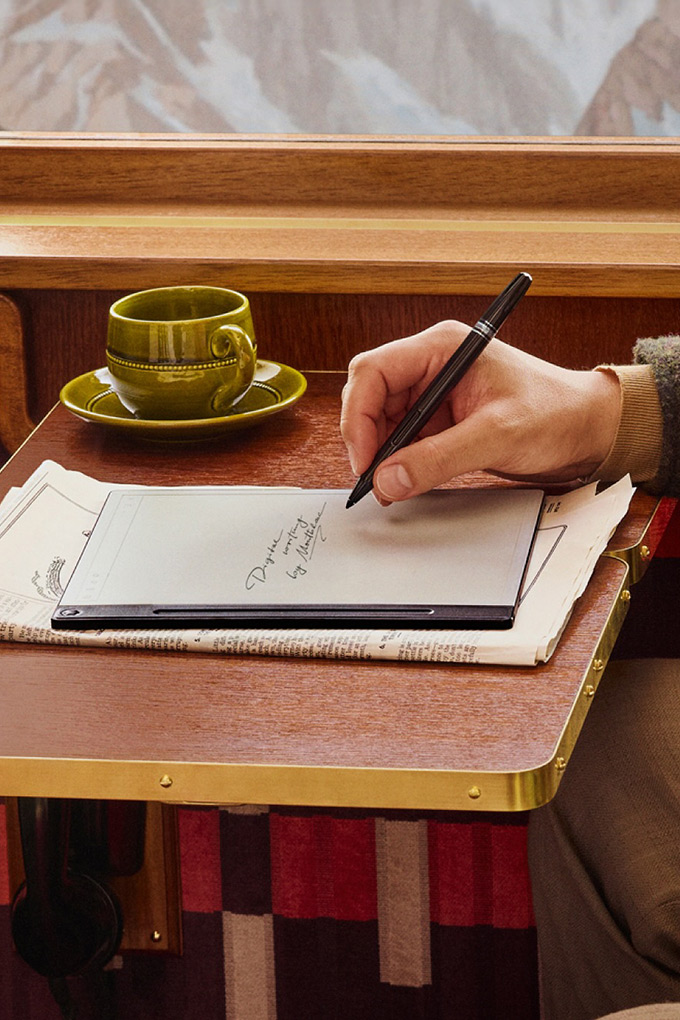
That question of old and new, modernity and heritage is rife in one of this brand’s most oddly compelling new products: the Montblanc Digital Paper. Conceived as a slender metal electronic ink note pad with an attached digital pen, it bridges two distinct parts of Montblanc’s identity. The first is naturally its romantic perspective on writing by hand, and all the meaning and emotion that can entail. The second is its boundary breaking attitude. Montblanc, in fact, has a whole New Technologies division dedicated to exploring categories beyond its well-established writing instruments, leather goods and timepieces. This very division helped bring the brand’s forays into smart watches, in-ear and over-ear headphones to life—the whole point being to approach these tech categories in a way that only a luxury brand can.
To review the Digital Paper, it might be more useful to start with what it patently isn’t. It is not a tablet in the common sense of the word. It is not a paper notebook replacement. It is not a snazzy, high tech device—not truly, anyway, but there is more on that to be said.

What it is, though, is a very refined writing experience that has been considered, designed and built to slow you down. Montblanc, on its part, is one of the rare champions of writing by hand. It describes the pens it crafts, for instance, as writing instruments—a world of differentiation in experience and intent from, say, the utility of dollar store ballpoints. Handwriting, shared former Montblanc New Technologies director Felix Obschonka who brought the Digital Paper to life, “offers a more immersive, reflective, and emotionally rich experience. It can ground us and inspire us in an increasingly fast-paced world.”
To that end, Montblanc has applied its rich expertise and knowledge of the writing experience to bear. The Digital Paper’s e-ink screen (like on a Kindle or a Kobo) has a matt paper-like finish, so that the digital pen that it pairs with creates the subtle, satisfying scratching sounds and tactility of pen and paper. Fountain pen and paper enthusiasts call this the ‘teeth’ of the paper, meaning a preference for paper that is not too smooth and which has the subtlest touch of texture, grip and resistance you can feel in your fingers as you write. The digital pen comes with an option of three nibs (a linen type, smooth and matt) to customise a preferred feel.

The digital pen itself is, of course, a hugely important part of the Montblanc Digital Paper. The brand collaborated with acclaimed designer Yves Béhar’s design and innovation firm Fuseproject to come up with the pen. It takes inspiration naturally from the signature Meisterstück, and references that classic in details like the three metal rings and the Montblanc snowcap emblem at the crown of the pen. Its tech conveniences are subtly hidden: two buttons on the barrel with customisable functions (like undo, erase, and more), and the snowcap crown which acts as a home button.
To test the Digital Paper out, I brought it with me to Geneva for the Watches and Wonders horology fair as a note-taking gadget. It unsurprisingly drew a lot of looks and questions, and the most common refrain I heard after offering colleagues and strangers a chance to try writing on it was that it feels as good as analog pen and paper. Proof, then, that Montblanc achieved what it set out to do. It had a strong battery life that lasted me five full days of writing, and the backup field notebook and rollerball pen I brought with me went completely unused. The size of the Digital Paper, though, might make it best suited as a very handsome and elegant desk accessory—not so much a portable writing device, unless Montblanc decides to make a smaller version.
But an unassuming moment of conversion and enjoyment came a little later. After the fair in Geneva had concluded, and I landed back in Singapore and returned to work, I dove straight into meetings. Meetings at which I have, for years, taken notes on pen and paper. I reached into my bag, pulled the Montblanc out, and started writing on it without really thinking about it. Only after perhaps a minute did I realise with a start that my natural reflex, the object I reached instinctively for to write on, had actually shifted. It was a change, or perhaps even a rewriting, that pleasantly surprised me.