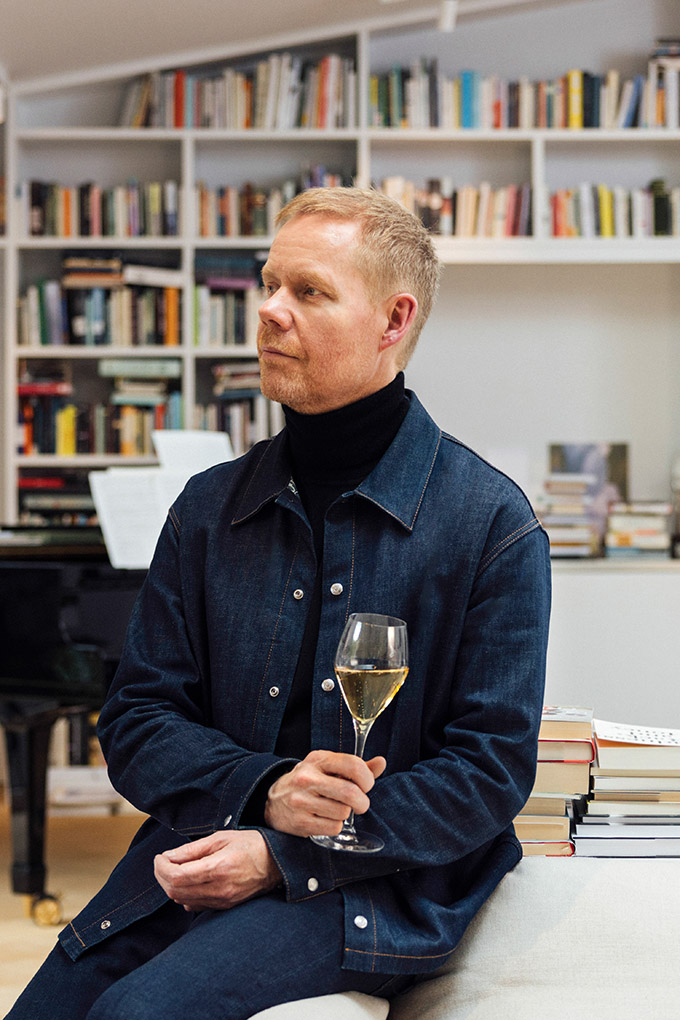

They should need no introduction. Maison Krug has honed its craft of winemaking since 1843. Their champagne has taken centre stage in moments of joyous celebration both intimately personal and triumphantly public. Max Richter is one of the most acclaimed, prolific composers of his generation. His peerless blend of postminimalist and classical music has moved listeners around the world, across stage and screen. Together in this unique encounter where every note counts, they offer a bold, yet intimate creative vision that is, somehow, even more than the sum of their parts.
Following an exceptional harvest in 2008, Krug’s cellar master, Julie Cavil, distilled a vast world of liquid possibilities into three distinct expressions. Those champagnes were the call that became creative fertile soil for Max Richter’s response—three original compositions that hold a mirror to each expression’s unique character.
First is Clarity, from Krug Clos d’Ambonnay 2008, a singular perspective that channels a solo fiddle, piano and cello to contemplate the purity of a single grape. As a larger composition of chamber music, Ensemble lenses Krug 2008 to underscore the impact of the broader year’s harvest on creative expression. The third and final composition comes by way of Krug Grande Cuvée 164ème Édition: Sinfonia. This remarkable arrangement of sonic texture and timing captures the breadth of a full orchestra to celebrate the most generous expression of Krug’s craft, assembled from 127 wines across 11 different years.

This journey between Richter and Cavil is an extraordinary ode to the universal language of art, borne from the minds of two masters of their craft. And while certain aspects of composing music and winemaking might vary, one essential belief unites their uncompromising approach to precision and experimentation—the details matter.
To uncover what those details mean to their art, we sat down with Max Richter and Julie Cavil. The resulting conversation was an analogue of their creative partnership, opening our eyes to how their shared vision serves to connect people through the incisive marriage of taste and sound.
Hi, Max and Julie! Thank you for your work on Every Note Counts—it’s a phenomenal window into the dialogue that exists between music and winemaking. Tell me, how did this all start? What brought you two together?
Max Richter: I’ve known about Krug’s storied relationship with music through other projects they’ve done in the past, like with the wonderful Ryuichi Sakamoto, who is sadly missed. And because I am a Krug lover at heart and always interested in exploring new ideas and connections, especially the boundaries between languages, I thought this would be a fascinating opportunity.
Julie Cavil: Yes, although we don’t share the same technical language, we discovered a profound common ground in our craft by virtue of our connection to nature. We both focus on deep listening—to the environment, to sound and ultimately to emotion. When you think about it, there’s a rich harmony to be heard in the way champagne and music each celebrate individuality.
This is a unique partnership, embracing a contemporary creative voice through Max’s music while still upholding Krug’s savoir faire, which is rooted in tradition. How did you strike a balance between the two?
JC: At Krug, tradition and reinvention are not opposites. Joseph Krug’s founding vision was simply to craft the very best champagne he could offer, regardless of climate variations, which requires a very innovative way of thinking. For example, to create what would become the first Krug Grande Cuvée, he went beyond the notion of vintage and pushed the boundaries of his time. In this same spirit, we continue to seek new ways to enhance the tasting experience while remaining faithful to his winemaking philosophy. Music offers a beautiful illustration of this blend of heritage and modernity.
MR: Exactly, there’s a kind of classicism, in a sense, that music shares with Krug. Their tradition has been perfected over time and continues to evolve in a way that naturally connects to music culture. We’re all living in the same historical building—what we’re doing now is adding modern extensions to this wonderful edifice.

What parallels do you see between the composition of a cuvée, and the composition of a piece of music? How do the details in each craft shape the other?
MR: My starting point was the sensory aspect of the champagne—its colour, light, texture, the movement of it all. And also its connection with landscape, nature and time. Krug’s champagne is a special thing, deeply connected to moments of joy and celebration. These fundamental principles of craftsmanship and humanity helped me build a distinct language and grammar for all three compositions—Clarity‘s soloist approach, the chamber music in Ensemble and Sinfonia‘s grand symphony.
JC: Likewise, Krug considers each plot as a fine musician who we audition through tastings. Just like Max, I work as a composer and conductor, deciding which individualities should appear and how they should play in the full symphony of champagne, like with the final blend of Krug Grande Cuvée. When I heard Max’s first compositions, I found that his ability to make classical music so accessible was incredible. It’s no easy feat, applying great mastery to an elevated art form, to create something everyone can enjoy, just as we do at Krug.
MR: Speaking of plots, I’m really impressed with Krug’s spirit of experimentation and adventure. They don’t really know what they’re going to get, you know? The wind, rain and sun do their thing, and every year is different. Winemaking, like music, is an iterative voyage of discovery. This openness to seeing what might come to pass really impressed me with the way Julie and her colleagues approached their craft. Of course, it was also an inspiration to just walk through the vineyards and feel the primal elements of earth and soil—listening to the wind, feeling the sunlight and getting a real, genuine sense of place.
Every Note Counts is a refreshing affirmation that art is art, whether in music or winemaking. To that end, Max, would you be interested in exploring other multidisciplinary projects in the future?
MR: Absolutely. I like the fact that creativity is, by its nature, borderless. I write concert music, make records, compose for ballets and write film scores. So for me, it’s all about exploration—finding meeting points between art forms and new spaces to discover. That’s one of the great privileges of doing creative work.
What do you hope people will take away from your partnership, from Krug’s champagne and Max’s music?
JC: Max and I want to offer an unforgettable journey that feels simple to experience for everyone, in their own way. Although, what feels simple to experience carries an enormous amount of work, time and precision; nothing takes more effort than making things feel effortless. You do not need to be a musician to enjoy music, and you do not need to be a wine expert to enjoy Krug. I also hope people sense our obsession with Krug Grande Cuvée’s generosity—the full music of champagne from north to south, east to west. The journey from soloist to ensemble to orchestra is a fitting tribute to that.
MR: I’m hoping to be surprised. I want people to respond in ways that I’m not expecting, because that’s one of the beautiful things about art—everyone brings their own biography with them, which then completes the story in a way. I’m also hopeful that this will encourage an openness to approaching art differently and making new connections, which is what makes culture so interesting.