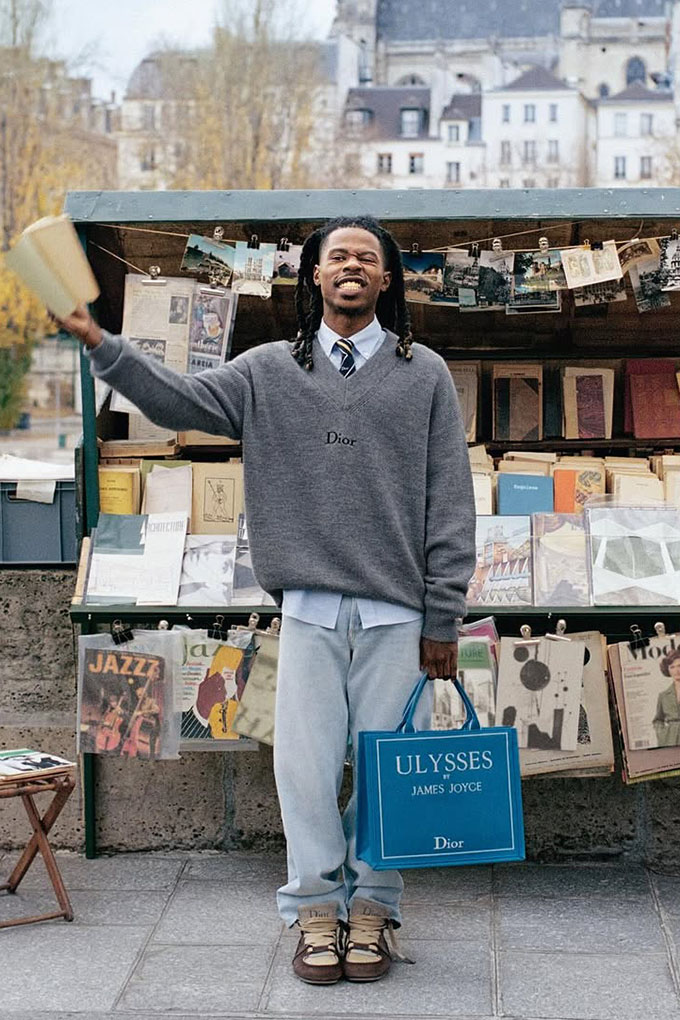
The bookworm archetype in movies has never exactly been portrayed as the popular character. Awkward and a little nerdy, the type whose biggest thrill is finishing their seventh reread of a beloved trilogy or dropping an obscure literary quote at precisely the wrong moment. But fast forward to 2026 and reading might just be the sexiest thing you can do. From fashion houses weaving literary references into their collections to the steady rise of celebrity book clubs, reading as a hobby seems to be enjoying a very public glow-up.
At a time when our feeds are saturated with AI-generated content and attention spans that feel increasingly toddler-like, reading is the slow page turner that cuts through the noise. Perhaps, it can even be used as a way of distinguishing ourselves from the rest and to establish a sort of cultural capital.
So why reading specifically? Unlike most hobbies you can simply appear good at, reading requires a bit of work. You actually have to engage with the material and make your way through the thing. But in a culture built on instant gratification, that endeavour has begun to carry its own kind of appeal. In a world where everything can be achieved with quick fixes—Ozempic to lose weight, filters to mask it all—time in itself has become a luxury. Instead, having the time to slow down, try something new and enjoy the process? It almost seems like a far-flung ideal. Being well-read, or at least seeming like you could be, signals something about the kind of person you are: intelligent, curious, maybe just disciplined enough to finish a book longer than a Twitter thread.
View this post on Instagram
At the same time, the renewed interest in books just might be the anarchist response to doomscrolling. Long-form reading offers a small antidote to our increasingly depleting attention spans, a way to push back, however slightly, against the brainrot. Whole corners of the internet have sprung up around this impulse. BookTok has been thriving for years now, while platforms like Substack have exploded as more people turn to writing and publishing on their own terms. Of course, a bit of performativity comes with the territory. Our feeds are full of posts promising to make you “disgustingly well-read” or recommending “niche books that will make you smarter.” But the stakes are fairly low. At worst, it results in a few aesthetically pleasing but unread books on a shelf; at best, it nudges someone back into the habit of reading. And if the cultural side effect is that people want to seem a little smarter…well, there are certainly worse trends to follow.
View this post on Instagram


Fashion houses are not the only players turning the page. A growing wave of celebrity-led book clubs has also entered the cultural landscape, reshaping how audiences discover and engage with literature. There’s Dua Lipa’s Service95 book club, a space to celebrate all things literary through her monthly reads, author Q&As and curated recommendations. Then there’s also Reese Witherspoon’s hugely influential Reese’s Book Club, which has propelled numerous titles onto bestseller lists and into film and television adaptations. Meanwhile, Kaia Gerber’s Library Science book club taps into a younger, fashion-adjacent audience, blending literary discussion with the cultural network of the fashion world. Rather than existing solely within traditional literary institutions, books are now circulating through the same cultural ecosystems as entertainment and social media. In this landscape, the celebrity book club has become both a taste-making platform and a powerful marketing engine, capable of transforming a single recommendation into a global reading trend.
With the rapid churn of internet aesthetics, it would be easy to dismiss the renewed fascination with reading as just another trend. Every few months, a new online persona emerges, and the performative male who “reads” feminist literature phenotype could feel fleeting. Yet, we’d like to think that something else is in the works here. Every day, we’re plagued by information—but what are we retaining? This cultural shift in the zeitgeist might be pointing to something bigger: that we’re resisting. We’re trying to sit down with ourselves, and attempting to excavate a thought from start to finish. All in hopes to reclaim independent thought.
So as the cultural value of genuine curiosity—actually engaging with ideas rather than signalling them online—gains ground, there’s little to lose. Head to the libraries, put on your little librarian glasses, hang up your Coach book charm if you have to. We think there’s never been a better season to be coined the resident bookworm.