Vogue Wellness Day set out to explore what it means to live well. Against the luminous backdrop of Fort Canning Park, a dedicated day of activities unfolded at METT Singapore on 6th June. No matter how you define your journey with wellness, there was something for everyone who came through the doors. With a morning run club, reformer pilates classes—from Absolute Pilates and The Reformer Society—and padel on the courts, guests got their workouts in—some clad in Wiskii Active sets of their choosing. Tending to everyone’s internal wellbeing were masterclasses on journalling, meditation and financial wellness, as led by Syfe, VIVA and Madison House. Whenever a refuel was needed, Zespri kiwis and supplement-infused drinks from IM8 and The Purest Co. were there to replenish the body. Even apart from the usual tenets of wellness, lifestyle goods from Vetreska made sure to take good care of your fur kids too.
And that wasn’t all. The wellness journey continued with immersive experiences from the Company of Wellness and dedicated on-site consultations with GenPrime. VIP guests enjoyed a session at The Longevity Suite Asia. Perfuming the air was Chloé‘s Atelier Des Fleurs collection, lending delicate floral notes to soothe the body, mind and soul with.
Perhaps most nourishing of all were the conversations—where practitioners, athletes, researchers and acclaimed experts discussed everything from nutrition fads to burnout culture, ancient Asian health systems to women’s reproductive health, and pro-athlete performance to longevity in the new age. Nadya Hutagalung and Chee Hee Seng were among those who flew in for the occasion, contributing regional perspectives to Singaporean discourses. Below, see the lessons we gleaned from the voices steering the new frontiers of wellness—along with practical tips to apply to your own life.

1 / 7
Nutrition: The Politics And Philosophy of Your Plate, Presented by Zespri
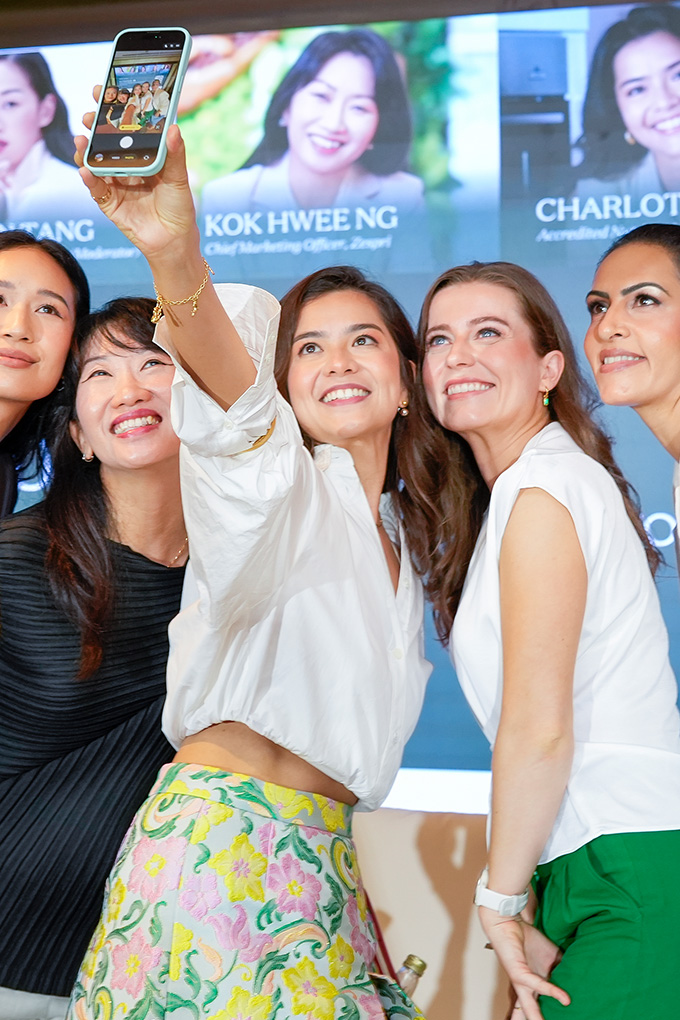
With the discourse around nutrition constantly in flux—prescribing the likes of creatine, fibre and an ever-changing host of vitamins—dissecting what our bodies actually need can feel like a Herculean task. Presented by Zespri and moderated by nutritionist, model and creator Karmen Tang, experts across the food innovation and nutrition space gather to re-define our relationship with food—including Chief Marketing Officer of Zespri Kok Hwee Ng, holistic nutritionist and founder of Everiday Foods Riyana Rupani, accredited nutritionist and content creator Charlotte Mei, and UFIT dietitian Ellie Cheale.
On the topic of eating well, Ng emphasises that it’s not about what to avoid, but what to include instead. Mei highlights that a lot of people are under-eating. Yet, all these principles around nutrition get lost in translation, often becoming an emotionally charged topic instead. “Food is tied to their identity and appearance. It’s also tied to morality—we say we’re good when we eat a salad, but bad when we have cake. That’s the kind of language I hope to shift too,” notes Mei.
Cutting through the noise, Rupani establishes that the conversation extends beyond what you eat. “It’s what you digest and absorb. When we’re eating, our bodies should be in a parasympathetic state, or a ‘rest and repair’ state. Most of us are in a sympathetic state, or a ‘fight or flight’ state.” Cheale assures us that optimisation shouldn’t become an obsession—balance is more important. “It’s really about being more intentional about what we choose,” notes Ng. “Brands have a lot of influence right now, which means we also carry responsibility. We advocate for nutrient density, and believe in the holistic quality of nutrition.”
So what does eating well look like? Mei breaks it down: “There’s a misconception of an all-or-nothing approach. The problem isn’t access in Singapore, we have one of the most diverse food cultures. Everyone thinks every meal has to be perfect, but we cannot achieve that all the time.” Instead, Cheale asks us to choose one or two things to stay consistent with. “We don’t need more info, we just need to execute.” As long as we are paying attention to the contents of our plates and ticking most of the boxes most of the time, nourishment doesn’t have to feel like a test.

2 / 7
From Burnout to Balance: Rethinking How We Feel and Live
In an age of constant connectivity and infinite phone notifications, most of us find ourselves living in a state of chronic exhaustion—which later develops into burnout over time. We understand that it isn’t healthy for our bodies, but burnout has far deeper roots than rest can solve. Here to unpack the phenomenon is Maya Menon, associate deputy editor of Vogue Singapore, joined by founder of Forest Wolf and Deep Human Club Crystal Lim-Lange, partner and director of Capybara Bathing Nicole Chew, and senior clinical psychologist Zaylea Kua.
In her investigations of burnout amongst her clients, Lim-Lange has uncovered a common thread. “To some level, we have been programmed to have this fear in our systems, and this expectation that the world is scarce. When we have this worldview, then burnout becomes a safety and survival strategy,” she explains. Ironically enough, it takes a toll on our bodies—Kua identifies that the digestive system starts to produce more stomach acid, which is why some people start to experience heartburn, acid reflux and a compromised immune system.
Emotionally, it leads to a disconnect in your sense of self. Recalling a moment of rupture in her personal life, Lim-Lange reflects: “I wasn’t at the frontier of my own truth. Who I think I am is an old story, and it is made up of a lot of old beliefs that were implanted in my head about what success should be and what happiness looks like. A lot of the time, particularly for women, we are taught to define ourselves by expectations and how people perceive us. But are we really checking in with ourselves? Are we asking, do I know who I am? Am I fulfilled?” The physical spaces matter too—Chew observes that a lot of the time, we clutter our spaces with decor, but it distracts us from accessing our true essence.
“We cannot be grateful for everything, but in every moment there is something to be grateful for,” Lim-Lange reminds us. To address burnout, there are a few methods. Kua follows the four ‘S’s: stop to take a breather; separate yourself from the problem; stabilise with good sleep, exercise and meals; simplify to get rid of unnecessary stressors. Chew prompts us to start small by showing up consistently—cold plunges, for instance, might feel painful at first, until we pay attention to how it actually feels. Ultimately, it’s all about reconnecting with ourselves, and listening to what we truly want and need.

3 / 7
Built, Not Born: The Performance Mindset of Elite Athletes
Some things are decided by genetics and biology. As the world watches Olympians perform seemingly-impossible feats, it almost seems like a select few are born with a natural gift. But is that all it takes to be an elite athlete? Host and partner of The Sports Arina Kelly Latimer uncovers the truth with Olympian and SEA Games champion Amita Berthier, artist, director and former national athlete Benjamin Kheng and ultramarathoner and Guinness World Record Holder Natalie Dau.
“It’s just years and years of being consistent. It’s also self-belief—if we put elite athletes on pedestals, then it gives us an excuse not to chase our goals because we think it’s too hard. But if you just show up for yourself every day, do the work that no one sees, then you can become your best self—no matter what that looks like,” advises Dau. Even after an illustrious career in running marathons, she confesses that it does not always come easy. For Berthier, there are bad days too, but above all—“Our love for what we do is bigger than the struggle.”
Speaking about his transition from swimming competitively to becoming a runner, Kheng reflects on the process of re-engineering himself through every stage. From sports school to a career in music to running, discovering his ‘why’ has been transformative. “I found immense satisfaction in doing the external-internal thing—picturing what I would do if I were Natalie, or Amita, or an athlete. The external then flows into the internal, and you start to believe it.”
Not to be overlooked is the aspect of recovery. “It’s important to push your boundaries, but also manage them. It all goes back to knowing your body and your limits. When things get tough, it doesn’t mean it’s too much. Maybe today I have to push a little bit more,” Berthier notes. “Everybody requires different things to motivate themselves.” As for what high performance actually is, Dau answers: “High performance is truly believing in what is possible and breaking those barriers, to become someone you’ve never been before—even if it’s just a little bit of someone you’ve never been before.”

4 / 7
The Longevity Blueprint: Engineering A Life Well Lived
While it used to be that longevity was defined by adding years to our projected lifespans, the leading voices in wellness, medicine and innovation are now honing in on the quality of the lives we live. Along the journey of biohacking and optimisation, medical doctor and international expert on psychoneuroimmunology Dr Olivia Lesslar invites us to pause and take stock of what ageing well truly entails—in the company of Chief Wellness Officer of The Longevity Suite Asia Diana Kraemer, bodyworker, counsellor and co-founder of Soma Haus Kathy Gabriel, and Professor of Medicine, Director of NUS Academy for Healthy Longevity, Founder of Chi Longevity Professor Andrea Maier.
Addressing the misconceptions surrounding longevity, Kraemer remarks, “People think of longevity as a destination, something we reach if we follow the right protocol. But the people who age the most beautifully are not the ones who are most optimised or integrated, but the ones who integrate emotionally, physically and spiritually as well.” Gabriel highlights what’s missing: “We have a lot of data nowadays to show us how we’re doing, but we’re missing the interior self awareness about what longevity is, really.”
As for whether we are truly healthier, Maier asks for a shift in focus. “It’s not the lifespan, but the health span. We are living longer globally, but most importantly, can you do the things you want to do? Do you have the capacity to live longer and healthier?” Emphasising biological age as a more accurate indicator of one’s health, she explains: “Biological age is a measure of the rate of your ageing. We are not only scanning, but also looking at cells and functions.”
Beyond metrics and numbers, they call for attention to our bodies as they are. “We’ve given away our agency to technology and external agents, so even though we have the info, there is an undertone of anxiety in relation to information overload,” observes Gabriel. “Instead, we should constantly ask ourselves: what do we actually need right now?” 10 years from now, Kraemer anticipates, “Medicine will really change from reactive to preventive. I hope it will be as emotionally rewarding as scientifically proven.”

5 / 7
Future of Wellness: The Age of Intelligent Living, Presented by Syfe
With AI-powered technologies weaving their way into our everyday lives, the shift calls for a re-evaluation of our wellness philosophy. In the debate between technology and humans, how are they co-existing and influencing each other? Moderated by Natasha Damodaran, publisher at Vogue Singapore, experts across the frontier of wellness innovation weighed in—more specifically, COO and Head of International at Syfe Samantha Horton, bestselling author and professor of innovation Dr Catherine Ball, and founder and managing partner of The Trapeze Group, Grant Wee.
“At what point does wellness technology stop supporting our own self-awareness of our body and start replacing it?” asks Damodaran. It appears that caution is already necessary at this juncture, as Ball directs our attention to gender disparities in optimisation metrics like recovery scores. “The error rates in general are 10 to 20 percent and for women that error rate can go up to 50 to 60 percent, because they’re based on a standard medical model—which is a man in his 20s,” she cites. Overreliance on technology for our wellness has its perils, which is where human touch becomes a necessity. “Loneliness is an epidemic, and it can’t be solved by AI or technology,” reflects Wee. “It’s never going to replace hugs with friends or people you love—which is why third spaces are important.”
Another emerging realm of self-care lies in financial wellness. “It is the bedrock of physical, mental and emotional wellness,” notes Horton. “The way I like to think about investing and money is that money can’t buy you happiness, but it does give you options and allows you to make choices to do the things you want to do, instead of things you have to do.” In fact, investing early is a way of easing your cognitive load. “If we can start early and make your money work for you, then you won’t have to work yourself so hard.”
Ultimately, it is undeniable that technology has eased our lives. The key to making it work for humanity lies in discretion. “What this all comes down to is literacy. Literacy around how these products are built, how they work. Are they good, are they not so good? That is where we should be having those conversations,” Ball muses. Horton reminds us of our agency: “No matter how good the technology is, no matter how good AI is, you have to first decide how you are using it, what you are using it for, and what you want it to give you.” Above all, it’s remembering that innovation is a human endeavour. Wee reminds us: “The struggle, the grind is what produces great art and progress, and that’s what makes us truly human. The willingness to do hard things.”

6 / 7
Asian Remedies: Traditional Medicine in a Modern World
They’re not just passing fads—Traditional Chinese Medicine and Ayurveda have rich cultural roots and generational legacies. As a new generation discovers the rituals and beliefs of the ancient health systems, how are they informing modern wellbeing? Exploring the interconnections are Nadya Hutagalung, wellbeing and sustainability advocate and founder of Svara Mandala, alongside Chinese Medicine practitioner Chee Hee Seng, founder of Sol House Candice Goh, and founder and chief physician of Common TCM Victoria Tan.
Analysing the influx of media attention on traditional medicine, Tan observes that nothing has suddenly changed. “The medicine and methods are the same. But what has changed is the accessibility to reliable information. There is less confusion and uncertainty, and so people choose to give it a try.” Referencing a viral guasha scene from The Pursuit of Jade, Seng notes that people now have a visual of how effective traditional medicine is.
Far from being short-lived trends, traditional medicine can be woven into every aspect of our lives. Tan explains the concept of a sub-health state, characterised by sleeplessness, chronic bloating, or the general sensation of not feeling quite right. With the ongoing discourse, there’s been a shift—health no longer means a lack of illness, but that the sub-health states are being optimised. Explaining burnout from an Ayurvedic perspective, Goh observes that we are stressed because we are distracted. “We give energy to everything apart from ourselves. When the wind element is out of balance, everything is too.”
In a modern day context, there is space for all these systems to co-exist at once. “Integration is not East versus West. It is about the strengths of both,” Seng muses. With ongoing medical research solidifying the concept of qi, traditional medicine will only give us more insight into our bodies. As we reconnect with ancestral wisdom, Goh sums it up well: “Wellness is just about coming back to ourselves and listening to what we need and know innately.” Tan asks us to start with the small habits, and to remain consistent with them until they become our state of health. The ultimate goal? Balance, Seng says.

7 / 7
Her Story: Fertility as Part of Modern Wellness, Presented by GenPrime
As hormones and menstruation continue to be demystified, there still lies an oft-neglected aspect of women’s health: fertility. Egg-freezing, in-vitro fertilisation and postpartum recovery remain largely under the radar, despite being vital pillars of women’s reproductive health. Led by Vogue Singapore’s beauty editor Emily Heng, GenPrime seeks to empower more women to make informed decisions about their journeys—with the guidance of founding Chief Executive Officer of GenPrime and Rhea Fertility Margaret Wang, medical director Dr Jessie Phoon and fertility advisor Bea Camacho.
Explaining why women often leave fertility out of the equation, Phoon raises a point that isn’t often highlighted. “Infertility is not thought of as a medical disease, and so it was never taken seriously,” she elaborates. Speaking about her own upbringing—an experience shared by women everywhere—Wang reminds us that women spend the first part of their lives avoiding pregnancy, only to suddenly be expected to know everything about it. “So much of our work is bringing together communities to open the conversation and say, hey, you don’t know what you don’t know. Here’s an opening to talk about it.”
Her own egg-freezing journey started as a desire to reclaim agency over her own reproductive health—and build optionality for her future. For Camacho, she recalls experiencing anxiety as she contemplated the option of freezing her eggs for the first time. “Clients often feel anxious, alone, and too afraid to voice out to their family,” Phoon concurs. It can help to speak to confidantes and women who have undergone the process to decide if this is the journey for you.
How do you know if it’s the right time for egg-freezing? Phoon recommends that the optimal age to freeze eggs is usually within 28 to 33. Even if you haven’t made decisions about your reproductive health, a routine gynaecology check-up can come in handy. Pelvic scans, follicle count and AMH blood tests—or a basic egg count—can help you think about egg-freezing long term. “Fertility is more than just about conceiving, and more about the health of your own eggs—giving you a hormonal system that can help you maintain your quality of life,” Phoon concludes. By understanding your options early, you can empower yourself to make better decisions, advises Camacho.