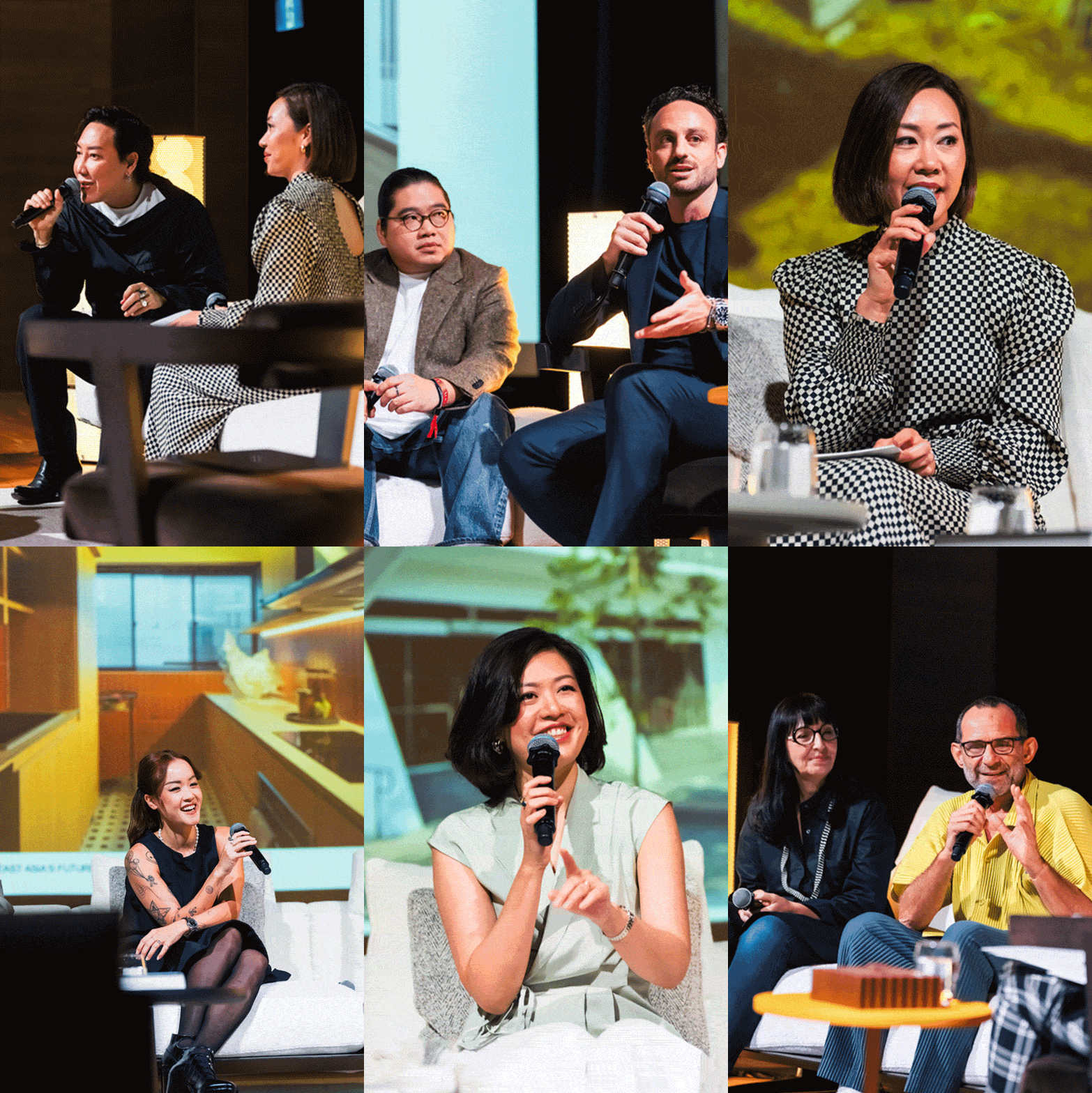
How does one step away from the grip of the digital world and reconnect with the loving embrace of the physical? That’s what good design is for. Whether in fashion or architecture, at home or in the office, good design is meant to ground you in the beauty of human craft in all its facets. After all, the ongoing story of design, whether made manifest through individual artistry or communal rituals, is one rooted in connection. And on 16 October, that story laid the groundwork for each and every panel held at the inaugural Vogue Living Conversations—the hallmark event capturing Vogue Singapore’s first official foray into shaping the wide world of design, interiors and architecture through the lens of fashion.
The big day saw Vogue Singapore host six panel talks at the Ngee Ann Kongsi Auditorium at National Gallery Singapore. On paper, the venue made perfect sense: the art museum is the preeminent centre for modern and contemporary art from across the region. Appropriately, Vogue Living’s first exhibition launched within the gallery’s hallowed halls just two weeks prior. The first international showcase of ABITO, a cultural exhibition commissioned by Italy’s Ministry of Foreign Affairs and International Cooperation, helped set the tone for Vogue Living by addressing the intersection of fashion and design over the last several decades.
In practice, the panel talks at Vogue Living Conversations were a rousing affirmation of the importance of design’s role in shaping the world and our place in it. Six conversations, 21 voices, one community. The panellists that spoke at the event included architects and hoteliers, spatial designers and civil servants. On one hand, Roberto Palomba, founder of Palomba Serafini Associati, and Nathan Yong, co-founder of Grafunkt, brought a wry, unfiltered flair to discussions. On the other, Samuel Ding of the Capella Hotel Group and Minako Tanaka, design director at HBA Residential, grounded conversations with a mature touch bolstered by years of experience. Elsewhere, His Excellency Dante Brandi, Ambassador of Italy to Singapore, and Alessandro Ficco, Managing Director of the Molteni Group, APAC, graced the day’s affair—proving to attendees the enduring value of Italian craftsmanship and insight.
If you weren’t able to catch us at this year’s Vogue Living Conversations, we have you covered. Continue below for all the insights and takeaways from the panel discussions.

1 / 6
ABITO: Designing Her World: Fashion, Design and the Changing Shape of Women’s Lives
Moderated by Bettina von Schlippe, Publisher-at-Large of Vogue Singapore, ‘Designing Her World’ navigated the rapid changes in fashion and design in recent years through the lens of womanhood. Panellists included Roberto Palomba, Architect, Designer and Founder of Palomba Serafini Associati; Laura Miotto, Associate Professor at the School of Art, Design & Media, Nanyang Technological University; His Excellency Dante Brandi, Ambassador of Italy to Singapore; and Shaoyuan Han-Montillet, Luxury Executive and Independent Advisor, and former Managing Director of Fendi, Southeast Asia and Australia.
Von Schlippe started the panel talk by asking a simple question: ‘Why Singapore?’ In Brandi’s view, the small island nation’s conscientious relationship with design makes it the perfect starting point and “seed for ABITO’s international tour.” Naturally, the next line of questioning centred on ABITO itself, to which Palomba replied: “The exhibition is not just focused on what we wear, but also how we live. The role of a woman is the way we can measure the evolution of a society.” Appropriately, each dress showcased in the exhibition was chosen to encourage reflection of this very dynamic.
According to Miotta, ABITO’s vision is to platform women as not just mere consumers, but as well-intentioned designers and curators of contemporary living. As the saying goes: there’s no better time than the present, and for Miotta, Singapore seems poised to help pave the way for this platform, as the country is “a receptive space for design”, boasting a unique “attention to discourse.” Han echoed this sentiment, recalling the story of luxury fashion house Fendi’s birth, brought about by the five Fendi sisters who banded together to make the impossible possible.

2 / 6
The Future City: Designing for Density, Nature and Belonging in Singapore
Moderated by Elaine Tan, Director of Research for the Centre for Liveable Cities, ‘The Future City’ opened with Tan posing a series of rapid-fire questions to each of the panellists, meant to prime the audience with conversation of what life in Singapore looks like in 2026—and what it could look like in the future. Panellists included Yong Min Ho, Heritage Educator and Founder, The Urbanist; Lynn Khoo, Deputy Executive Director of DesignSingapore Council; and Seah Chee Huang, Architect and CEO, DP Architects.
Seah pushed back on Singapore’s increasingly fraught relationship with density by invoking two modern developments that are shining examples of ‘good density’: Our Tampines Hub and Bukit Canberra. In both cases, commons, greenery and shared domains are proof that density can actually amplify human connection—when it’s well-designed and curated, it helps make life both possible and better. On the flipside, there is no shortage of traditional heritage buildings that have been either preserved or transformed in the pursuit of good design, as evidenced by Khoo, Ho and Seah.
Khoo invoked buzzy lifestyle enclave and former school New Bahru as an example of limitless possibility. Ho recalled the rich history of Kada, once the St. Andrew’s Mission Hospital and now a bustling retail hub. And Seah pointed to Golden Mile Complex as an ongoing testament to how both old and new tenants can reside within storied walls.

3 / 6
Vogue Living: Fashion’s New Habitat
This intimate fireside chat approach to breaking down Vogue Singapore’s latest venture featured Desmond Lim, Editor-in-Chief of Vogue Singapore, and Kissa Castañeda, Contributing Editor of Vogue Living.
The exchange played out very much like a casual conversation between two friends. Lim and Castañeda spoke on the importance of experiences, an aspect of branding and creative development adopted by many industries in 2026, including, of course, fashion. Fashion’s venture into the experiential is evidenced by luxury houses turning to food, beverage and lifestyle establishments to better champion community in a digital age. Case in point: the Coach Restaurant at Jewel Changi Airport and Tiffany & Co.’s Blue Box Cafe.
Castañeda also referenced other brands like Aesop and Gentle Monster, who are taking this notion of ‘the experiential’ and running with it, by spreading their wings and pioneering uncharted territory in the design space. The former’s vibrant array of riveting interiors across all of its outlets attest to design’s enduring role in establishing a sense of communal belonging at the heart of retail. The latter shocks and stuns with larger-than-life installations and cutting-edge innovation—sparkling silver, reflective glass and all.

4 / 6
The Sanctuary Within: Home as a Refuge in a Restless World
Presented by luxury Italian furniture brand Molteni&C and moderated by Andrea Savage, Co-Founder, CEO and Creative Director of A Life By Design, ‘The Sanctuary Within’ turned the audience’s attention to the meaning of ‘sanctuary’ in our modern age. Panellists included Alessandro Ficco, Managing Director, Molteni Group, APAC; Minako Tanaka, Design Director at HBA Residential; Mikael Teh, Founder, Monocot Studio; and Edmund Ho, Lead Strategist of Sol Luminaire.
Savage kickstarted the panel off by opening the floor to the audience, asking them what home means to them—whether it’s a sanctuary by means of shutting off the outside world, or a way to celebrate community and shared human connection. She touched on the multitude of ways one can shape the home, from techniques like layering lights, building spaces that are flexible enough to adapt to changes throughout the day and curating furniture to complement a homeowner’s desire for intimacy.
Naturally, the experts had plenty to offer the conversation. After all, designers are hired for their curatorial skills—their expertise, judgment and input. In Ficco’s words: “We are an extension of what the client wants.” Even if the client thinks they know what they want, however, Ho cautioned: “You can learn all you want, but that’s where the designer comes in. What clients want isn’t always what they need.” Unsurprisingly, listening skills are important when it comes to design, as noted by Tanaka. “Listening is key. That’s where we’re tasked to challenge our clients. They don’t want us to simply be the executor of their wants.”

5 / 6
Designing Identity: Meet the Creative Voices Shaping Southeast Asia’s Future
Moderated by Maya Menon, Associate Deputy Editor of Vogue Singapore, ‘Designing Identity’ centred the ongoing discussion of design on Southeast Asia’s role in the industry, at home and abroad. Panellists included Budiman Ong, Founder and Creative Director of Ong Cen Kuang and Co-Founder of Jia Curated; Stephanie Er, Founder and Creative Director of Cream Pie Studio; and Nathan Yong, Co-Founder of Grafunkt, Founder of Nathan Yong Design and NathanHome, and Programme Leader (BA) of Lasalle College of the Arts, University of the Arts Singapore.
Menon asked panellists what their one bit of advice for aspiring designers would be. According to Er, social media can only take you so far. Instead, if you want to pursue a career in design, “look at the materiality around you in the region” and seek inspiration by “going out into the world and embracing the analogue.” Yong took this sentiment a step further and encouraged the audience to read broadly and expose themselves to international institutions and publications. That being said, at the end of the day, a designer’s vision is theirs, and theirs alone—Ong doubled down on this by urging the next generation to simply “trust your own instinct.”
Of course, Singapore is a small country, and international recognition is something many creatives aspire to. However, Yong was careful to address designers’ desire to sell products because of their perceived commercial value: “In the long run, you have to ask who you are yourself: do you design another Danish chair because you know it’ll sell?” He also spurred future designers to embrace their emotions: “Anger is important. That means you have the conviction to turn your ideas into something.”

6 / 6
The Luxury of Place: When Design Becomes the Destination
Moderated by Kissa Castañeda, ‘The Luxury of Place’ directed the day’s last conversation towards the hospitality industry. Panellists included Clint Nagata, Founder and Creative Partner of Blink Design Group; Mark Wong, Senior Vice President of Small Luxury Hotels of the World, APAC; Samuel Ding, Senior Vice President of Design & Technical Services at Capella Hotel Group; and Aik Wee Ong, Senior Director of Design Hotels, APAC.
In the hospitality industry today, the panellists noted that aesthetics matter less, and ‘place’ matters more. The less explicit details of community and memory have become more central to determining a hotel’s success. This trend was noted by Ding, Wong and Ong as being especially prevalent in Japan. In a post-pandemic world, the properties based there embody a particularly special kind of soft power—their grounded aesthetics and authentic sense of place and locality better suited to address the modern patron’s travel sensibilities.
With most of the speakers being voices for smaller, more ‘boutique’-minded property groups, there was a much greater emphasis placed on intention and curation—and not just in the Land of the Rising Sun. The slow life is a good life, and coming from a country like Singapore, contemplation and quietude are boons.