There was a time when travel was about discovering new places, and that desire remains unchanged. What has evolved is how we experience them. Beyond simply visiting historic landmarks, exploring culturally rich destinations or admiring places renowned for their craft heritage, travellers are increasingly seeking opportunities to immerse themselves in its way of life, connect with local communities and engage with the traditions that shape them.
Experiential travel has opened up new ways to explore a destination, from immersing oneself in its food and natural landscapes to discovering its creative traditions. Craftcations take this a step further, inviting travellers to get hands-on with the art of making and experience a place through the skills, stories and traditions passed down through generations. Destinations are increasingly offering opportunities for travellers to roll up their sleeves, learn from local artisans and experience the age-old practices that give a place character—travellers are becoming participants rather than mere spectators.
It is about slowing down, getting your hands dirty and discovering a destination through the rhythm of its craft, the wisdom of its artisans and the stories woven into every creation.
The Dwarika’s Kathmandu, Nepal

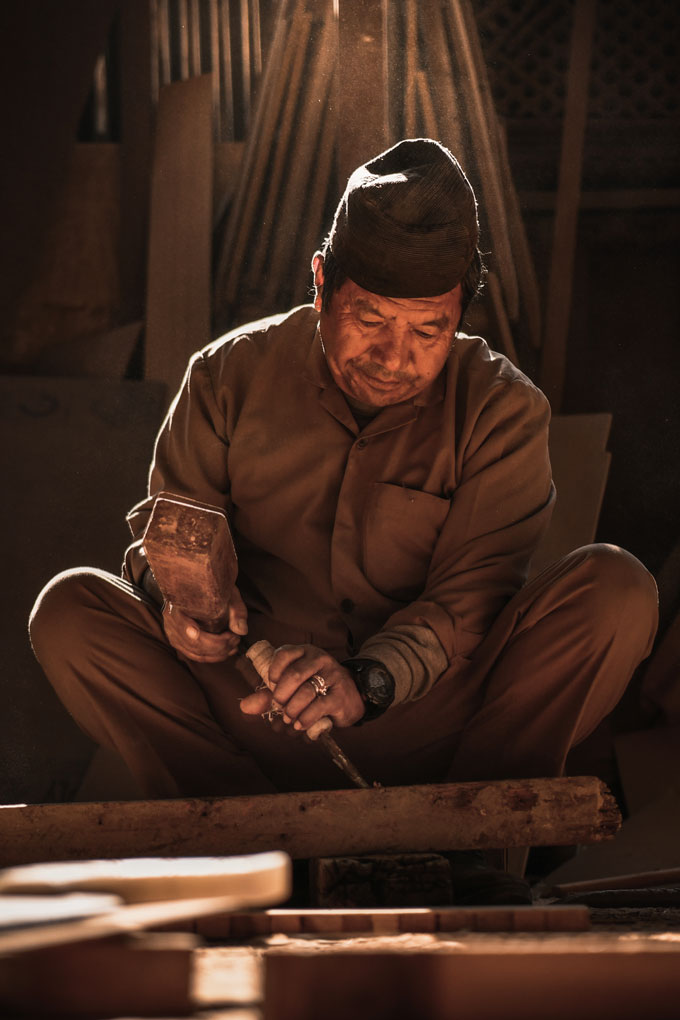
More than window dressing, at The Dwarika’s in Kathmandu, Newari woodcarving is the hotel’s reason for being. Founder Dwarika Das Shrestha began rescuing carved fragments from demolished buildings in the ’50s. Today, centuries-old beams, lattice windows and pillars have been given a second life within the brick buildings and courtyards of the compound.
In the restoration atelier around the corner, a team of craftsmen painstakingly prepare aged timber for reintegration into the architecture. This rugged space is also where hands-on workshops for guests are hosted.Sessions typically begin with a tour led by René Vijay Shrestha Einhaus, the founder’s grandson and CEO of Dwarika’s Collection, who explains the motifs, tools and exacting techniques behind this style of wood carving. A master craftsman then guides participants through completing a small carving of their own.
Under his guidance, even a spectacularly inept participant emerges with a floral motif that looks passable. Now that’s skill.
Capella Kyoto, Kyoto, Japan


Past the unassuming shopfront of 150-year-old Kyoto footwear atelier Gion Naito lies a world where shoes are chosen through well-honed intuition. Fifth-generation craftsman Seiji Naito continues his family’s tradition of making open-toed geta and zori, the latter an ancestor of the modern flip-flop, alongside contemporary ojojo sandals.
He also practises the subtler art of atsurae, a Japanese tradition of bespoke creation in which artisans intuit a client’s tastes and character beyond mere measurements.
Capella Kyoto’s Book & Chat experience offers guests a contemporary encounter with both traditions. Following an introduction to sandal-making, participants enter the atelier’s ‘B-side’,a backroom reimagined as a library. With book specialist Kenya Nakazawa who also acts as translator, they select several titles to spark an unhurried conversation spanning philosophy, life and more. Naito listens, observes and eventually chooses a pair of carefully crafted soles for each participant. The selection proves uncannily apt, suggesting the session has measured something rather more revealing than size.
Mandarin Oriental Qianmen, Beijing, China


For millennia, craftspeople in China have transformed silk, bamboo, paper and ink into forms that make the everyday beautiful and meaningful. Mandarin Oriental Qianmen, Beijing, draws on that legacy by offering hands-on workshops in traditional kite-making, paper-cutting that creates intricate figures and, most exacting of all,calligraphy.
Led by a trained instructor, each calligraphy session takes place in the study of the guest’s courtyard house. The setting is especially resonant. The hotel has adapted 42 historic siheyuan residences woven through the Caochang hutong neighbourhood into private suites. Within this subtle synchronicity, calligraphy and architecture reveal a shared discipline: both are shaped by balance, proportion and space.
The lesson reveals how pressure, angle and the flow of each stroke lend mood and meaning to a single character. As marks cohere into a painting in miniature, Chinese writing is transformed beyond language. Its beauty lies equally in how it is seen.
Joali Maldives Raa Atoll, Maldives


Works of art dot the sand around Joali Maldives, the country’s first art-immersive resort. More than a dozen commissioned pieces, from a colourful mosaic-tile table and chairs to floral-painted ceramic vases, decorate the resort spaces. But travellers here can do more than admire art; they can make it.
At Joali’s Art Studio and Gallery, two pottery wheels await. Neither my mum nor I had used one before. But our instructor gently guided us on the delicate balance of water on our hands and power on the foot pedal to create a clay bowl, even enough to fire. At the end, I glazed my bowl in a light azure blue, and the finished product sits on my parents’ kitchen window sill, a daily reminder of the Maldivian waters.
Regent Phu Quoc, Phu Quoc, Vietnam


Island beauty and local artistry are interwoven like rattan at this resort on Phu Quoc, the largest island in Vietnam. Every vantage point, from its mural-lined hallways and infinity pools, artfully frames swaying palms alongside the sea. As the rain poured down, creating dimples on the pools, guests like myself were invited to sit down for one of the Regent’s complimentary daily arts and crafts offerings.
This session was candle making, and I couldn’t decide between lavender and lemongrass. I went with lavender oil and splashed a few drops into the hot wax before gently pouring it into a traditional ceramic rooster bowl. The next day, I painted a Vietnamese conical hat. But unlike the candle, that one didn’t fit in my suitcase.