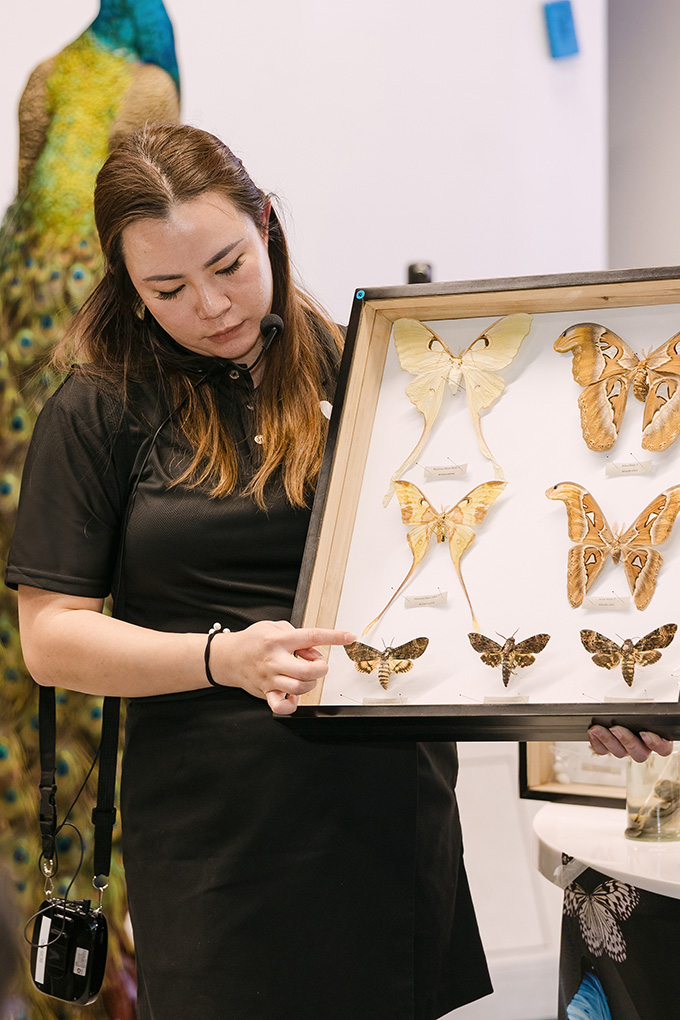
At Black Crow Taxidermy & Art (BCTA), death is rarely treated as the end. Instead, it becomes the building block of something new: skin, feather, fur, bones and memory shape creations that can be held, studied and remembered. With her expertise in zoology and histology, founder Vivian Tham, 32, marries science and art to preserve pets and animal specimens as the only commercial taxidermist in Singapore. From a minuscule fruit fly to a large horse, she believes all specimens are worth being preserved—no matter the size or species. Through her work, Tham captures how each specimen looked when alive, chronicling their lives for remembrance and appreciation.
Most of her work happens in an unassuming studio nestled within the industrial blocks of Sin Ming Lane. Step through BCTA’s doors into an otherworldly atelier where the specimens look as good as alive. Adorning the walls are framed collections of glistening beetle specimens pinned and encased in glass. In the corner, a majestic albino peacock perches, feathers perfectly kempt. In a chest of drawers sit trusty tools beside a tray of butterfly wings, awaiting to be embedded in resin for Tham’s next jewellery workshop.
Thin as paper and just as fragile, the stray wings were donated to her by butterfly farms and would have otherwise been discarded. Tham says BCTA follows a strict ‘no kill, no catch’ policy, and she only works on animal specimens that died naturally or were found as roadkill. “We also work together with various societies here, such as the Herpetological Society of Singapore, where we can verify that the animals are not endangered or illegal,” she adds.

In the back is where the magic happens—the workspace where Tham preserves and mounts the pets that have passed for their owners’ remembrance. Her latest work reunited a pet parent with her beloved golden retriever. While the chemical treatment of a small pet like a hamster might take a day, Tham took weeks to process the dog’s body and pose it according to the owner’s instructions.
Typically, animal specimens mounted for scientific study would only need to have their anatomy or physical characteristics presented correctly, but Tham says preserving pets requires a keen eye for the little quirks and features that owners know intimately, such as tilted ears or uneven eyes. To capture the pet as accurately as possible, she consults owners to understand the animal’s personality and studies photographs to identify the little mannerisms that made them unique. “When I first started, it was quite hard to actually capture how they look,” Tham admits. “But I learnt a lot along the way.”
Although the process can take months, Tham believes it’s well worth it when owners can see beyond the preserved physicality and recognise their pet’s intangible personality within her work. “When an owner looks at the finished piece and starts telling us a story about their pet, or remembers something that the piece brings back to them, that is a very meaningful moment for us,” she says.


But dealing with death and grief regularly means Tham, a pet parent herself, has to maintain emotional boundaries, being careful to not let each death affect her too much, without also becoming desensitised. “We try to approach every animal with respect and professionalism, while remembering that the grief ultimately belongs to the owner and their family,” explains Tham. “We can empathise with them, but we cannot carry every loss personally.”
While pet preservation calls for Tham to produce a sort of replica, her other taxidermy projects let her creativity take centre stage. She follows a routine procedure: study a specimen to observe its natural behaviour, anatomy and characteristics, choose a preservation method, begin the chemical preservation process and decide on an appropriate pose before finally mounting it. This time, however, Tham goes beyond technical considerations. “We also consider the story we want the piece to tell,” she elucidates. “A specimen can be technically perfect, but if the pose feels unnatural or lacks a sense of movement and personality, it doesn’t necessarily work as a piece of art.”

Beyond traditional taxidermy, where specimens are preserved, stuffed and mounted, Tham also practises other methods of animal preservation. This includes skeletal preservation where a specimen’s bones are cleaned, organised and reassembled into a complete, anatomically correct skeleton that mimics the animal’s natural posture. One of her works, a skeletal articulation of a python, was displayed as part of Dutch fashion designer Iris van Herpen’s Sculpting the Senses exhibition at the ArtScience Museum last year.
Tham has also received requests from museums for bespoke pieces and educational workshops. For one of National Gallery Singapore’s SG60 installations, Tham took a bold, artistic risk to produce a hybrid taxidermy piece named Coralia, using locally and ethically sourced animal remains to reimagine the little red dot’s emblematic Merlion.

With these organisations taking notice of Tham’s practice and introducing BCTA to a larger audience, she says more people are gaining a deeper understanding of taxidermy and recognising the craft as a legitimate expression of art, beyond mere preservation. But she divulges that it hasn’t always been an easy journey. At the start of BCTA, when public understanding of taxidermy was still lacking, Tham had to navigate and dispel misconceptions that her practice promoted animal cruelty, as people conflated taxidermy with trophy hunting. “The biggest difference between practising taxidermy here in Singapore and overseas is that there is no hunting involved here,” she explains. “Overseas, you may find ‘trophy mounts’. Here, everything is donated, and we don’t kill anything here for the craft.”

According to Tham, this perception is, slowly, but surely changing. As the public gains a deeper understanding of taxidermy, she sees an uptick in people interested in learning more about the craft. Within herself, years practising taxidermy have cultivated a profound appreciation for nature’s beauty. “Things that I may have overlooked before suddenly become incredibly interesting—the subtle variation in feathers, the structure of an insect’s wings, or the way light interacts with an animal’s coat.”

Spurred by the changing tide, Tham has her eyes set on opening a miniature museum next. With taxidermy being a craft in which art, science and nature converge, she envisions an immersive space with naturalistic dioramas and interactive displays, where visitors can step into these three worlds at once. Rather than presenting specimens in isolation, Tham wants visitors to see animals in their natural elements and understand how they exist within an ecosystem.
Ultimately, she wants her work to inspire curiosity and a deeper respect for nature. When people see the specimens not as objects or decoration, but as lived beings with stories to learn from, Tham’s goal will be achieved.