“I’m trying to recolonise what I’ve lost. What they take from us, we take them back. Whether that is the furniture or the place. I redesign to recolonise. For example, a lot of the things around here are in Malay or Jawi, instead of Latin,” says local artist Johann M. Fauzi.
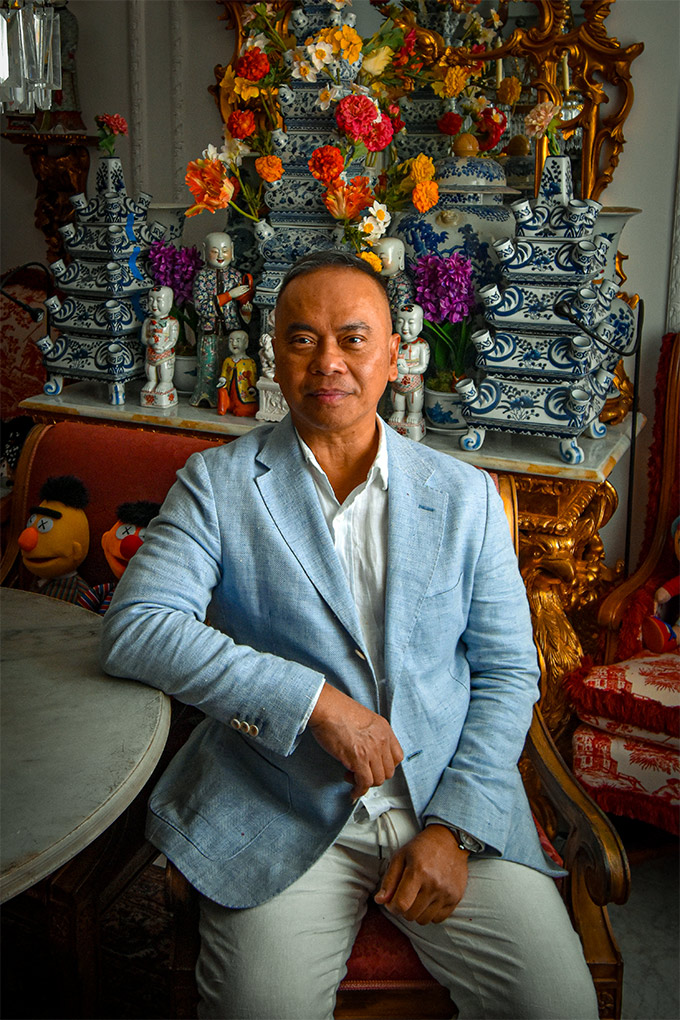
Like most days in Singapore, it was a hot afternoon in Bedok when I arrived at this particular HDB complex; the sun beating down on my back as I was confronted with rows upon rows of neutral buildings. Inside one such dwelling is Johann M. Fauzi’s studio, where he has converted his HDB flat into an opulent Rococo-style apartment filled to the masses, brimming with porcelain, gold, and more ceramics spanning the 13th to 19th centuries. But look closer, and you’ll find Fauzi’s own artworks embedded within every crevice of these collected works; in addition to Fauzi’s alterations to the sculptures, to interject and write his own meaning, what he calls his “interventions” to the colonial pieces.

The Singaporean artist-collector’s work explicitly adheres to Gesamtkunstwerk: a cross-medium practice involving ceramics, painting, collection, and more, rather than committing to a single discipline. Though Fauzi tells me he only became an “actual artist” when he was 50, after his parents passed away, his collection has been a long time coming, having started when he working in Australia in the 90s. “It’s where all my pocket money went,” he quips.

There is nothing out of the ordinary if one were to chance upon his flat—in fact, even when entering his apartment, the vast majority of it is enclosed behind a curtain. Every window is covered, barring even a glimpse as to what is going on inside his apartment.
Enter, and you are quite literally crossing the boundary into Fauzi’s mind. When I arrived at Fauzi’s HDB flat last August, he serves rhubarb pie and a cup of tea. It’s easy to get lost in time here, with no clocks, no screens, no windows, or any semblance of time. “[When my friends come,] we just talk. There’s no TV, no radio. I only play music. They don’t check their phone. Time just stands still here,” says Fauzi. “Sometimes I make seafood. I put the seafood in my sculptures, just for the fun of it. For pleasure, to amuse myself. When you have it, you flaunt it, right?” Rather than treating the collected pieces as delicate decor, Fauzi is using them to his own means.

Fauzi’s work is based on the appropriation and re-transformation of Western art idioms, to reflect the colonial legacies of Malay-speaking Southeast Asia; with his collection spanning 13th to 19th century art. And yet, with each elaborate tapestry and colonial sculpture, they have been altered with Fauzi’s “interventions”—appropriating colonial motifs to his own means, and placing new meaning on the legacies imposed upon him.
Both the HDB flat and the commercial gallery can be understood as publicly accessible spaces, albeit governed by very different structures and agendas. By purposefully placing his work between these two places of “public”, Fauzi creates a scene that is not meant to be seen, but experienced. I asked Fauzi what his plans were for the studio tour. “Nothing much,” he laughs. “My partner and I are buying takeaway, canapés to share. Let everyone explore and they can ask me questions on whatever intrigues them.” Unlike colonial legacies past, information is not force fed to the guests, but an invitation to probe and question what is real and what is not.


When researching Fauzi’s work, I chanced upon a panel with author Viet Thanh Nguyen speaking adjacent to the subject for Hay Festival Global: “One of the interesting things happening today, I think, is this realisation that, in fact, we’re not post-colonial.” Fauzi is the living, breathing epitome of that statement, as immersed in the colonial in his upbringing as he is in his practice—and today, is still negotiating with that tension, and deciding the narrative of what that means for himself. “I’ve even unknowingly collected colonial items which I’m not aware of,” says Fauzi.
Now, Fauzi is opening his HDB flat to the public, with studio visits as part of Singapore Gallery Month. The public and private are often juxtaposed politically—and the HDB flat is one of the most visible material expressions of Singapore’s social and political projects to lessen this gap. In turn, Fauzi has chosen to negotiate the tension between the colonial and the independent, and the meaning of still living in a colonial era—through the very neutral setting of a HDB flat.


Just recently, Fauzi showed his works at the Venice Biennale in May 2026, and is now preparing for a solo exhibition at Gillman Barracks in 2028. Stacks upon stacks of Louis Vuitton boxes crowd the entrance of the flat. I ask him what they are for. “You’ll see,” he says. “I’m going to make sculptures centred around consumerism.”


Look closer, and you will see that all the flowers and animals in the seemingly opulent Baroque and Rococo-inspired household have all been replaced by Fauzi’s interventions—whether that be painting over the tapestries, or sculpting it himself—with those native to the Southeast Asian region. Water apples, guavas, ylang ylang, tuber roses, blue pea flowers, and Malay Baron butterflies are injected into the space. “The setting of my [HDB flat] is like an English country house. But when you look closely, all the objects are Asian. The flowers, the animals. Even the colours of my paintings follow Dutch still life paintings—but the flowers are Asian.”


Fauzi’s own family was part of the colonial trauma and legacy. “My grandparents are from Central Java, Surabaya Central—in the thick of the action during the Dutch colonial war,” muses Fauzi. “My grandparents told me a lot of stories. When we were younger we didn’t feel the colonisation, we didn’t experience it; but indirectly we were colonised, too. Practically every country in this region has been colonised, and there’s so much material for me to use.”
Malaysia—or, as it was known then, Malaya—had an international reputation for gold. It is no coincidence that this material also plays a significant role in Baroque and Rococo aesthetics, which also inform Fauzi’s space-building. Fauzi gilds almost everything in sight—the vases, the frames, the surroundings of the objects he collects and sculpts. “The rich, back then, invested in the VOC (Dutch East India Company, a Dutch trading corporation that controlled major parts of Indonesia from 1602 to 1799)—and they would take our gold to Europe, to decorate their country houses. My work is reclaiming this gold, and the wealth that has been ripped from my country,” says Fauzi. But he never gilds the flowers, or the animals, or other objects of life seen in the scene—it is always the vases and frames that they are encased in. “It’s to represent, basically, how we are trapped,” says Fauzi.


As part of the “recolonisation” of these works, Fauzi even made his own family crest, which appears on all the frames and furniture in the HDB flat. Based on the Dutch clan of Valckenier, active between 1737 to 1741, they are remembered today primarily for their role in the 1740 Batavia massacre, in which Dutch East India Company soldiers killed thousands of ethnic Chinese residents of the city, present-day Jakarta. Though the arms of the Valckenier family are adapted to his crest, his meaning is “completely different.” The eagle in the Valckenier arms has been replaced by a dove, a universal token of peace; the green crescent moon signifies Islam; and hibiscus blooms reference Malaysia’s national flower, or bunga raya.


As part of the crest, Fauzi has inscribed a Malay saying: kata itu kota, that translates to “a word is a city”: an exhortation to keep one’s promises. “Kata itu kota means whatever you say, right? You must make it to a city. From when I was young, before I went to university, I told myself, I want to work on this. By my 30s, 40s, I was asking myself, how can I make art full-time? My parents were against me becoming an artist, saying I couldn’t feed myself. When you’re young, it’s just a dream. But when you focus, when you give it your word, things will fall in place.” I asked him what his dreams are now. “Maybe a supermodel,” he laughs.
Follow Singapore Gallery Month and Art Galleries Association Singapore for more details and art events happening in Singapore.