We are sitting in a black-walled auditorium inside the Arts House, one of Singapore’s oldest colonial-era buildings. ArunDitha strides into the centre with a slim volume in her hand. She steps up to a mic and shuts her eyes momentarily, then takes a deep breath, audible through the crackle of the mic and over the pin-drop silence that has descended over the room.
She begins: “My body is a monster built from disassociation; hand from elsewhere stitched onto forearm. Clavicle buried so deep in my ribs, it scrambles to recall the sharp edge of its length; feathered wing protruding off sylphlike soldiers.”
I look around to see that a transformative energy has filled the air. Audience members are transfixed, some staring meditatively towards the ceiling or the ground, some looking straight at the slam poet herself as the pitch of her voice reaches a crescendo, juxtaposed with a looping backdrop of hypnotic vocal effects she recorded live before our very eyes.
This is our introduction to Rib/cage, the first collection from Singapore’s newest literary publisher, Afterimage. As the publishing arm of the literary non-profit Sing Lit Station, the press describes its mandate to support “impactful and efflorescent work that extends and renders anew the country’s rich literary lineage”. As I sit through its launch event, which takes the form of an electrically-charged night of spoken word poetry, the word ‘lineage’ pops into my head more than once.

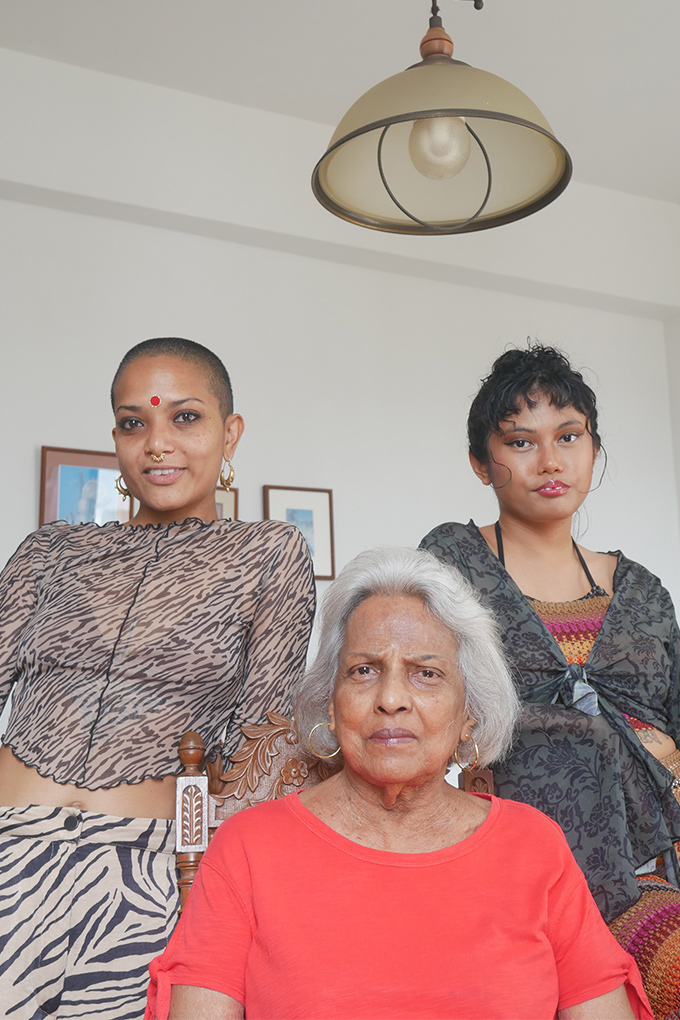
The poets featured in Rib/cage span several generations. The youngest of the three—making their debut in print—is 25-year-old Zeha, a non-binary, multi-disciplinary artist whose experimental poetry bends form and genre as easily as it does language. Zeha’s work is placed alongside that of ArunDitha, a world-travelled performance poet whose words explode with the force of nature; and 89-year-old Rosaly Puthucheary, a former teacher of English Literature and one of Singapore’s most valuable poetic pioneers.
A first leaf through the collection makes it apparent that the three poets each have their individual gifts and merits—abundant and undeniable. But where Rib/cage truly bursts to life is in the conversation that develops between the works. Penned decades apart by different hands and against vastly disparate backgrounds, there is something almost divine about the way the poems slot together—not quite puzzle pieces, but like layers of oil paint swiped onto canvas: brushing up together, cutting into each other’s path, mixing together to create something wholly new. It is staggering to realise that while the poets themselves might not have crossed paths till now, their words have been dancing together in the ether all this time.
“Reading this folio is an act of time-travel,” muses Zeha. “I wonder a lot about struggles that are universal and timeless. In this body of work, we are having a conversation, through poems, about topics that are difficult. These poems do not just complement each other but they also contrast, which I think is a very honest representation of what conversations between different generations can look like.”
“These poems do not just complement each other but they also contrast, which is an honest representation of what conversations between different generations can look like”
“It blows my mind that we wrote these lines, some of them decades apart, but the images from our hearts know each other with such a deep and timeless resonance,” says ArunDitha. “Seeing how beautifully our pieces dance with one another makes me feel more confident that I am part of a voice much larger than my own—the echo of diaspora and the sound of a collective alienation.”
One of Rib/cage’s most noteworthy accomplishments lies in catalysing the rediscovery of Puthucheary’s work, especially to a new generation of readers. While she has been putting pen to paper over five decades, with 15 published titles across poetry and prose to her name, Rib/cage still manages to mark several firsts—the first time her work is being anthologised beside two other poets; and her first time doing a live reading, to a mesmerised audience at the collection’s launch event.
She grips the mic with one hand and holds the book open with the other, reading out loud from a poem titled ‘Future’. By the closing stanza, Puthucheary’s eyes have filled with tears, mirroring many in the audience—including myself—barely stifling sobs. “I sit emptied of belongings in the nakedness of new birth,” she reads, voice wavering slightly. “With a suitcase of longings, I face the rooms of the future.”

Puthucheary tells me that much of the inspiration behind her earliest pieces of writing came from her divorce, a tumultuous period in her life which left her grasping for a creative outlet. The first poem she ever wrote, however, was not about her marriage. “I was about 15,” she recalls. “I had a friend—one of my classmates. We used to go for walks outside of the classroom and we used to talk a lot. Then suddenly, one day, she stopped talking to me and I had no idea why. So, I decided to write.”
“At first, I thought that I was writing a letter. My brother looked at what I had written and he noticed this phrase: “tired, my tongue tied in a knot”. That was when he said that what I was writing was actually poetry.”
In Rib/cage, a series of Puthucheary’s most visceral poems about her marriage and divorce comes right after a piece from ArunDitha titled ‘Storm’—the latter written about the domestic violence the slam poet witnessed as a child in her parents’ relationship. The poem’s arrangement beside Puthucheary’s work creates a cosmic moment of emotion, dialling up its already searing impact, and that of every poem in its vicinity.
“Every thought, every feeling, every existence is inexorably interconnected whether we choose to see it or not”
“I wrote ‘The Storm’ over 12 years ago when my mother was still alive, and it was driven by a need to exorcise the demon of domestic violence from my memory, from where I have carried it in my chest since the days of early childhood,” says ArunDitha.
“The conversation [between the poems] is a ripple across lifetimes and timelines, which demonstrates a deeper truth I believe from my spiritual core,” she reflects. “Every thought, every feeling, every existence is inexorably interconnected whether we choose to see it or not. Rib/cage allows the reader an opportunity to witness and touch this reality in many moments.”
Zeha, who went through their whole archive for the making of the collection—”even works that I wrote when I was 14 or 15 years old!”—describes the experience of seeing older work in new light once recontextualised in the collection,
“In the process of editing ‘Trapdoors’, which I wrote when I was 14, I realised that when it was placed right beside ArunDitha’s ‘Unidentifiable Object’ and then Rosaly’s ‘The Nightmare’, it did not feel so childish anymore. Instead, it felt like a necessary entry point into the subsequent poems.”
They conclude, giving voice to the powerful intention the collection fulfils: “Our poems are positioned to intertwine, to give strength and take some away as well. It is a privilege to witness the souls of women who have gone through so much more than me. I see my future, my present and my past within this folio.”