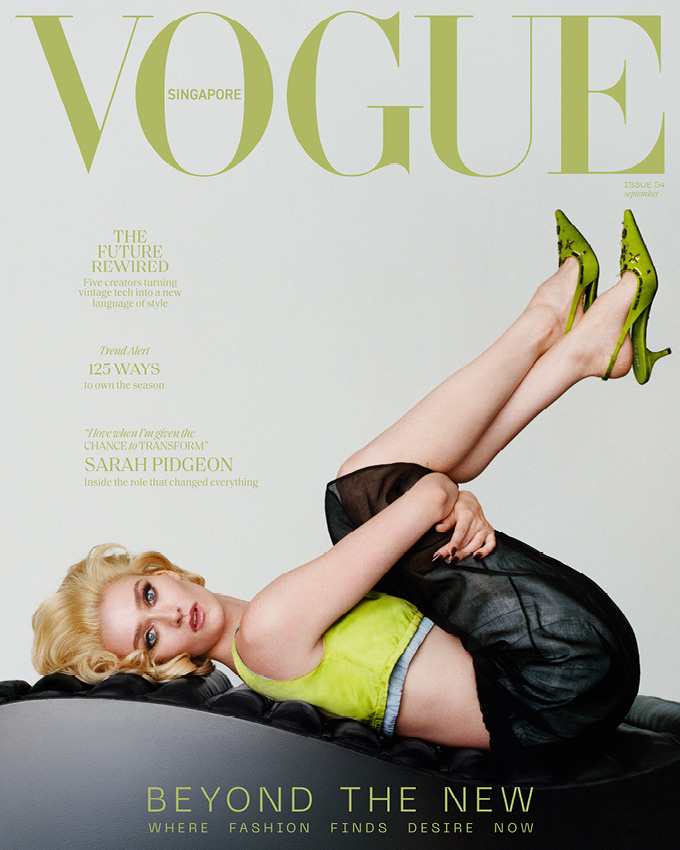
Few actresses have attracted as much attention in recent months as Sarah Pidgeon. At 30, the American actress is entering a defining new phase of her career with Love Story: John F. Kennedy Jr. & Carolyn Bessette, the nine-part drama created by Connor Hines and executive-produced by Ryan Murphy. Best known for The Wilds and Tiny Beautiful Things, Pidgeon takes on the formidable task of portraying Carolyn, whose marriage to John transformed her from a respected Calvin Klein publicist into one of the most closely watched women in the US.
Opposite Paul Anthony Kelly as John, Pidgeon traces Carolyn’s journey from the creative world of Calvin Klein to the increasingly claustrophobic reality of life within the Kennedy orbit. The series examines the intensity of their attraction alongside the pressures of fame, family legacy and relentless press attention.

The scrutiny began long before the series premiered. Early images sparked debate over Pidgeon’s hair, wardrobe and resemblance to Carolyn, revealing how firmly the latter remains embedded in the cultural imagination. Her precise tailoring, muted palette and instinctive rejection of excess continue to shape perceptions of ’90s minimalism decades later.
Pidgeon’s performance, however, moves beyond the recreation of a familiar wardrobe. She approaches Carolyn as a woman whose composure functioned as both power and protection, someone self-possessed and exacting who became increasingly aware that every small move could be interpreted by the public. The role offered Pidgeon the chance to explore the person behind the photographs and the mythology surrounding the Kennedy name.
Now back home in Michigan with family and friends, Pidgeon is attempting to make sense of a chapter that has accelerated both her career and public profile. Here, she reflects on the early experiences that led her to acting, the projects that shaped her and the lasting impression she hopes to leave through her work.

Hi Sarah, thank you so much for joining us. Many actors can trace their careers back to one defining experience as a child. What were those formative moments that ultimately set you on this path?
Acting in plays was how I spent my summers. That turned into my hobby and then something I decided to pursue at arts school. I somehow always ended up performing and liked to entertain people. Throughout grade school and middle school, I’d receive bad marks for talking and distracting students during class. When we finally got to public speaking, I couldn’t wait to get up and debate and orate and tell a story to an audience that was required to pay attention to me. And I couldn’t wrap my head around why some students hated it. Maybe it was my early exposure to being in front of people, but I had an underlying need and desire to try and hold someone’s attention. And hopefully impact them in some way, change their mind or make them laugh. I also adore a costume. Who doesn’t love to dress up and become someone else for a moment?
Looking back, was there a moment when you realised acting was something you could genuinely build a career around?
I’m incredibly lucky that I grew up in artistic environments and my parents encouraged me to seek out those spaces. Because of that, I saw older students I respected pursue a degree and career in the arts. Some idea of a real ‘path’ appeared. I went into drama school with a desire to pay my bills with acting. Thanks to a lot of work, but also luck and good timing, things have been working out so far. But had it not panned out, the four years I spent at school were focused on stretching and expanding my imagination as wildly as possible.

Many people discovered you through The Wilds. Looking back now, what does that project mean to you?
The Wilds set an incredibly high bar at the very beginning of my career. At its heart, the show was about exploring the complexity of girlhood and I was fortunate to do that alongside such an extraordinary cast of women, with equally remarkable women leading the series: Sarah Streicher, Jamie Tarses and Amy Harris. Having that as my first long-term experience on a set shaped my expectations of what this industry could be. We had eight fully realised women at the centre of a story, each with her own perspective, and the creative team invited us to be true collaborators, and in turn, real advocates for us despite being so young and new to this industry. That’s a lesson I’ve carried with me into every project since.
Tiny Beautiful Things dealt with grief, family and growing up with extraordinary sensitivity. How did that experience shape you as an actor?
That project came on the heels of losing someone very close to me. I often draw on my own experiences to connect to the characters I’m playing. But that was the first time I played a character who had gone through something unimaginable for them and, in turn, I had to call upon my own experience with unimaginable pain and loss. While I don’t look at acting as a form of therapy, it can of course offer catharsis for myself and the audience. The added filter of playing a character allowed me to feel the extremes of that experience. I, Sarah, didn’t have to watch or analyse her feelings because who was Sarah to judge my exploration of Clare’s emotional experience? That’s one of the pieces I find most thrilling about acting, that through these characters I’m able to erase my own agreement to a social code of how Sarah behaves and responds and can live out every colour and hue of emotion while embodying someone else.

You’ve spoken before about being drawn to emotionally complex women. Is that something you actively seek out or do those roles naturally seem to find you?
It’s a bit of both. I find myself to be, for the most part, pretty even keeled, completely adverse to conflict, and pretty shy about saying what I actually think aloud. Reflecting on the characters I’ve played collectively, they have all expressed themselves either through dialogue or display of emotion, often in better ways than I could ever imagine myself doing.
Your filmography already spans coming-of-age dramas, literary adaptations and period pieces. What is it about a role that immediately captures your attention?
I think dialogue is what initially excites me most about a role. I love when I’m given the chance to transform physically and vocally, but that only works if the dialogue feels like it gets to the nut of whatever that character, however different from me, is feeling. The projects that excite me have a sense of specificity to them. The more granular something is, the more universal it becomes. I struggle with broad strokes. I like being able to read something with a very clear tone or point of view. I prefer material with a real spine instead of something that offers too much agency to create something that’s not immediately on the page. I feel most creative and inspired when I feel like my opinion can be just as strong as what I’m reading, whether it’s in conflict or harmony with the initial vision of the writer.

Every actor has their own process. What does yours look like from the moment you receive a script?
Apart from reading, then re-reading, then reading the script again, I don’t have a set way of preparing for a project. For Love Story, being asked to physically embody an iconic historical figure was something I knew I had to develop and allow myself the time to sit with so I could find comfort and a sense of second nature in. There was a period of deep and vast research before setting foot on set. While playing Diana in Stereophonic, I had to become a member of a rock band. The learning curve was steep — not only to learn the music, but understand what it’s like to play musically as an ensemble, as well as building the camaraderie as not only actors, but musicians in a band. I am excited by projects that challenge me to learn something new, whether that be a skill or perspective. I’ve found that if you are inspired by the project, it will be on your mind all the time. You will find inspiration in your every day. Someone’s walk, an incredible performance in a movie, a book you’re reading that’s completely unrelated to the project at hand. It’s sort of like dreaming—where your brain works out all the half-thought thoughts that you weren’t aware were swimming around in your head. I think that’s what my process is like, silently sort of humming in the background of everything I do.

Is there a role that challenged you more than you expected?
Despite growing up doing so much theatre, working on Stereophonic for such a long run required a level of endurance I hadn’t had to tap into before. Every performance asks you to return to the same emotional places with honesty, while also sustaining the vocal demands of the music. While there were many nights the show I knew so well felt meditative, live theatre still demands a sense of being present, and finding ways to prepare for a show that would allow me to operate in that place became the main way I spent my free time. So much real life happens over a year, and the daily practice of finding ways to leave that at the door in order to perform the version of the play we worked so hard to create was a discipline I hadn’t had to give much weight to in the past.
Has your relationship with acting changed as your career has grown or does it feel much the same as when you started?
I have more of a sense of how I’m perceived now as I’m becoming more recognisable but also as I’m getting older. When I become self-conscious, I try to quiet that voice. I’m making an effort to get closer to that sense of abandon and lack of judgment that I had growing up doing plays and at the beginning of my career. It’s so freeing when no one knows you and you have no expectation to meet.

What has this chapter of your life taught you about yourself, personally and professionally?
Personally, I’ve found a real longing to surround myself with friends and family and those that have known me for a long, long time. And while that was true before, this year has required me to be more public-facing in a way I’m not used to. It’s relaxing to be around people you have a shorthand with and who know you on a deeply personal level. Professionally, it’s been refreshing to realise that what people say is true: this business is very small. And people actually see the work you do. It has meant the world to me to be able to show up on a set and see a familiar face and feel like a real part of an artistic community.
Your latest projects continue that thread of emotionally layered storytelling. What conversations did you hope they would spark?
So much of my relation to a project is insular. It’s in the making of it and I always have a moment of surprise when I remember there will be an audience introduced to it one day. At a certain point it always becomes someone else’s. I have my own opinions and judgments of the circumstances my character finds themselves in and the projects as a whole but, as a performer, it’s important to me to focus on the story at hand, not anticipate what might come after. I want the work I’m doing to resonate with people, for them to be moved and changed or exposed to a slice of life or ideas they wouldn’t have had otherwise.
“You hope that some of the positive parts of all of the roles you take on stick with you, but this was a singular experience and one I don’t know that I’ll ever experience again.”
You’re now stepping into Love Story, a title that carries enormous cultural weight. What was your first reaction when you found out you had been cast?
Complete and total silence, brought on by shock. I understood the magnitude and weight that Carolyn’s legacy carries and I wanted to do her justice. I was understandably frightened and nervous about taking that on. But also motivated by the opportunity to try to understand who she was as much as anyone in this circumstance could. I have so much admiration for what she was able to accomplish and experience in her life, and to be able to have the chance to embody such a remarkable woman has been an incredible gift. You hope that some of the positive parts of all the roles you take on stick with you, but this was a singular experience and one I don’t know that I’ll ever experience again.

What about your character felt immediately relatable, or perhaps completely unfamiliar, to you?
Something that was definitively familiar was being a young twentysomething woman in New York. Portraying Carolyn’s early years at Calvin Klein were some of the most difficult to pin down energetically and physically because I had significantly less photos and videos to draw upon from that period of her life. But I intimately know the feeling of walking down the street in Manhattan with complete anonymity, abandon, a sense of possibility in the best city in the world. I know what it’s like navigating a new space and job while trying to figure out the version of myself I want to become.
Was there a particular scene in Love Story that stayed with you long after filming wrapped?
I find different scenes popping into my head all the time. I particularly loved filming Episode 8, which takes place entirely within their apartment. Our director, Jesse Peretz, had the idea to explore the passage of time through a series of vignettes of Carolyn at home. Finding new parts of the apartment we hadn’t seen before and finding different physicality to convey her sense of feeling trapped was a refreshing way to enter the headspace needed to start that episode. I also find the shots so beautiful, with so much stillness.

Romance can easily become sentimental on screen. What makes a love story feel believable to you?
Everything has the danger of becoming sentimental. I like to avoid a feeling of preciousness, trying to ground it in a real conflict versus an idea or mood. Sentimentality comes about when there’s nothing actually driving things forward and therefore it feels empty. For Love Story, our intention was to use their connection as the motivator, not the salve. In so many of the scenes, love was not the issue. Rather it was how that was communicated, how they decided to navigate the obstacles together, how love did not mean they automatically understood each other in those moments.
Every project leaves something behind. What do you think you’ll carry with you from Love Story?
Carolyn had a real sense of self. She knew who she was and didn’t apologise for it. You witness that in how she dressed. While wearing incredibly beautiful clothes, you still always see Carolyn first, which is part of why her style has remained so iconic throughout the years. It’s easy to copy the outfit formula but it’s near impossible to capture that aura. I hope I carry some of that self-possessiveness she had into my own life.
“Carolyn had a real sense of self. She knew who she was and didn’t apologise for it.”
How do you protect yourself emotionally after spending months inhabiting a character?
I don’t think I do. Showers always help at the end of a day to literally and figuratively wash the day away, but upon wrapping I don’t have a practice to extricate myself from whatever mindset I was in during the project. I’ve learnt that it’s less about separating myself from a character than it is about making space to return to myself. I’d like to think that the best qualities of the people I’ve played have rubbed off on me, that by inhabiting their lived experience my own has expanded. I don’t think the goal is to erase the experience or compartmentalise. I think it’s to let it become part of you and then keep living your own life.
Fashion is another form of storytelling. Has your relationship with style evolved as you’ve become more visible?
I’ve always thought of clothing as an essential part of storytelling. As an actor, wardrobe is often one of the first ways I begin to understand a character. The way someone dresses can reveal so much about who they are, how they want to be perceived and even what they’re trying to hide. When it comes to my own style, I think it’s something that’s constantly evolving. I don’t know that there’s ever an endpoint. When I look back at photos of myself from 10 years ago, I see someone with a very different understanding of herself and the clothes reflect that. They told a different story about the person wearing them. I imagine I’ll probably feel the same way looking back 10 years from now and I think that’s a good thing. Style should evolve as you do.

How would you describe your personal style today?
Right now I’m in jeans and an old T-shirt I found in the closet at my mum’s house. I tried to pack light this trip and only brought a carry-on. It’s fun to come back and find clothes I’ve seemingly forgotten about and didn’t like enough to bring with me to New York, but now I can’t believe I lived without them. It also smells like home and has some cat hair on it, so that’s an added bonus.
Finally, when you think about the next five years, what kinds of stories and what kind of artist do you hope to become?
I hope that the next five years are filled with a wild range of projects. That the choices I make don’t feel obvious, but thoughtful and surprising. My definition of success is to be in rooms with the people I admire, that I’m someone artists call when they want input on a script or be involved in a project. I hope to feel like a valued member of an artistic community that I find myself so lucky to be part of.
Photography Dan Beleiu
Styling Xander Ang
Hair Sonny Molina/Streeters
Make-up Francelle Daly/Bryant Artists
Manicure Danny Tavarez/Opus Beauty
Set design Jacob Burstein
Casting Jill Demling
Executive producer David Bay
Producers Lea Turco, Antonia Tedroff and Sheri Chiu
Production assistants Cade Halvorson, Diego Faucher and Justin Oceguera
Photographer’s assistant Marion Grand
Light director John Griffith
Stylist’s assistants Coco Li and Delphine Schowalter
Hair assistant Brooke Tokar
Make-up assistant Madrona Redhawk
Set assistant Cullen O’Grady