Few nations balance culture and craft as seamlessly as Japan. There, both concepts are intimate lovers. The quiet presence of one is never without the other. What sets Japan apart is the ongoing evolution of that relationship, strengthened and infused with new meaning almost daily. This arises not only from the enduring weight of its centuries‑old history and mythologies, but also from the assured, measured innovation of its youngest generations.
The latest example set by the artisans who call the Land of the Rising Sun home comes courtesy of one of Japan’s most famous exports: Hibiki whisky. The Japanese distiller, whose name roughly translates to ‘resonance’, is part of the expansive House of Suntory portfolio. Since 1989, it has staked its reputation on breathing new life into the cultural concept of wa, or harmony, through its approach to making whisky.

This creative vision was put to the test in its latest campaign, which united the disciplines of performance, material handiwork and whisky blending in a stunning video featuring actress Anna Sawai of Shōgun fame, the brand’s first global ambassador. In it, Sawai, dressed from head to toe in a one-of-a-kind kimono and holding a glinting, gold bottle of Japanese Harmony, utters: “The masterpiece of Japanese artistry.”
This whisky is the crux of this story and the reason for my recent trip to Kyoto, Japan, courtesy of the House of Suntory. For three days, in the company of nearly 30 participants, including a dozen members of the media from across Asia-Pacific, I came to understand why Japanese Harmony is considered Hibiki’s pride and joy. Within its liquid gold currents, I discerned a timeless tale of Japanese craftsmanship.

You most likely know what those words, ’Japanese craftsmanship’, signify: time patiently awaited, patience unwavering, and attention to detail of the most exquisite kind. Above all, they embody silence. In Japan, things are created not with a shout but with a whisper. Its artisans feel no need to proselytise, no need to proclaim their mastery from the rooftops. Their reputation for the elemental essence of craft precedes them, for it is woven into the culture itself. In Kyoto, I witnessed this truth through a threefold silence, born of a rare calibre of craftsmanship that speaks for itself.
I visited the gallery of Chiso, Japan’s oldest family‑run kimono house. I listened to washi paper artist Eriko Horiki. I toured the vast inner halls of the nearby Yamazaki distillery and interviewed the House of Suntory’s chief blender, Shinji Fukuyo. Through each quietly powerful encounter, I (and my liver) came to appreciate the extraordinary depths of whisky blending. Most importantly, I discovered how seemingly disparate disciplines are carefully and lovingly woven together in harmony to celebrate Hibiki’s finest. Admittedly, I had high expectations, yet they were swiftly surpassed from the outset, starting with my visit to Chiso kimono house.
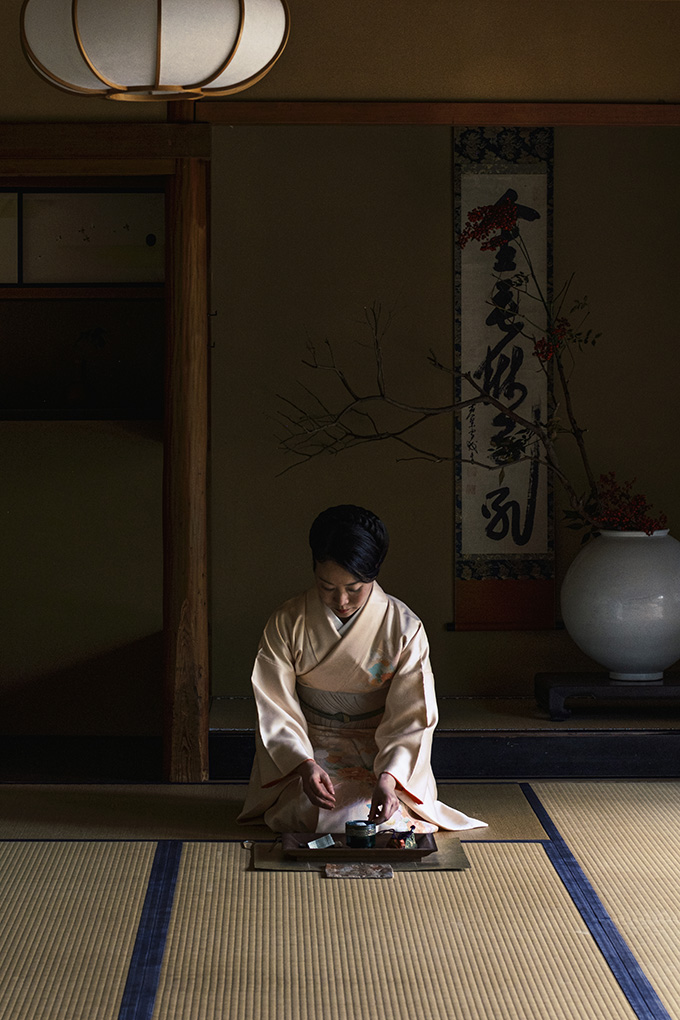
Perhaps more than any other part of the trip, the morning of my first day was a reminder of the hushed power of history writ large, beginning, fittingly, with an exercise in stillness—a kōdō incense ceremony conducted in the heart of Kyoto’s Philosopher’s Path. Afterwards, at the kimono house, I came face to face with history. As it turns out, Chiso has remained on the same plot of land since 1555, long before the city ceased to be Japan’s capital.

For close to 470 years, the family has drawn from the same well of refined miyabi, or elegance, to produce their kimonos. Many take over a year to make, the latest evidence of this time-honoured practice being the one-of-a-kind piece worn by Sawai in Hibiki’s campaign. Every square centimetre of its lush white fabric is based on an archival design based on Chiso’s storied past. Like all its pieces, the kimono is the product of hundreds of specialised artisans working in close concert, and a platform for Chiso’s world-renowned, utterly time-consuming kyo-yuzen hand-dyeing technique to shine.
While unique aesthetic choices, like the inclusion of a delicate purple butterfly, a key motif in the campaign, places the kimono in modern territory, the whole piece was clearly drafted with a patience cultivated from centuries of tradition. The past, giving birth to vivid life in the present (and knowing the quality of Chiso’s garments, well into the future). But what of the bottle held by Sawai? On that front, Hibiki has Horiki to thank, her eye for innovation a welcome complement to Chiso’s long-standing practice.

In Horiki’s gallery, the scintillating fibres of vast, metres-tall sample paper sheets indicated we were in the presence of another master of their craft. Her art is used as the label adorning each bottle of Japanese Harmony and, like her work, the artist bucks convention. A former banker, she was introduced to washimaking much later in life. Per tradition (and this tradition dates back over 1,300 years), washi paper is typically made with white fibres, a symbol of purity. However, Horiki chose to stand out from the crowd by embracing innovation through the implementation of dyed fibres and unconventional materials.
Two things can be true: craft can be moulded by tradition; but it can also be resisted, inverted and played with. Horiki and her team use manually operated cranes and mounting boards to drive their painstakingly precise artistry, removing individual air bubbles by hand, one by one, so as to preserve the integrity of their work.

At the same time, Horiki relies on the very droplets of water that traditionalists would deem anathema to washi in order to intentionally create holes in the fabric and give birth to riveting new designs. This mindset, paired with a self-assured relationship with the organic chaos of nature—the whims of time, water and air—helps place her art in a rarefied space. With regard to the latter, Horiki is adamant: “Unpredictability is important. It would be arrogant for me to try to control everything. If I did, my work would be very boring.”
The third and final point of silence that took shape during my trip was, of course, Hibiki. Harmony made manifest, literally. For this, I had the privilege of not just touring the Yamazaki distillery, but also of interviewing Fukuyo, its chief blender. The fifth person to assume this distinguished mantle, Fukuyo is a man of few words, but a finely attuned palate and discerning eye for craft, shaped by a wealth of experience, more than justify the esteem of his role.

“Quality takes precedence above all else,” he declares. “The blender serves as the final guardian of that quality, bearing the responsibility of delivering the finest possible whisky to consumers. That sense of pride and duty does not waver, regardless of the times.”
A bold claim, to be sure, but this commitment to excellence is undoubtedly Suntory’s lifeblood. Not a single detail is left unattended in its process, which is rooted in aesthetics unique to the nation. As Fukuyo explains, the country’s water, craft traditions and climate are indispensable components of whisky making, which together embody what he describes as a “consciousness of Japanese beauty”.
When it comes to craft, however, true beauty is hard-fought. You do not live and breathe whisky for over four decades without arriving at the truth of this reality. Fukuyo insists: “Being a blender is not so much a ‘calling’ with a clearly defined goal from the outset, but rather a role that is gradually shaped and cultivated over time.” The proof is in the pudding.

The man has spent two-thirds of his life in the single-minded pursuit of perfection, even going so far as to change his diet in order to accommodate the 200 tastings he undertakes each day. It almost seems too good to be true. But such is the Japanese culture and their approach to craft: time, patience and detail. Rinse and repeat.
I saw the factors in his visionary equation come to life firsthand as I walked through the halls of the Yamazaki distillery. All the infinitesimal minutiae of whisky making, from malt and mash to fermentation and distillation, opened my eyes to a frankly ridiculous calculus made possible only through countless years of hard work. By the end of my time there, it was clear all the myriad facets of whisky were as Fukuyo claimed: sacrosanct.

Funnily enough, the chief blender admits that the sentiment behind Hibiki’s namesake is difficult to pin down. Resonance, after all, may mean different things to different people. Instead, he likens the blended whisky to poetry, much more than the sum of its constituent parts and beautiful precisely because of its lack of specificity. According to Fukuyo, it is only after the various whiskies are brought together in the blend does the product “gain a greater sense of completeness, and any unnecessary elements are gradually stripped away. In that state, there emerges a sense of ‘finish’ and ‘space’ that cannot be fully explained in words.” Simply put: let the whisky do the talking.
Today, most corporate ventures would derive a product’s viability from its quantifiability—its value must be measured, counted and rigidly articulated in order for it to hold any worth. Heaven forbid anything stops the line from going up. But what does it matter if there is no beauty in the process? Thankfully, there are some who think differently.

Chiso, Horiki, Suntory and Fukuyo. On their own, the singular purpose with which they pursue craft is nothing short of remarkable. Taken together, though, with a spirit of mindful silence and open gratitude for the story they have to tell, something else emerges entirely. Culture and craft, as one. Hibiki: a masterpiece of Japanese artistry, indeed.
The July/August 2026 ‘Audacity’ edition of Vogue Singapore is available online and on newsstands.