Olivia Rodrigo, Chappell Roan, Rosalía. If you’re not living under a rock, there’s a good chance you’ve heard of these pop icons, who sell out stadiums with earworm-inducing tracks that dominate streaming platforms as much as they do the cultural zeitgeist. They are also solo artists—marking a profound shift in the fabric of female singer-songwriters in the 21st century.
But for every Taylor Swift or Laufey out there, there are countless artists who don’t enjoy the benefits of a ravenous fanbase or billions of streams online. These are the musicians working in the background, putting their nose to the grindstone to create art that’s as meaningful as it is underrated. Their efforts are no less deserving of your time and energy.
First things first, though: what does ‘singer-songwriter’ even mean in 2026? Simply put, it describes musicians who write and perform their own work. At the turn of the century, as music’s celestial body began its slow descent across the event horizon of dying radio waves and MTV, the term might have applied to artists like Jason Mraz, Jack Johnson and Iron & Wine. Rewind further, and you arrive at the prototypical ‘white guy with a guitar’, albeit with greats such as Bruce Springsteen and James Taylor.
Now, it’s anyone’s game. Do you sing? Do you write songs? Well, then, you’re a singer-songwriter. The folksy formula of days long past has been forced to evolve with the times—the genre is no longer stuck within the confines of soulful warbling accompanied by the gentle strumming of acoustic guitars. And, crucially, both whiteness and maleness are no longer prerequisites for success.

New slices of the singer-songwriter pie are cropping up daily. Thunderously glacial shoegaze filtered through used MIDI keyboards bought off eBay (see Della Zyr from South Korea). Gridlocked electronic production forged in the mathematical crucible of digital audio workstations like Ableton (see Wu Zhuoling from China). The tried-and-true classic of ‘guitar plus vocals’ still looms large, too, but new generations are carrying that torch forward with a regional flair (see Fazerdaze from New Zealand). Unfortunately, despite the wealth of talent on display today, the hard work of making music remains an uphill battle for everyone.
The great myth of the modern age is that social media has placed the podium of success within everyone’s reach. Alas, the truth is far stranger—and far more unforgiving—than this fiction. When all is said and done, we all need to eat; we all need a roof over our heads. And if you’re going solo, then you need to grapple with marketing and outreach, administration and logistics.
Therein lies the crux of the issue: how does one make a living as a solo musician? Genuine, creative self-expression isn’t always enough to put food on the table, especially when the price of living continues to skyrocket. You could work your creative muscles down to the bone, but if you don’t get that record deal, if you don’t properly manage tour costs, if you don’t catch your break, what then?

What happens to the calling when it no longer provides material relief? Is authentic artistry even feasible in a world actively being consumed by the gaping maw of the oligarchy? Many would say the endeavour would be a thankless fool’s errand. But music, like all art, is a pursuit of passion. To those truly invested in the practice, the value of millions pales in comparison to a life well-lived—to small satisfactions like a song sung well.
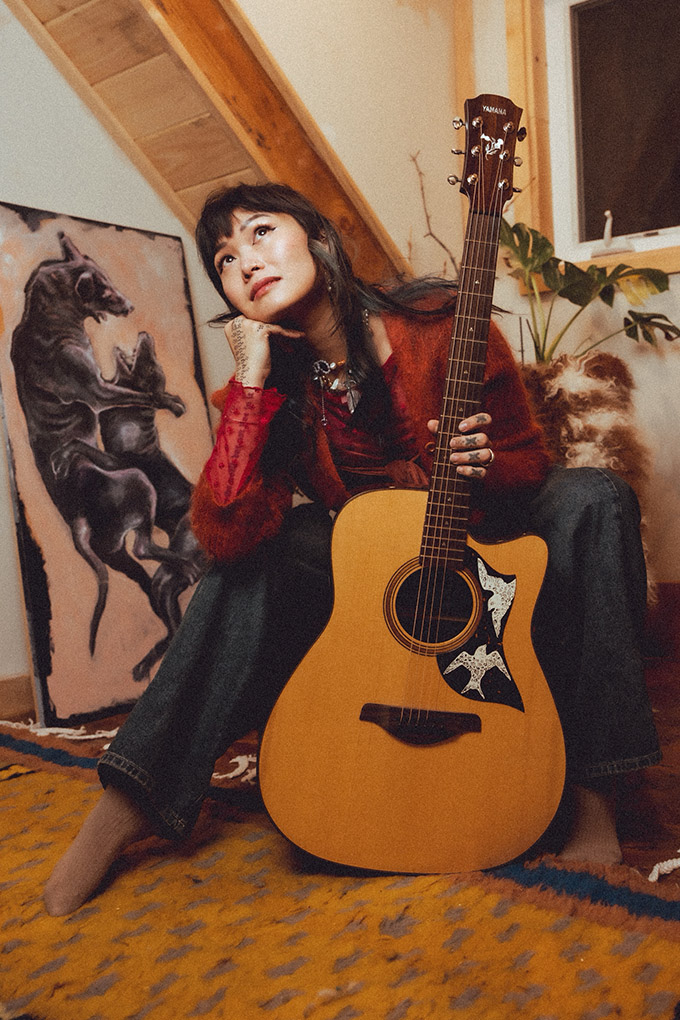
For your consideration on this front, dear reader, I present to you: Yvette Young. She is one of the artists who would argue that pursuing music today is still, in fact, possible. In the face of a world that pulls no punches, she knows what it takes to remain herself, boldly and unapologetically. Why should it matter if corporate culture refuses you entrance to its rat race? Success, defined by modern metrics, be damned.
Young was named the 155th greatest guitarist of all time by Rolling Stone in 2023. However, the Chinese multi-instrumentalist from San Jose, California, shreds a little differently than Steve Vai or Yngwie Malmsteen—think more tapping math rock, less screaming heavy metal. When she’s not rocking out on stage with her band Covet, she’s embracing the quieter side of singing and songwriting, juggling piano, violin and guitar at home.

I spoke with Young to get a closer look at what makes the singer-songwriter clock tick—and how the role continues to evolve in an ever-changing musical landscape. Read on for her perspectives on everything from the shifting dynamics of the singer-songwriter and social media’s impact on the art form to the importance of solidarity in supporting artists, as well as the state of Asian representation in the industry today.
On her creative journey
My parents pushed me to play piano and violin as a kid, and I hated practicing and competing to the extent that I developed an eating disorder. When I was in hospital, I got an acoustic guitar to play with, which ended up being instrumental in my recovery (no pun intended!). That was my gateway back. It helped me discover my voice and have some control over my life. I owe my life to it. I no longer hate playing music, but I am extremely resistant to anything that reeks of competition. You can’t quantify how good music is because it’s so subjective. When you create from a truly authentic place, that process is priceless. As a classical musician, I used to have so much anxiety around performing, because I thought it needed to be perfect. Now I realise perfect is boring—it’s all about a transference of energy with the audience. Some of my best shows have been when things have gone wrong, I showed a moment of humanity and then recovered.
On her love for music
Music with lyrics can tell you how to feel, but instrumental music listens to you—it lets you self-reflect. But both are powerful because they are a vehicle for empathy, transporting you to a place, time or emotional state. Music also has the power to heal and is an incredible universal language. After all, I am only here today because I found music as my outlet. When I create that feeling I’ve been chasing in my mind, it feels euphoric. It’s like falling in love. All these years later, the creative process still feels so mysterious and magical.
On the term ‘singer-songwriter’
A singer-songwriter is anyone who uses their voice to create original music. If you love to sing, you are a singer. If you love playing guitar, you are a guitarist. If you take joy in imagining and executing concepts, you are a creative. I used to feel shy singing and leaned heavily on instrumental music, calling myself just a songwriter. However, following my own advice, I should be more confident calling myself a singer-songwriter, especially since I employ vocals in much of my recent work.

On her sound
Initially, I felt pressured to be someone I wasn’t, to be more virtuosic or flashy in my playing. But the longer I’ve been in the industry, I realise what I truly value in music: the emotional aspect of it, the way it can uplift people. That’s my North Star. I like that people can listen to my music and tell that it’s me, my voice. Whether intentional or not, the way I approach music is a byproduct of me trying to protect my love for what I do. It’s important that I don’t ‘people-please’ with my art. Honestly, I’m so bad at doing things I’m not genuinely invested in emotionally, so I have to find a way to truly be myself in all that I do, even if it is for a bigger purpose (like when I wrote the guitar tracks for last year’s Superman movie).
On material solidarity
Our attention-based economy—fueled by algorithms, filtered through the lens of capitalism—has decimated people’s ability to take time with their art. It’s only gotten more demoralising with AI, simultaneously diluting and competing with human-made art. So buy music, buy merch, go to shows, form local communities. That’s how artists can make a living, and afford time to experiment and grow. It’s important to not be successful sometimes, because that’s what builds character. Depth, imperfection, struggle—that’s what makes art diverse and profound. Don’t be afraid to slow down, too. Taking time in a fast-paced age, where the algorithm is hungry for content and rewards homogeneity—that is an act of rebellion!
On social media
I owe my whole career to social media. It’s funny, I was so resistant to it at first. I wanted it to die with MySpace. But then one of my videos on Instagram went viral, which got me endorsements and tours, which was crazy. I think you can utilise it in a healthy way. I use it to promote shows and track my own progress; it also lets me connect with other artists, which is one of the best things about it. But I try not to get too involved in the numbers part of it. This is probably tied to my aversion towards competition, but I don’t want to let the algorithm dictate my self-worth. I’ve turned off all likes and comments, and I don’t let myself doom-scroll either—it’s not a productive use of my time. I also have most things muted. My feed’s really just art and nature.

On fame
I never really aspired for fame. I am such an anxiety-ridden introvert, and I think being in the public eye has only made it worse. I’ve had stalkers, death-threats and delusional people come to my parents’ home with a weapon. I had to move a few times because of it! When every facet of your life is scrutinised, you have to be careful about what you share online. But I also don’t want to be inauthentic. Being a role model for others has been a silver lining, though. Part of it is healing my own childhood wounds, but I also appreciate that I get to have a platform (like this one) to be candid and talk about the things I struggled with, so others won’t feel alone in their struggle. And, of course, I love the power to make people happy. When I play a show and meet people and hear that I’ve helped them through a dark time or inspired them to pick up guitar—it grounds me and reminds me that I have the power to do some good.
On representation
I’m thrilled to see more and more badass Asians and people of colour coming onto the scene and absolutely crushing it. I feel like we are eradicating the stereotype that we are all so meek and only play certain types of music or pursue certain ‘safe’ careers. Life is too short to do something you’re not truly invested in. I think a lot of younger Asian people are discovering their own agency and ability to break the mold. That being said, I’d like to see more people speak up about things they care about and stand up for the Asian community during times of injustice. We have a reputation for being quiet, but I think we should stop being afraid of taking up space and being loud! I am trying to adopt more of that unapologetic attitude myself!
On her inspirations
I love Bjork. I love that she has always made it about art and environmentalism and isn’t afraid to be vocal about the planet. I love that she is always going to be herself and has created a whole universe around it. I also love comedians like Conner O’Malley and Tim Robinson who are making comedy that is absurdist and so uncomfortable and strange. I love people in fields that challenge what is ‘safe’, and I get so excited when they break into the mainstream because it helps expand peoples’ tastes. I am always thrilled when the underdog becomes the tastemaker! I am so inspired by some of my younger peers making some of the most creative music I have heard in awhile, too, like Dobi and Alexander Panos! Hearing their music, I feel comforted that the future of music is in good hands. AI could never!
On aspiring musicians
You can always cultivate talent, but working on developing yourself and understanding where your heart and values lie is how you will survive and keep your passion alive. Also, take care of your mental health. You only have one brain and you must protect it. Take some time to go outside and be well-rounded. You could practice music for hours in your room, but sometimes inspiration can come from unexpected places. Going out and experiencing the world is how that inspiration will never dry up. Never allow yourself to become an island.
The September 2026 ‘Beyond the New’ edition of Vogue Singapore is available online and on newsstands.