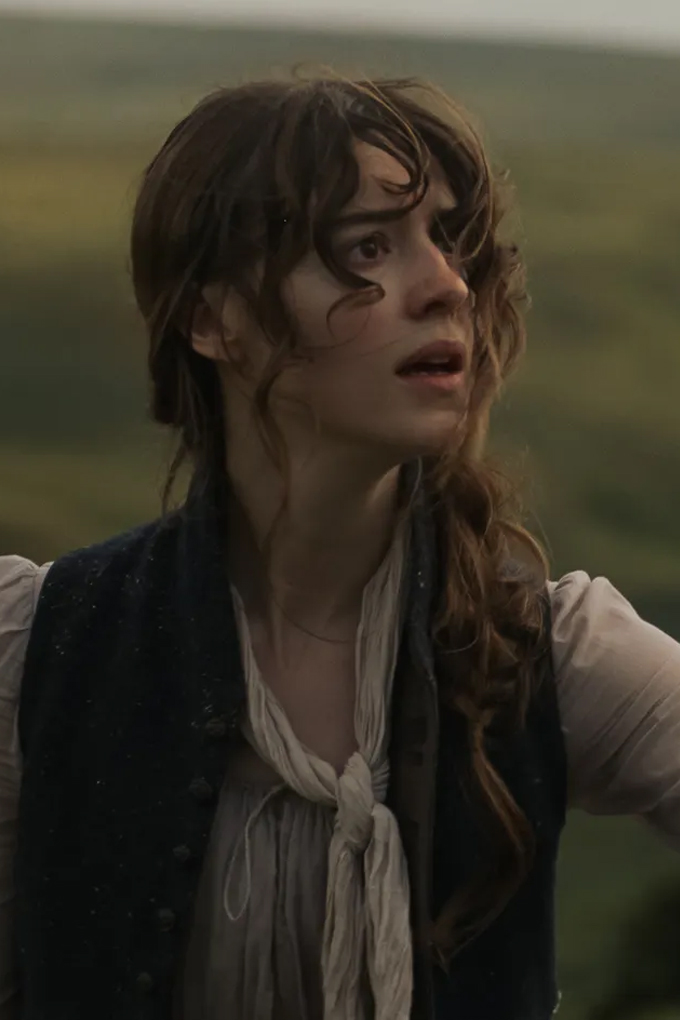
Rounding out a year positively teeming with adaptations of classic fiction, beginning with Emerald Fennell’s raunchy Wuthering Heights and spanning retellings of Lord of the Flies, Little House on the Prairie, East of Eden, and Pride and Prejudice (the latter four, for Netflix alone), English director Georgia Oakley’s Sense and Sensibility will arrive in theaters this October—and we have the first ravishing look at her Dashwoods.

Daisy Edgar-Jones, Esmé Creed-Miles, Bodhi Rae Breathnach, Caitríona Balfe, George MacKay, Frank Dillane, and Fiona Shaw star in the film, based on Jane Austen’s first published novel, released in 1811. (Novelist Diana Reid has capably handled the screenplay.) For Oakley (Blue Jean), Sense and Sensibility has long intrigued for the precarious position of the family of women at its center, who must move from their sprawling Sussex pile, Norland Park, to a far more modest, slightly shabby country cottage in distant Devonshire following the death of their paterfamilias. (In Austen’s memorable description of Barton Cottage, “the building was regular, the roof was tiled, the window shutters were not painted green, nor were the walls covered with honeysuckles.”)
“Looking back, I think it must be something to do with the fact that the Dashwoods sit close to the centre of society, but at the same time, they get pushed close to the edge,” Oakley says. “That’s definitely something, as a filmmaker, that I’m drawn to over and over.”

So too was she drawn to Austen’s scrutiny of the conventions of her own time, noting how the author boldly “poked holes” in the power structures maintaining prejudicial traditions like male primogeniture. “I see it as something really brave that she was doing,” Oakley says. “Everybody else that was writing at that time was pretty much writing about things that happened 500 years ago, so that they could smuggle in these kind of messages.”
In a corresponding fashion, Oakley was keen to conjure an authentic sense of place, lingering in the textural details of both the built and the natural environments that the Dashwoods—reserved Elinor (Edgar-Jones), passionate Marianne (Creed-Miles), young Margaret (Breathnach), and their affectionate but mildly flighty mother (Balfe)—occupied.

“It was really important to me to feel like we’re watching a story about human beings, and we can actually feel what it was like to live in the houses that they lived in—irrespective of whether we’re talking about a moldy cottage on the edge of the sea or a huge, palatial country house,” she says. “I’m a little bit sick of the sort of fetishisation of that time period, and this idea that everybody spent, like, seven hours doing their hair and makeup, and everything was always pristine, and somebody was always waiting to help you out of your dress or whatever. I’m not a historian, but I don’t buy all of it.” Among the films that Oakley and her creative team—which included production designer Francesca Di Mottola, costume designer Grace Snell, and cinematographer Arnaud Potier—discussed as points of reference were John Schlesinger’s Far From the Madding Crowd, Céline Sciamma’s Portrait of a Lady on Fire, and Hlynur Pálmason’s Godland.

A feeling of authenticity was also urgently important when it came to the casting; though Elinor and Marianne both have their suitors (the latter, more than one), Sense and Sensibility is, perhaps more than anything, a story about the love between two dynamically different sisters. So it was a boon that Edgar-Jones and Creed-Miles already knew each other a bit, having worked together as teenagers on the 2018 film Pond Life. “Seeing Daisy and Esmé together in the first chemistry read was just such a delight,” Oakley says. “Something about the fact that this wasn’t the first time they had stepped into a room together—I think it really helped.”

Breathnach—who had recently won the part of Susanna, the eldest Shakespeare child in Hamnet—was another exciting discovery; while for Mrs. Dashwood, Oakley was deliberate about bringing in an actor who didn’t appear to be much older than the women playing her daughters. “That felt more historically accurate,” the filmmaker points out, “and there’s a lot of stuff in the book about how Willoughby and all the other men that set foot in the cottage couldn’t help but fall in love with her.” Besides, she adds, “Caitríona has such an amazing, gentle energy that immediately they just became the Dashwood family.”
Ultimately, it’s Oakley’s hope that, between her talented company of performers and Reid’s “propulsive” screenplay, she’s created a Sense and Sensibility that both honours Austen’s rich material and beguiles a new generation, just as other iterations—maybe most notably, Ang Lee’s Oscar-winning adaptation from 1995, starring Emma Thompson, Kate Winslet, Alan Rickman, and Hugh Grant—did in decades past. “One of our actors hadn’t seen the previous film, and he hadn’t read the book, and he asked me whether he should,” Oakley recalls. “I was like, ‘Well, maybe don’t.’ It’s kind of important for some people to come at this without any of those preconceptions. Something I would love is for people who know nothing of the book and who haven’t seen previous versions of it to see this and to connect with it.”
What she didn’t necessarily want, however, was to create something that felt identifiably 2026. “My fantasy is always to make a film that could be discovered on a DVD in someone’s attic, and you can’t tell from the soundtrack or anything exactly when it was made,” Oakley says. Instead, “you find something in it that’s a little bit separate from time.”
This article was originally published on Vogue.com.