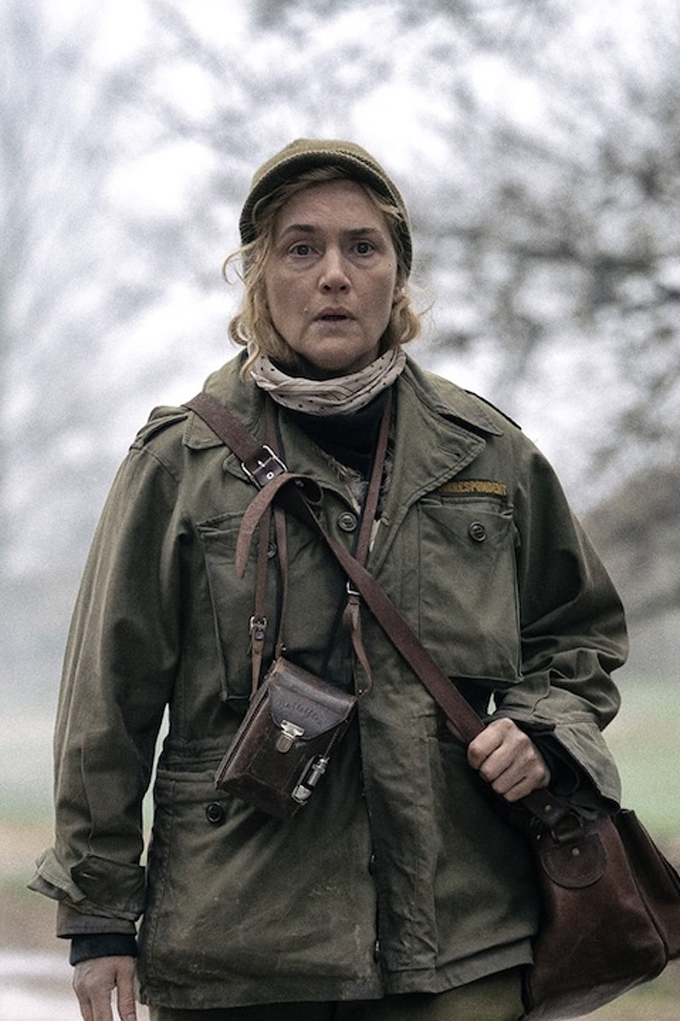
At one point in Lee, Kate Winslet’s character, Lee Miller, chances upon a male soldier forcing himself onto a woman in a secluded alley. Horrified, she thrusts herself forward to protect the woman, brandishing a pocket knife in the perpetrator’s face. As he concedes and leaves, he is unfazed, taunting even. Lee, on the other hand, is visibly frightened, hands shaking despite the weapon in hand.
Directed by Ellen Kuras and produced by Winslet herself, Lee is the story of American photojournalist Elizabeth ‘Lee’ Miller, the acclaimed war correspondent to Vogue in the throes of World War II. An ex-model-turned-journalist who saw the need to capture the devastating, under-reported realities of the war—especially for the women who stayed behind as their husbands went out to the frontlines. The women holding the fort at home as bombs raged down, heavily kept in the dark about the true horrors of the war. The women who had to go about their daily lives, rife with anxiety. The women who might have found certain comfort in seeing what was actually happening in the real world, through the unlikely pages of a magazine like Vogue.
And to some heart-wrenching degree, Lee is a battle hard won on its own. Having fought tooth and nail to make the biopic a reality, Winslet had previously revealed at the Zurich Film Festival that “people didn’t understand what this film was about.”
But anyone who watches it will glean its essence at once: Lee is a tale of one woman, and consequently, of all women.

The biopic starts off with Lee in the thick of the war zone, smoke and gunfire consuming her surroundings. We later discover that this is a retelling of her life story from nearly 40 years later in 1977; perched on an armchair in her family home with stacks of the photographs she took throughout WWII, she willingly (although curiously) shares her life with Antony Penrose (Josh O’Connor), whom one might hazard a guess to be a reporter or writer of sorts. It is here that we get our first glimpse of who Lee is; a battle-worn woman seemingly unfazed by Antony’s probing questions; yet with eyes that could tell stories for the ages.

Flashback to France of 1938, Lee is living in the coastal town of Mougins, her fashion model past seemingly behind her. A succession of events occur soon after; she meets charming art dealer Roland when her artistic circle of friends come to visit from Paris; they embark on a relationship that brings her to start her life anew in London; and the beginning of Hitler’s regime is hinted at via the news. And when the war finally takes all of Europe, Lee is driven to document it all, using her talent for photography to gain a stint with British Vogue, with the trust and faith of her editor and friend, Audrey Withers. But with a war blazing on, the patriarchal restrictions on what a woman can do multiplies tenfold. Women are not allowed out on the frontlines, women are not allowed into the press room at base camps, women are simply not given the same access men are, despite being a fellow journalist herself.

She struggles to forge a path for herself, but she barrels against the militaristic establishment anyway—all the way till she’s in the eye of the storm. But along the way, it’s precisely this gendered exclusion that also grants her access to document the lesser-seen faces of a war zone. The female pilot she meets in a room with a sign that reads ‘No Men Allowed’. The room of scared, hungry women she chances upon at a base camp along the German border. She seems fearless and purposeful in her efforts, dedicated to a cause she doubtlessly cares for.
Yet Lee is anything but. There is fear in her eyes when she realises what might have happened to the woman she had barely saved in the alley if she didn’t do something in time. There is fear when she is reunited with her closest friend, Solange d’Ayen, played by Marion Cotillard, only to see her broken by the woes of the war. There is fear when she and fellow journalist David Scherman (Andy Samberg) are faced with documenting one of the most harrowing images of the holocaust.

Throughout the film, we recognise that Lee’s ferocious courage and wilfulness to stand up for the women around her is a learned result of her own scars—the one she carries after years of being a renowned model in a cutthroat fashion industry. An industry known to disregard its women when they grow old, or when their bodies begin to show signs that they’re aging—something immediately exemplified through the knife-cutting words thrown at her by one of the other male editors, Cecil Beaton.
It is for precisely this reason that when a French girl she later meets in a war-torn zone is dragged out and branded a ‘whore’ by her own people after being taken advantage of by a Nazi soldier, Lee’s eyes betray her own emotions. “No one can tell you what it feels like—shame. There are different kinds of wounds, not just the ones you can see,” she says in a voiceover. The shame of an editor, who failed to publish the stories that needed to be shared most. The shame of a mother, who constantly felt undeserving of motherhood. The shame of a friend, who felt helpless in the face of her distraught friend. The shame of a woman, whose body is no longer considered her own.
Perhaps with Lee, a proposal is made. Shame burns, it rages, and it stings in the fumes. But as Lee so clearly embodies all throughout the film, it only really matters if you don’t fight against it at all.
Lee is now showing at The Projector.