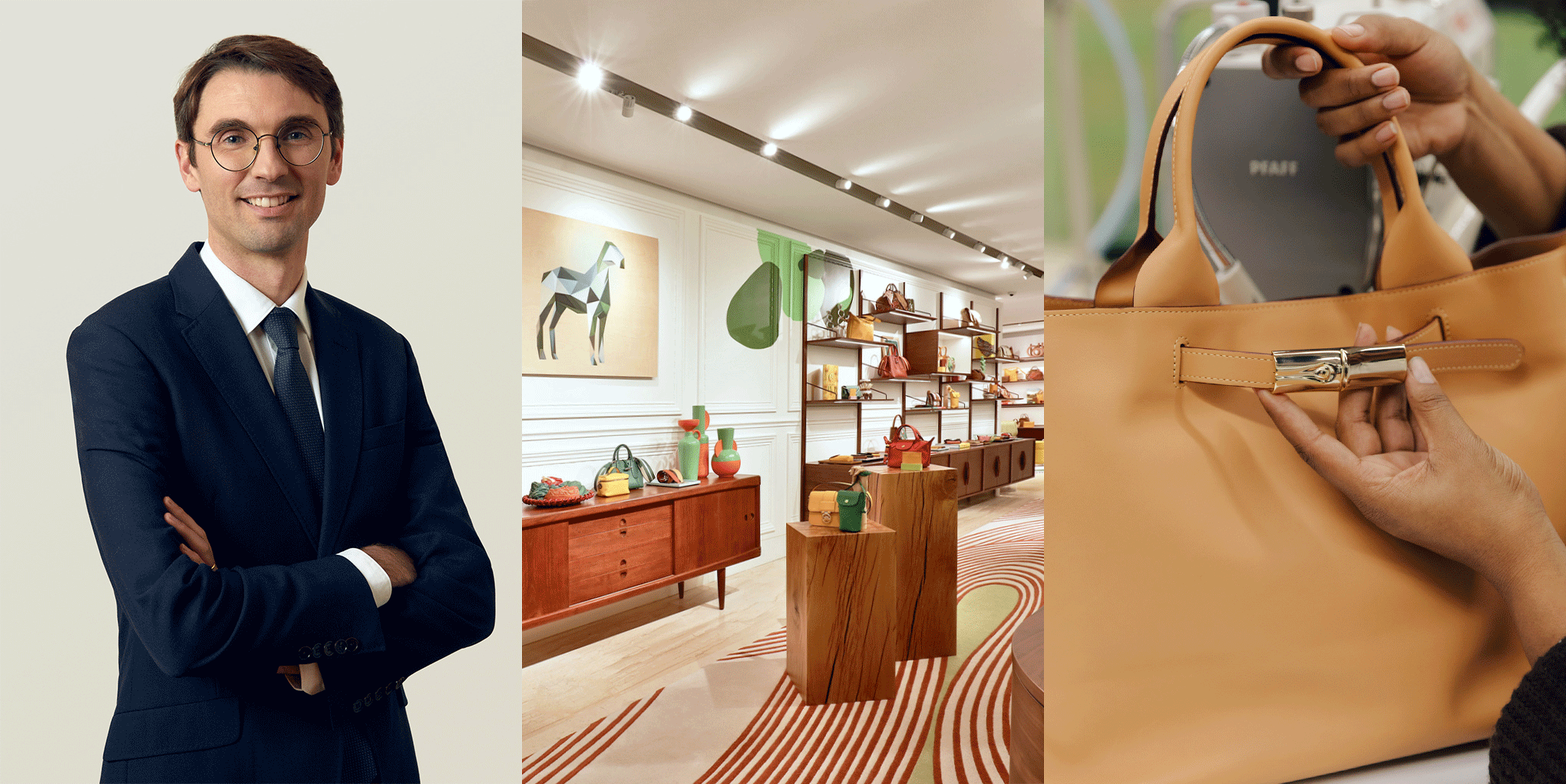
Few fashion houses can claim the kind of continuity that Longchamp has built over more than seven decades. Founded in Paris in 1948 by Jean Cassegrain, the house began as a leather goods company before expanding into the bags, accessories and ready-to-wear it is known for today. What has remained constant through all of it is its family ownership—now in its fourth generation, the house is led by CEO Jean Cassegrain, creative director Sophie Delafontaine and CSR and transformation director Adrien Cassegrain.

This continuity has given Longchamp the opportunity to operate with a rare independence that allows it to make decisions on its own terms, at its own pace, and with a long view that publicly listed companies rarely afford. That independence has shaped everything from the way Longchamp designs its products to the relationships it maintains with its suppliers—many of whom the house has worked with for decades. Collections build upon the house’s heritage instead of departing from it, while initiatives around responsible sourcing, repair and product longevity reflect a philosophy of stewardship—preserving the values it was founded on while adapting thoughtfully to a new generation. It has also meant that decisions are made with a longer horizon in mind, prioritising longevity over seasonality and craft over trend.

That long view is perhaps most visible in the house’s recent achievement of B Corp certification in 2026—one of the most rigorous and widely recognised standards for social and environmental performance in business. The certification, awarded after a four-month audit process covering all aspects of Longchamp’s global operations, is the result of several years of deliberate, structured work. For a house whose Le Pliage tote has become one of the most recognisable bags in the world — carried by students, professionals and fashion editors in equal measure—the certification is a statement about what kind of cultural institution Longchamp wants to be. It is also, as Adrien Cassegrain explains, less a destination than a formal recognition of values the house has always held.
As the CSR and transformation director at Longchamp, Cassegrain serves a role that puts him at the intersection of the brand’s people, its practices and its future. Here, he speaks to Vogue Singapore about what B Corp certification means for the house, why craftsmanship and repairability remain central to what Longchamp does, and what comes next for a brand that has always believed in doing things properly—even when that takes time.
Could you introduce yourself and tell us a little about your role within Longchamp?
I am Adrien Cassegrain—the CSR and transformation director at Longchamp. I’ve been here for five years now, and my role is about making sure we design the governance tools so that we all go in the same and right direction.
Longchamp recently achieved B Corp certification, congratulations. What did that mean for you personally, and for the brand?
It is the achievement of several years of work—quite a relief, to be fair. It is the recognition of who we are as a company. We had been actively preparing for this certification, but there are so many things we were already doing that have been brought to light through the B Corp process. The certification allowed us to formalise and prove to the government what we had long been doing. It is a way of rewarding efforts that are longstanding.
Longchamp describes this as an enduring commitment—something longstanding. Why did this feel like the right time?
You know, at some point when we were a smaller company, it was easier to convey ideas and make sure they were applied—everyone knew each other. When the company grows, it becomes more important to define policies, to write things down. And externally, consumers now have higher expectations of brands. Many brands have done a great deal but mostly spoken about it, some more wisely than others, and because of that, consumers now expect proof. Being audited across all aspects of our operations, in every country where we have employees, for four months—that is a strong proof element, both internally, to keep improving our practices, and externally, to show the efforts we are making.
“We did not decide to become certified. We decided to become better at CSR, because it was already part of our culture and DNA.”
How do you think this certification changes Longchamp’s decision-making in the long term?
It is a tricky question. When we decided to go for the certification—as I said, three or four years ago—we did not decide to become certified. We decided to become better at CSR, because it was already part of our culture and DNA. Because of that, we wanted to improve our practices further, and then we looked at what could help us go in that direction, and the certification was the answer. The certification had us formalise things—define policies, set different goals—but in the end, it did not change the way we see things, because the way we see things is the Longchamp way. Of course it changed in the sense that we had the opportunity to see where we are good, where we are not that good, and where we should improve—but in the end, the formalisation helps, while the intention remains the same.
Your CSR strategy is built around two pillars—the Longchamp Family and Made by Longchamp. How have these two ideas shaped the wider essence and building of the house?
The Longchamp Family is about people—our employees and the communities close to Longchamp. It is the recognition that the company works thanks to the people working for Longchamp. It is not just an entity that exists by itself; it is something alive because of all the energy put into it by everyone here. So the Longchamp Family is about recognising that strong bond between all our employees, people working around us and the company, and nurturing it—for the benefit of the company, but also for the benefit of our people. It is a win-win.

Made by Longchamp—we had to do something: we had to build products, to sell products, to have our products worn by people in real life. So it is the recognition of this second part of what Longchamp does. We are making products that are made by Longchamp—sometimes we use our contractors or our own workshops, but it is always the same ideas—the recipe is always the same. This way, our products can have an important impact socially, depending on the way they are made, and environmentally, because of the raw materials that we use. So it is also the recognition of this impact, and of our efforts to limit it to our maximum.
A big part of what resonates with consumers is the craftsmanship and the people making these pieces. Why was that so important for Longchamp as a brand, and to keep that up until today?
It is part of who we are. We are a brand that designs products—as many brands do—but we are also a bit more than that. It is part of our culture, and I think that it is a strong advantage compared to our competitors who do not do the same, because we have a better understanding of how our products are made and how the materials behave. We have direct access to our suppliers, and we know our tanneries and our fabric makers—and we have been with many of them for a very long time. When we want something very specific—a little more shine, a little less, a little more rigidity—we can go to them and say exactly that. It helps us enormously.
In Singapore specifically, consumers love the idea of being able to repair a product from the very start of its life to its last legs. How do you see this service shaping the way people buy Longchamp bags, and what is the value of that?
The value of repair service is a very important part of the relationship we build with our clients. When we say we can repair any product Longchamp has ever made, depending on its current state—theoretically, we can repair anything. It shows our clients that we commit. It is not simply that you come to our store, you buy something, and then we say goodbye and go apart. There is a real commitment from the maison to work with our clients. Our products are made to be used, to be cherished, to be carried all the time. Through our ability to repair, we can show that this is something we can help them with.

In a fashion landscape that moves so quickly, how does Longchamp fit into this cycle?
The fashion market is so large that there is room for everyone. We do not necessarily want to fit into a specific box. We do our thing, and we are very happy with that while recognising that we still have room for improvement. I think being true to yourself is always the right answer, because people can feel that. We build products that are made to last a long time, both in terms of durability and design. Some clients are looking for that—and for those who are not, there are many other beautiful brands.
It is impossible to function within the industry without speaking of the topics of circularity and sustainability. Beyond the Re-Play initiative, how does Longchamp commit to this idea of sustainability?
I think there are two important things. The first one is—when you use something and you create waste or use resources, the idea is what do you make out of that? Is it something that is very useful or not very useful, and how long will it last? And then we go back to longevity. Our first job is to make a product that will last over time, because the longer the product lasts, the more the resources used to make it have been well spent. The second thing is the good use of all the raw materials. We have to use raw materials that are fit for purpose—meaning if this is something that you will carry every day, it has to be resistant. So we test it to make sure it will be able to be carried every day, especially in Singapore where it is very hot and humid. The products are already put to the test.
We work a lot around leather offcuts to limit them to a maximum, and we have used recycled fibres extensively—the nylon in Le Pliage, for example. It’s a little far from Singapore, but in France, we have a second-life platform where clients can buy and sell pre-owned Longchamp products. It is not available in Singapore—not yet! We have a partner for that, but they have to develop with Singapore first.
“That is something important to us. We want to welcome everyone into the Longchamp world.”
How do you see Longchamp’s relationship with new customer bases, from Gen Z to Gen Alpha, evolving?
For me it is a mystery—they are further and further from me—but it is very interesting. With Longchamp, there is an idea of universality. We want to be able to speak to anyone, and we are proud of that. We are a brand where our products are not that pricey, but not that cheap either—not everyone can buy a Longchamp bag. But we are not exclusive in the sense of only wanting a certain category of person. In France, we have people from all generations and traits of life wearing Longchamp—older customers, very trendy people, younger people. I am sure it is quite similar in Singapore. That is something important to us. We want to welcome everyone into the Longchamp world.

Longchamp has initiatives like the Women Programme and Mission Handicap. Why was it important for Longchamp to define this responsibility in a people-first way?
It is important because these people give us their time, so we owe them in exchange–it is a piece of themselves after all. They put their effort, their will, their ideas into the company, so we have to take good care of them. We have 80 percent women working at Longchamp at the moment, so it is important to make sure that everyone feels welcome—not just as a customer, but as an employee—and make sure that everyone can be who they are working at Longchamp and bringing their ideas in. The Women’s Programme, for example, helps women at Longchamp facing very serious challenges—domestic violence, cancer—issues that can be deeply affecting for their quality of life. As a family, you want to be there in the good times, but also in the hard ones.
After this huge milestone, what comes next? What is an area you want to develop?
B Corp was not a goal in itself, but rather a global direction that we want to take. And I think it also helped us realise everything that we still have to do. We were certified with 91 points, for which I am proud of myself and the team, but there is still a great deal of room for improvement. We designed a lot of new tools that we now have to maintain and operate over the long run. There are many other things we still have to do to better understand our impact—for example, the impact of leather. There is not one answer that exists for that the way there might be for something like the excess around cotton. So it is like research and development in the end. We have to work on that, sometimes alongside our markets and even our competitors, to better understand the impact of our operations.
And when it comes to Mission Handicap and the Women’s Programme—there is still discrimination in society, so it is sadly a never-ending job. We always have more work to do to make sure there is no discrimination at Longchamp. Life is moving on and we have to move on too. There is a lot still to do.