From a quaint Parisian shop nestled on boulevard Poissonnière, a legacy quietly began to flourish. In 1948, Longchamp started as a humble family business selling leather-covered pipes, subsequently evolving into a powerhouse of French craftsmanship. Over the years, the maison has remained rooted in its heritage. One key reason for its lasting success? The vision and influence of the founder’s granddaughter and artistic director, Sophie Delafontaine, who is the third generation to lead the brand.
Delafontaine’s journey is intertwined with Longchamp, though her path to the helm of the maison wasn’t as predictable. Growing up above the family’s first store, she was surrounded by the world of leather goods, but felt no pressure to follow in her family’s footsteps. It wasn’t until 1995 that she joined Longchamp, recognising the immense potential waiting to be unlocked.
Delafontaine’s approach was not one of rapid change but of deliberate, thoughtful progress. “At Longchamp, we have always taken the time to do things well,” she shares. This philosophy is evident in her work, from the introduction of ready-to-wear and footwear lines to the enduring appeal of collections such as Le Pliage and Le Roseau.

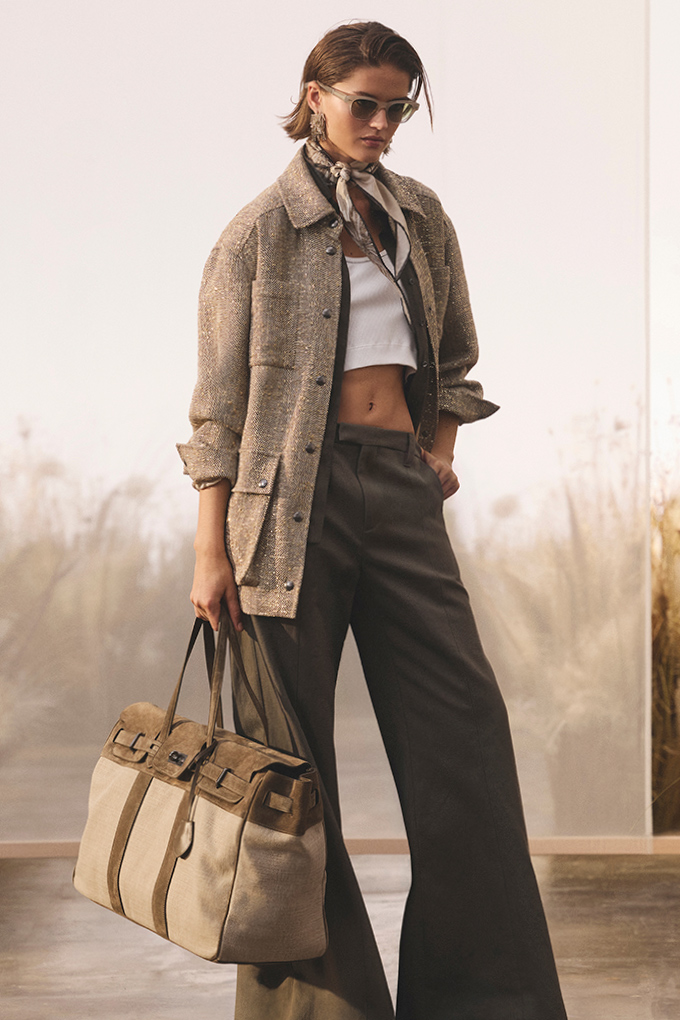
This spirit of freshness carries through to each new range, including the house’s latest spring/summer 2025 collection, which Delafontaine describes as a celebration of lightness and fluidity. Here, she plays with textures and layering, introducing unexpected details that add a novel twist to classic pieces while staying true to Longchamp’s core values of authenticity and quality.
Under her leadership, Longchamp has embraced the fast-paced nature of the global fashion landscape without losing its soul. She has positioned Longchamp as a brand that resonates with the contemporary woman who seeks class, adaptability and a touch of Parisian charm in her wardrobe.
Vogue Singapore’s editor-in-chief Desmond Lim speaks to Delafontaine about her journey with the brand, Longchamp’s growth through the years and its spring/summer 2025 collection.
You’ve mentioned that authenticity is key for any creative. What are the top three mantras that have guided you in your work?
Authenticity at Longchamp is a word that is part of our DNA because we are a family company. More specifically, the spirit of family is something we cherish and wish to maintain. Secondly, we are a company that is product-oriented; we manufacture each piece in our workshops. For us, the product is always the star. The third aspect is having an open mindset. My grandfather had a store in the Paris airport when it first opened, marking the first step towards what we now call duty-free shopping. He travelled extensively around the world to find inspiration while building global contacts. So, for me, open-mindedness, product focus and family are my three key mantras.
When did you decide to go into ready-to-wear?
We started ready-to-wear in 2006, coinciding with the opening of our store in Soho, New York. My brother Jean, our CEO, and I felt that we should begin offering ready-to-wear to bring the Longchamp woman to life. The idea was to demonstrate how to carry the bags and what to pair them with. I started with the first collection, which included four or five coats. Over time, I developed dresses, sweaters, trousers and skirts. Gradually, I expanded the range, eventually incorporating shoes as well. It was essential for me to take the time to navigate this new territory as we established a lifestyle surrounding our bags.

Do you think female designers have an advantage over male designers in understanding a woman’s psyche?
I never see it as a case of an advantage over my male counterparts, but more so its intended purpose when designing. I don’t see myself as an artist but more a designer—and for me, there’s a significant difference. Art allows total freedom. You can create whatever you want. Design, on the other hand, involves creativity with functionality. In fashion, the balance lies in understanding how people will feel when they wear the clothes. If someone can’t move comfortably or walk in their shoes, they won’t feel confident. I aim to create for women who want to feel confident, powerful, cute or sexy—whatever they aspire to be.
Pink is evidently your choice of colour for next season. What do you think is its appeal?
Pink is a colour that suits every type of woman. In France, we have a saying, ‘voir la vie en rose’, which means ‘to see life through rose-coloured glasses’. This phrase captures an optimistic outlook, similar to the idea of seeing the glass as half full rather than half empty. At Longchamp, we embody that optimism. We believe there’s something positive to find in every situation and I want to share this positive philosophy with everyone.
“In fashion, the balance lies in understanding how people will feel when they wear the clothes.”
I’ve noticed the tactile quality of your collection, with materials like velvet, sequins and faux fur. What inspired you to choose these denser materials for spring?
For the spring collection, I envision it as an end-of-year collection, symbolising a time of closure and new beginnings. There’s an inherent optimism in this transition. The mix of materials, such as the sequins, which I’ve chosen in a pale pink, is intentional. They’re shiny yet subtle, lending an air of elegance rather than opting for a stronger pink. I also incorporated velvet to create a balance between bold colour and soft texture. Colours carry a lot of personality and character, and materials do too. The interplay between colour and material is crucial.
What are your thoughts on washable leather?
Working with washable leather has been a delightful experience for me. Leather represents longevity; it’s our savoir-faire and an integral part of our history. However, for the dynamic, active woman—who’s working, travelling and always on the move, perhaps even practising yoga—this kind of leather is particularly intriguing for two reasons. Firstly, the fact that it’s washable makes life so much easier. You can simply toss it in the washing machine and it’s done. This convenience saves time and provides peace of mind. Knowing you can wash it means you feel confident wearing it without worrying about its fragility. You can incorporate it into your daily routine, whether for work or travel, without hesitation. Secondly, this material is also stretch leather, allowing me to create pieces of clothing that have a sporty vibe to them.

I’m obsessed with your Le Roseau bag in plush velvet. What inspired its design?
I designed it with that intention in mind. The concept was to use velvet to give a plush effect, and there’s padding inside for added tactility. I wanted to combine that with a vibrant pink wash to infuse a joyful spirit to the bag, enhanced by a metallic chain. For me, it’s the perfect tote for a night out. Whether you’re enjoying New Year’s Eve in front of the Eiffel Tower or heading to the clubs, it’s perfect.
If you had the chance to pick anyone you’d love to collaborate with next, who would that be?
These days, I’m fascinated by the younger generation of designers who are so brave in pushing forward, especially now when things can be tough for fashion. For nearly 18 years, I’ve been involved with the ANDAM (National Association for the Development of the Fashion Arts) Fashion Awards, which is something I really appreciate. It offers great support to young designers and involves a whole community of major players in the French fashion industry. As part of the jury and board, we’re dedicated to helping these young talents as much as possible. For example, we offer all our deadstock materials for free to these candidates. They come to our office to select materials—leathers, fabrics—so they can produce their collections at a much lower cost and that makes me really happy to be able to help them while being inspired by their talents. At this point, I am definitely keeping my options open.
At Longchamp, how do you perceive sustainability in the materials you use and how do you approach waste reduction?
We don’t talk extensively about sustainability because, as a manufacturer, it’s ingrained in our ethos. We hold a great respect for the materials we use, especially leather, which I consider a noble material. We handle it with care, aiming to create products that will last. For me, the best way to achieve sustainability is through producing high-quality and timeless items. When you have products that are 30 years old and still appeal to younger generations, it indicates that those products are of high quality and enduring design.
Additionally, we are mindful of the materials we use. For instance, all the nylon used in our Pliage line is made from 100 percent recycled nylon. The leather for our bags and ready-to-wear pieces is sourced from tanneries that meet the LWG [Leather Working Group] quality standards. This certification ensures that the tanneries operate sustainably. As a manufacturer, we also focus on repairing our products. Each year, we carry out over 60,000 repairs, many of which are free of charge. This commitment illustrates our respect for the products we create and our desire for them to last as long as possible. These aspects are important to us.
“When you feel strongly about something, trust your instincts and pursue it. It doesn’t always work out, but when it does, the satisfaction is immense.”
If you could relive a moment in your life from a creative standpoint, which period would that be?
Experiencing my first success from within the company was a highlight. I remember it vividly—it was shortly after I joined Longchamp. My father was the creative force at that time and he was exceptionally creative, having created a line of amazing products. However, I wanted to add a touch of eccentricity to our offerings. I proposed a bag made entirely out of transparent PVC—a completely see-through bag—this was about 30 years ago. When I presented the idea, he was sceptical, saying, “No one is going to carry a transparent bag; everyone will see what’s inside.” He challenged me, stating that if I could carry it for two weeks, we would consider adding it to the collection. Naturally, I accepted the challenge and carried it around. Eventually, it made it into our collection and became a tremendous success. You must give a product a chance. When you feel strongly about something, trust your instincts and pursue it. It doesn’t always work out, but when it does, the satisfaction is immense.
If you were moving across continents and could only carry one bag with you, which bag would it be?
I would probably take a suitcase filled with multiple bags! But in all seriousness, it’s worth noting that we pay great attention to the materials we use. We work with exquisite types of leather that become more beautiful over time, developing unique patterns that cannot be reproduced on an industrial scale. It’s the life of the bag that shapes it. So, if I had to choose just one, I would select the leather Pliage that my father carried. Within that bag, I can feel the life and history it carries—all the trips it has been on. That would be the bag I would keep.
Vogue Singapore’s November ‘Nurture’ issue is now out on newsstands and available online.