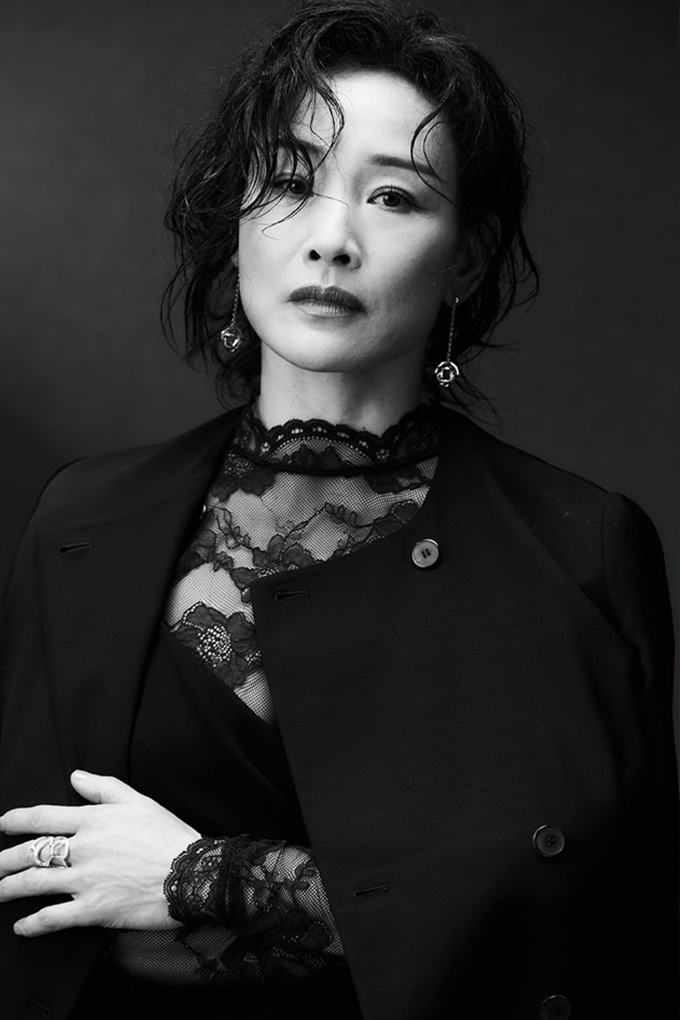
“Only when you have left your homeland, can you understand that feeling—that immense loss. You pay an enormous price. We had a one way ticket. If you went back, you would never be able to come out again. And so, you’d be dreaming about home almost every night, because you felt like it’s completely severed from everything you ever knew.” Joan Chen tells me this on a June afternoon. Sitting on the edge of her couch, it is already clear that our conversation is unfolding with a candour and vulnerability that is rare to find.

After becoming China’s sweetheart as a teenager in Little Flower, Chen rose to global acclaim with The Last Emperor, a breakout role for Chen which saw the film winning nine Oscars, and later as Josie Packard in Twin Peaks. It is a quick summary of a storied career that has now spanned more than half a century, and one that does little to capture the breadth of stories Chen has accumulated. A pivotal figure bridging Chinese and international cinema, Chen has also spent much of that time pushing back against an industry that has repeatedly attempted to define her: first through the lens of race as an East Asian actress in 1980s Hollywood, and now, through the constraints of age.
It is precisely this label—that of age—that Chen rewrites in her latest role in Xiaodan He’s Montréal, Ma Belle. But it isn’t a matter of shedding the fact, but embracing and expanding it wholeheartedly. Chen plays the protagonist Feng Xia, a woman who finds herself questioning her sexuality for the first time in her mid-50s. The role represents a new kind of resistance: the freedom to desire, question, and begin again later in life. Playing the role of a first-generation immigrant, mother and wife, Xia’s experience of her first ever lesbian and interracial romance is a daunting prospect. But though the premise may sound layered, Chen sees it simply, as “a straightforward theme and a straightforward desire.”

Central to this “desire” is realising the thrill of it all, when desire is unbound from duty. It’s a reminder how enduring desire is at every stage of life. “What I stressed more is that falling in love has nothing to do with sex or sexual orientation, except that her body was being denied all her life, decades and decades. She is now finally accepted not only by herself but by her lover—and it becomes beautiful,” remarks Chen.
But acting on a desire suppressed for so long is neither straightforward nor painless. Chen’s understanding of her character is entrenched in responsibility; one, perhaps, understood by someone who is herself a mother and wife. What does it mean to finally dream, after a lifetime of serving others? This crucial pivot and its aftermath are the most gripping aspects of Chen’s performance.
“Xia hasn’t dared to express herself throughout her life. When she finally feels [attraction for another woman], she’s so frightened by her own desire and facing her own truth. She’s duty-bound and hides herself, she didn’t even know who she was anymore, for a very long time. Her unhappiness was buried so deep down—layers of dust on top—and she herself cannot even reach it until that moment happened.”

The desire for something more—and this capacity to dream—is at the core of the immigrant experience, and therefore becomes one that Chen herself relates to: the constant search for what she describes as a “lost paradise”. The prospect of entering the unknown—the unavoidable truth that accompanies the immigrant dream—is daunting and thrilling in equal measure, and not without its hardships. “I left with a very vague desire of longing for the unknown and that vague concept of freedom, which I had never known prior to arriving in the United States, for that, I paid a hefty price. It’s not something that I had words to describe. As the years passed, the hardships did not get any less, but became more and more.”
“I left with a very vague desire of longing for the unknown and that vague concept of freedom, which I had never known prior to arriving […] for that, I paid a hefty price.”

It is refreshing to see the story of what happens after an arrival in a new country, the “lost paradise”; what it means to move somewhere new, to assimilate, to learn a new language, to raise a family whose roots are inherently unlike your own. It was in this way that the role enabled Chen to lean into her own experiences of motherhood, and the generational impact of diaspora. “I relate to the Chinese mother’s relationship with an American child, or in Montreal, My Beautiful, with a Canadian child. Motherhood is a duty bound with both love and loss, fear and courage. Your misunderstanding, your own feeling of inadequacy, there’s so much you cannot teach, because you don’t know this culture—what is right, what is wrong. That uncertainty brings turmoil—but ultimately, love transcends all.”
“Before that, I didn’t know how to ever tell someone, unless that someone was also like me.”
It was in John Crowley’s Brooklyn—released in 2015, almost forty years after Chen began her career as an actress—that Chen first saw her story reflected on the big screen, and felt understood. It makes taking on roles centring the immigrant mother a sentimental choice—like Montréal, Ma Belle, and in years past, Dìdi and Saving Face. “Before that, I didn’t know how to ever tell someone, unless that someone was also like me.”

Ultimately, what is most striking about Montréal, Ma Belle, is its depiction of desire at every stage of life. It was what cemented the role for Chen: a refusal to accept certain roles due to ageist beliefs, or become boxed in as an actress. It was never about portraying Xia as a flawless mother, a model minority—but bringing her ego, her flaws, her desire, to life. Xia—as a mother, wife, girlfriend—is just Xia. “I love that Xiaodan He dealt with an older woman’s desire. Usually the characters of that age that I have played, people don’t think of them as full human beings, who have desires other than desiring a good life for their children,” Chen tells me candidly.

From actress to mother and director, Chen has lived many lives herself—all of which feeds into her work. “I truly feel I haven’t even given 20%, 30% of what I’ve experienced in life, and aspired to.” For Montréal, Ma Belle, Chen learnt French for the role, with her protagonist speaking in French and Mandarin in the film. “It’s exciting that an old dog can learn new tricks,” she quips. But to call Chen’s continued capacity for reinvention simply “new tricks” would be a severe downplay of her commitment to craft, and her dedication across every hat she has worn. This includes her beginnings in Hollywood when she first moved from Shanghai. Despite hitting a breakthrough with acclaimed films Youth and Little Flower in 1977 and 1979 respectively, Chen essentially hit reset on her career—and it wasn’t until The Last Emperor in 1987, close to a decade later, that Chen finally made her mark on Hollywood and the international stage.

After half a century of storytelling—51 years, to be precise—Chen’s storied career is chaptered by each “trick”, each hat she has adorned. “My life is measured by these periods of my loves,” muses Chen. And time does not decay the memories of these loves. When recalling her 1998 directorial debut Xiu Xiu: The Sent Down Girl—for which she won the Golden Horse for Best Director and Best Adapted Screenplay—Chen’s entire air shifts; and her smile becomes lighter, lifted. Xiu Xiu shone a spotlight on the adolescents impacted during China’s Cultural Revolution, and is, at minimum, a sensitive topic. But that prospect only propels Chen, who recalls that period of her life with an immediate grin. “It was an intensity so high that any higher I would have broken into pieces.”
This gusto for life permeates Chen’s worldview, allowing herself to become enveloped by every experience. To be so imbued by such raw emotions, and not shy away from the vulnerability that that requires, is what makes her acting so compelling, so singular in each role she has adopted. “Every day was so new,” remarks Chen with a wistful smile. “I just… I remember I could notice every piece of cloud moving. You’re so sensitive to everything that you encounter: the colours, the textures, the grass, the wild flowers, the dusk and dawn.”
“With the changing times, the changing cultures, and with myself ageing, I’ve got to live so many different versions of myself. It is why I love what I do.”
This vivacity, this tenacious sort of attitude to life, has not left the actress; if anything, it has been increased tenfold. When we speak, she tells me she has 31 scripts due to read in the next week alone. But what a joy, what a privilege that is, to continue telling stories. This isn’t lost on Chen—and for the actress, reinvention as an infinite possibility is a joy in itself. “With the changing times, the changing cultures, and with myself ageing, I’ve got to live so many different versions of myself. It is why I love what I do. It is such a blessing.”

The future is bright—glorious!—for the actress. Whatever limitations the industry might impose, Chen is uninterested in observing them, and rightly so. Her capacity for reinvention is greater than it has ever been. Much like in Montréal, Ma Belle, it is the prospect of dreaming that fuels Chen. “I feel that I’m living more fully today. I feel this more than in my youth, because I realise time left is getting shorter and shorter,” remarks Chen. “When I look at a glorious sky this June—right now, outside our window—I want to see and remember everything, and to engage with life more intensely. I really say: hey, I’m here, and I won’t be some other time, but I’m here right now.”