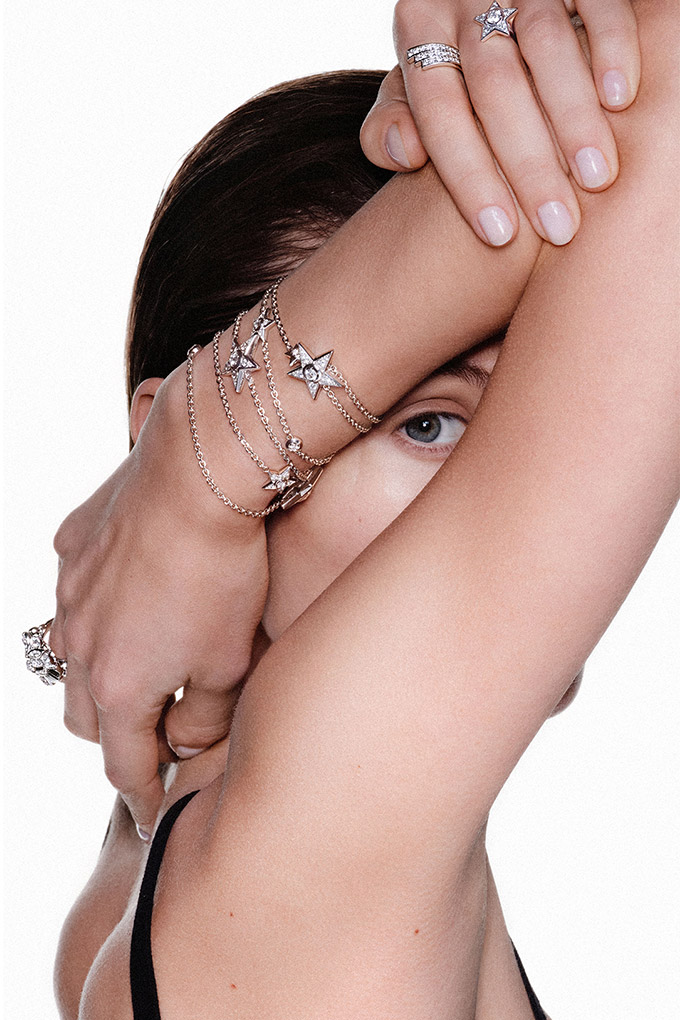
Why settle for one piece of jewellery when you can have several? Bracelets that double up as necklaces, transformable earrings, sliding pendants worn at different lengths, and rings that flip to reveal a second look. Multi-wear jewellery that can be styled and worn in more ways than one is having a moment.

One of the most iconic examples of multi-wear design is Van Cleef & Arpels’s Zip necklace, introduced in 1950 by the house’s artistic director Renée Puissant. Inspired by the advent of zippers in fashion and haute couture in the ‘30s, Puissant worked for more than a decade and over thousands of hours to create it. When it was completed, the Zip was a true masterpiece: a concept as simple as an everyday fastening turned into a high jewellery masterpiece with an actual, functioning sliding zip that could transform it from a necklace to a bracelet.
High jewellery has a long tradition of transformable, multi-wear design to add wearability and stylistic longevity to these high-value creations. In recent years, though, this element has also made its way into fine jewellery collections, bringing stylistic versatility to a wider audience. In a world where trends are always changing, the jewels that stand the test of time are the ones with different personas that can adapt to a variety of occasions, moods and outfits.


Long and short
For some jewels, transformation comes as easily as from altering its length. Sliding pendant necklaces have become increasingly popular, with many brands creating their own version. Perhaps the thrill comes down to a sense of freedom in deciding how to wear a piece: fastened up to the neck bolo tie-style, worn long and relaxed like a sautoir, or even draped down the back.
Fred, for example, recently introduced a sliding pendant into its Force 10 Rise collection. The necklace, which features the house’s signature sailing rope and buckle motif, can be easily adjusted for a more refined or laid-back look. It’s a smart way to wear a jewellery maison’s signature design. At Boucheron, the house’s famous four-tiered Quatre design wears beautifully as a tie necklace, which slides up and down to match different ensembles.


Shapeshifters
Other pieces shapeshift. This year, the Clash de Cartier collection welcomed new multi-wear earrings in yellow, white and rose gold. The stud, bead and clous carrés design takes on an elongated form, with two detachable pieces that can be worn three ways. The shorter earrings on their own make for a classic, everyday adornment; while the longer piece can be worn in front or behind of the earlobe to create a more commanding, distinctive silhouette to elevate an evening look.
Ring jackets are another way for jewels to transform. By wearing a jacket design as a whole, just the central band, or the jacket itself, there are endless possibilities. Simone Jewels has a triple-band ring inspired by Hokusai’s The Great Wave off Kanagawa, which incorporates a variety of textures to evoke fluid movement. The central diamond ring makes for an elegant piece on its own, but worn together, the ring becomes an elaborate work of art.


Flipsides
Sometimes the transformable element of a jewel is much more subtle and comes down to a reversible function. Van Cleef & Arpels’ Vintage Alhambra, which comes in a variety of decorative stone and gold combinations, includes two reversible rings with either blue agate or carnelian on one side, and guilloché gold and a diamond on the other.
Dior’s luck-infused Rose des Vents collections goes a step further: its circular charm motifs feature a compass rose on one side, and a smooth piece of each design’s matching decorative stone on the other. The Parisian house also has a Tribale-style mono earring with a removable pendant. Worn on its own, it looks like a more understated stud; and with the pendant on—either its compass rose or stone side facing forward—it takes on a fortuitous figure-eight silhouette.


Neck & wrist
The more inventive multi-wear designs change categories completely. Chanel has the Les Infinis transformable necklace in its fine jewellery collections, with a range of options from its Comète, Camélia and Nº5 lines. The necklace is made with two clip clasps, so it can be worn as a sautoir, Y-shape, double-row, or draped on the back as a necklace; looped around the wrist as a bracelet; and even on the waist as a belt.
Nanis, the Italian jewellery brand designed by Laura Bicego, has a similarly transfigurative icon in its Transformista line. First made in 1993, this patented design in contrasting polished and hand-engraved gold can be worn around the décolletage as an everyday chain link necklace or on the wrist as a statement bracelet.