For all the hype around Team France’s luxury handbag game and a certain blond-haired, blue-eyed player selling Chinese teas, the summer of sport—and the FIFA World Cup—is ultimately a measure of community, and a testament to sport’s power to transcend borders and limits.
The installation is a partnership between the FIFA World Cup 2026™ Miami Host Committee and Reefline. The latter, known for their work at the intersection of art and ocean education, developed and curated the project; having previously produced projects such as a seven-mile underwater public sculpture park and hybrid reef running parallel to the shore of Miami Beach, in an effort to raise awareness around ocean conservation. Alongside LA design team PlayLab Inc., who brought in the concept; artists Jessica Trosman and Emiliano Miliyo, who helped realise it all; and Uber as the title sponsor—the ‘Big Goals’ project embodies the very ethos it champions: many hands coming together in service of collective action and ocean conservation.
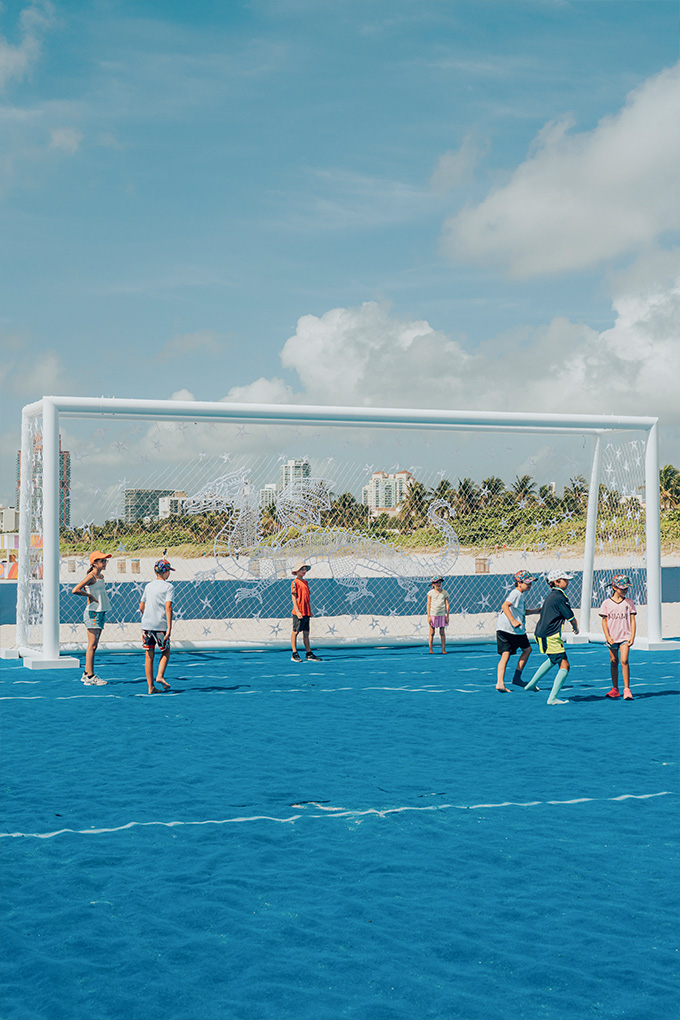
The project stars the gigantic football playland installation in Miami; with each goal containing intricate, hand-crocheted football nets, made from reclaimed and discarded materials. Brought in by Reefline’s CEO and founder Ximena Caminos, who is also a renowned art curator in Buenos Aires, Trosman and Miliyo led the project’s execution—weaving the reclaimed nets into constellations, in collaboration with women community weavers from their hometown.


The two nets trace the constellations scorpius (scorpion) and draco (dragon)—star formations which rest above the skies of the FIFA World Cup players in North America, symbolically connecting them to audiences watching worldwide, as the constellations traverse borders and oceans alike.
Installed on a supersized football pitch located on the Miami beaches, each net features one of the two constellations. Crochet, here, becomes a point of collective construction, bringing together the artists and weavers in a shared practice of making, while the public programming centres on play and public environmental education. Yet, nets evoke one of the ocean’s most pervasive symbols of pollution and destruction—offering a poignant duality to the project’s greater messaging around ocean awareness.

As a textile artist, Trosman is no stranger to subjecting fabric to dramatic form; rendering textiles yet always in conversation with it. Though her work across materials has now expanded—from injected and foamed plastic, PVC, to foil—Trosman’s practice is still grounded in fashion. Having previously begun her own label and worked on textiles for Chanel’s haute couture, she continues to collaborate with Rick Owens and Michele Lamy on textile design.
Miliyo is a sculpturist—and he, too, renders material to volumetric transformation; favouring works that foster an appreciation for true craftsmanship and manual labour. An active participant in Buenos Aires’ cultural scene throughout the 1980s, including the Ricardo Rojas Cultural Center and the Recoleta Cultural Center, Miliyo’s present practice offers critical reflection on contemporary cultural values, often probing the boundaries between sculpture and installation.
In conversation with Vogue Singapore, Trosman and Miliyo discuss exploring artistic play and manipulation, football’s capacity to turn dreams into a collective experience, and the ecosystem that made the project possible.


So, from the beginning. How did your creative dialogue begin, and how did you approach this project?
Emiliano Miliyo: We had received a call from our friend Ximena Caminos, the CEO and founder of Reefline, in addition to being a well-known art curator here in Buenos Aires. Alongside PlayLab Inc., they had developed a project about a football playland—transforming the game, rethinking the game to be more collaborative, and simultaneously, evoke and create a conscience surrounding nature preservation. It was about using the potential of sport to unite people, and at the same time, the power of art to bring ideas to the ideas. This combination of two ways of bringing people together was the beginning.
Jessica Trosman: When Ximena approached us, we thought: how do we materialise this project? How do we give it soul? Our answer was to focus on the symbolic element of the game, the football net. The net is not a piece of equipment, but a sacred place, where dreams are realised. Here in Argentina, we love football, and a collective ecstasy happens every weekend—where destiny is also written, in a way. In bringing this metaphor to life, it’s also a metaphor for human struggle.
How did the stars come into play?
JT: The World Cup is being played across three different countries. But across borders—we are all united under the same sky. The sky reveals different constellations—which is why our nets feature two celestial figures, that of the scorpion and the dragon.
But the true magic of this project doesn’t lie in the stars, it lies in the hands of these women. The nets were entirely hand-crocheted by a dedicated group of women from vulnerable neighbourhoods, day after day, pouring their talent into the craft. They took the traditional domestic practice and turned that talent into craft. We put this concept into the net, to give a soul to the project. It isn’t just a football goal, but weaving together a network of community and hope—which is the most powerful part of this project.

Both of your practices engage deeply with materiality. How has thinking about sustainability influenced the way you select, transform, or repurpose material?
EM: That part was very important. We had initially thought about how to do it with traditional methods like 3D printing metal, a more industrial way of doing it; and when we started to think about how to use reclaimed or eco-friendly materials, we realised that we needed to work with ancient techniques, not modern ones.
JT: Textiles are a second skin, representing warmth and protection for humans. That’s why we thought of crochet—in bringing crochet to the open seas, it’s like putting a protective mantle over our ecosystem. That contrast between the fragility of the yarn and the massive scale of the climate crisis is incredibly powerful to us. Crochet cannot be replicated by machines. These are the techniques and materials used by our grandmothers, the women in our lives, the people who protect us in the world.
I’m interested in how your approach shifted now that you’re thinking about play and manipulation from a different perspective—not just about the material but also the play of the viewer.
JT: Sport, especially football, carries a raw and universal energy that is very massive, which we’re not used to. As artists, we’re not massive. So to use this energy to bring crowds together and speak a language that transcends borders, we entered a different world.
EM: In my case, as a sculptor and visual artist, my goal is always to work with the forms, the material, and the meaning at the same time. In the case of this project, there is still that sense of advocating through the materials and the forms to create feelings and experience.

Football in Argentina, especially, is a cultural religion; a unifying cultural pillar. How has growing up within Argentina’s football culture influenced the way you think about collective identity and public space?
EM: For us, sport is closely related with our families, our neighbourhoods, our school years, our childhood friends. It’s not only the passion of our own team and the way we want to win the game—but more of a way to relate with our history. We pulled together that experience for this project, alongside our interests in art, fashion, and traditional ways of work.
JT: We also took the net as a tool for awareness. If we flipped its meaning in the ocean, nets are usually associated with destruction. Here, we transform it into a symbol of collective action and the unique power of sport to unite humanity. In a way, using art to shift the narrative.

Jessica, you began in fashion but have since shifted into sculpture—but your practice has always been grounded in textiles. How did this background come into play with this installation?
JT: I never left fashion, to tell you the truth. I’m doing consultancy. Fashion is in my blood. I dream in fashion. I still work with Rick Owens and Michele Lamy on textile collections. For me to start weaving this, it was like thinking of a collection. I return to my origins often—this is where I feel most comfortable.
But I wouldn’t have done this alone. Emiliano talks to me about the sculptures, and I talk to him about textiles—when I received this project, I said, if Emiliano is doing it, I’m going to do it too. The match is what made us do this amazing work.
Emiliano, your works are often in places of industrial architecture or white cubes, from which a new relationship forms with the viewer. This project enters a much more participatory and public context. How does that shift the way you think about audience engagement?
EM: For me, this was kind of a dream project, in terms of the possibility to connect with the audience. My deepest connection with Jessica is through our relationship with form and the materials. The art piece within fashion is the same, it is only a vehicle to have an experience. As an artist, we can try and provoke beauty, happiness, even sadness—but ultimately the important thing is to connect with people. My responsibility is to make the piece, but the responsibility of the piece is to connect with the people.


What do you hope for audiences to encounter with your work?
EM: It’s very important for us as artists to bring together the interest of people who want to play a game on the pitch, but at the same time, live the experience of the art piece. In a museum, an art gallery, or the theatre—you go there to be a spectator, to receive a message or impressions. When you go to a game, you participate only as a player. Here, it was a mix of those experiences, and to me that part was very special.
JT: This project only exists because different creative voices joined hands: Ximena Camino, Reefline, PlayLab Inc. Their conceptual design with our physical artistic execution alongside the weavers—this design was the powerful result of this ecosystem.
So really, it’s not just an art installation, but an ecosystem. We’re using the high energy and universality of sport to address something much deeper, a relationship with the ocean. We cannot do it alone, we have to do it as a collective.