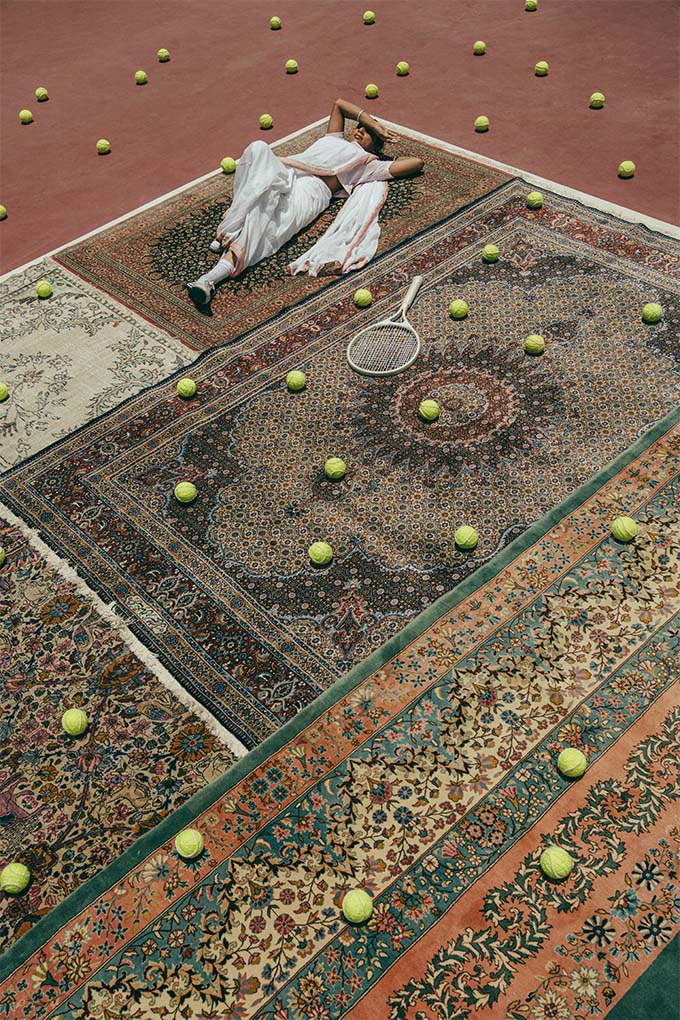
Rugs on a tennis court. Rugs on a cricket pitch. Rugs suspended above snow-capped mountains on a cable car. At first glance, such a description poses a conundrum, especially when the subject in question is a centuries-old craft whose weaves represent India’s rich cultural fabric. Sounds beautifully striking, right? Well, this boundary-pushing experimentation is precisely why Jaipur Rugs has been gaining traction swiftly. With campaigns that seem otherworldly, the brand has been rewriting the very face of Indian craftsmanship by placing handmade carpets in unexpected, almost cinematic settings, transforming the humble mat from an ordinary household object to a collectible work of art.


Founded nearly five decades ago by the inimitable Nand Kishore Chaudhary with just two looms and nine artisans, the brand has since become the world’s largest network of handmade rug producers, working with over 40,000 weavers across India to showcasing at Paris Fashion Week. The viral appeal of their carpets for Yogesh Chaudhary, director at Jaipur Rugs, has never been about spectacle alone. “ What feels most special is that the core of Jaipur Rugs has never shifted, even as the scale has changed. We started with a belief that the dignity of our craftsmen and the excellence of craft could coexist, and that remains true today, “ he tells Vogue Singapore.


Jaipur Rugs did not arrive with trends; it arrived with systems deeply rooted in textile knowledge, ritual, memory, and authorship. What makes them so appealing today is how they refine heritage, letting craft speak through compelling imagery and cultural context without translating its soul. “Fairly early on, we realised that craft alone, no matter how exquisite, can remain invisible without context. Younger audiences connect deeply with stories, visuals, and emotion. Our creative decisions always start with a deep understanding of the craft—its symbolism, process, and cultural roots. Pushing boundaries doesn’t mean erasing history; it means reframing it. The craft always leads, and the visual language follows—not the other way around,” Chaudhary explains. This belief gave rise to the Rajasthan-based brand’s now-signature campaigns, placing carpets beyond traditional settings. “Rugs are not static objects—they’re cultural artefacts. By placing them in unexpected environments, we challenge preconceived notions of where craft belongs. It’s a way of saying that handmade work is alive, adaptive, and relevant everywhere,” he adds.


By producing in-house, championing ethical practices, and fostering close relationships with artisans in Jaipur, Chaudhary ensures that creativity never comes at the cost of integrity. “For us, sustainability begins long before materials are sourced—it starts with intention. Hand-knotting itself is a slow, low-impact process rooted in natural fibres like wool and silk. We constantly look at how leftover yarns, sampling materials, and even older designs can be reimagined. Our Manchaha rugs were born from the need to use discarded yarn while allowing artisans complete creative freedom. Sustainability, to us, is as much cultural as it is environmental—preserving skills, livelihoods and ecosystems together,” he states. In a world obsessed with speed and novelty, Jaipur Rugs offers something quietly radical. Of exquisite craftsmanship, handwoven stories, meaningful designs, and a riot of colour, seating itself firmly in the crevices of innovation and heritage preservation.
Shop Jaipur Rugs here.