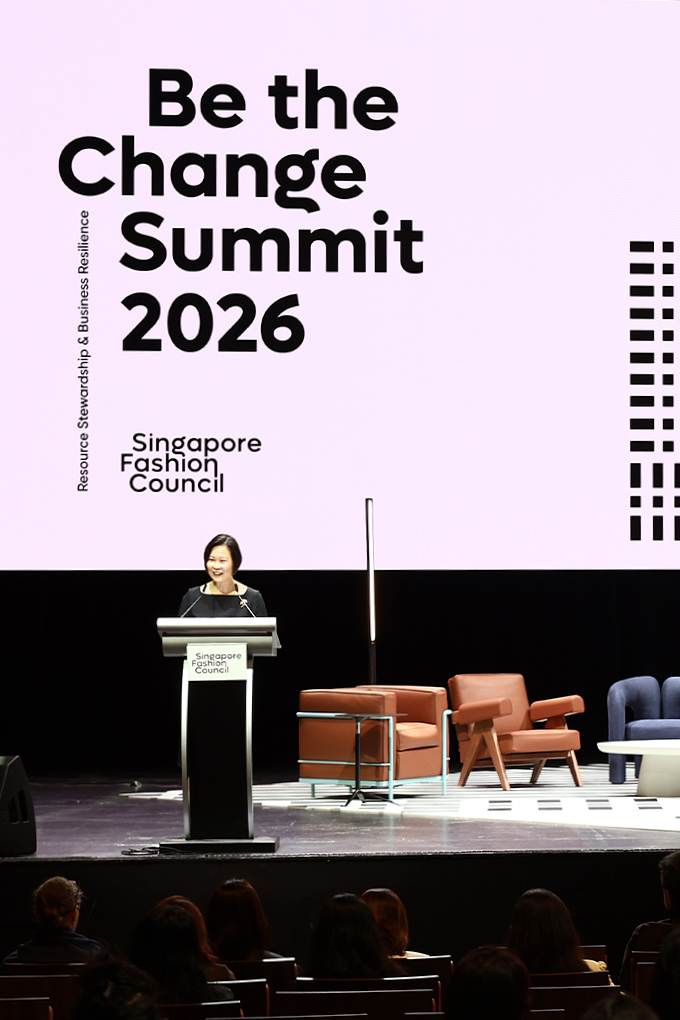
The Singapore Fashion Council (SFC) held the fifth edition of its Be The Change Summit on 1 October, an annual gathering of regional and international fashion leaders mapping out a more sustainable industry. This year’s theme, Fashion Futures: Resource Stewardship and Business Resilience, reflects a shift the industry is already feeling: sustainability is moving from a nice-to-have to a strategic business imperative.
By SFC’s count, mandatory Scope 3 disclosures reach major markets including the US and UK, requiring brands to disclose their supply chain emissions from 2027, with stricter supply chain due diligence rules following in the EU in 2028. For ASEAN manufacturers and brands, tracking and reporting now decides whether they stay in the global market. With Minister of State Gan Siow Huang as guest of honour, SFC answered with four announcements: a readiness tool for suppliers, a regional baseline, the third Impact Award winners and Singapore’s seat in the Fashion Cities Coalition. Below, the key highlights from SFC’s Be The Change Summit 2026.
On the launch of Sustainability Readiness Intelligence

The centrepiece of the summit was the unveiling of Sustainability Readiness Intelligence (SRI), which SFC calls an industry-first tool for ASEAN’s manufacturers and brands. Businesses answer more than 50 questions and are assessed across five dimensions: governance and strategy, environment and operations, responsible supply chain, circularity and design, and market readiness. They receive a personalised scorecard, plus a timed roadmap of short-, mid-, and long-term actions, with relevant certifications and resources.
SFC chief executive Zhang Ting-Ting said the launches will allow Asia to “claim its seat at the global table”. The need shows in the baseline report SFC commissioned from research agency South Pole: none of the surveyed brands track their greenhouse gas emissions, only seven of 15 manufacturers do, and no respondent measures or plans to measure water use, even though Scope 3 accounts for 80 to 90 per cent of textile industry emissions.
On the Sectoral Plan and what comes next

Alongside SRI, SFC launched its multi-year Sectoral Plan, a general guide to the sustainability tools, frameworks and resources available to fashion players in Singapore and ASEAN. The baseline report behind both calls for shared frameworks, harmonised regulations, digital traceability systems and collaborative pilots, and positions Singapore as the region’s bridge and accelerator. A Playbook turning the findings into industry-wide action plans is due in January 2027.
On the Impact Award winners

Minister Gan presented the third Impact Award, which drew 48 applications from seven countries across Singapore and Southeast Asia. Thailand’s Moreloop won the organisation category for connecting manufacturers’ surplus fabric with businesses and designers, while Indonesia’s Riversole, a collaboration between Indosole and Sungai Design, took the project category for turning waste recovered from rivers into new materials and products.
Nicole van der Elst Desai, chair of SFC’s Sustainability Steering Committee, called the winners “living proof that responsible fashion is both achievable and commercially viable in Asia”, while stressing that scaling them takes policy, infrastructure and consumer demand working together.
On joining the Fashion Cities Coalition

SFC also announced that it is Asia’s only representative in the Fashion Cities Coalition, which brings together industry representatives from Copenhagen, Cotonou, Dubai, London, Milan, New York, Paris and Singapore to accelerate circular, regenerative, transparent and socially fair fashion models by 2030. SFC will host the coalition’s Singapore Relay from 13 to 15 January 2027, a workshop feeding an International Best Practices Library and local roadmaps with impact tracking.