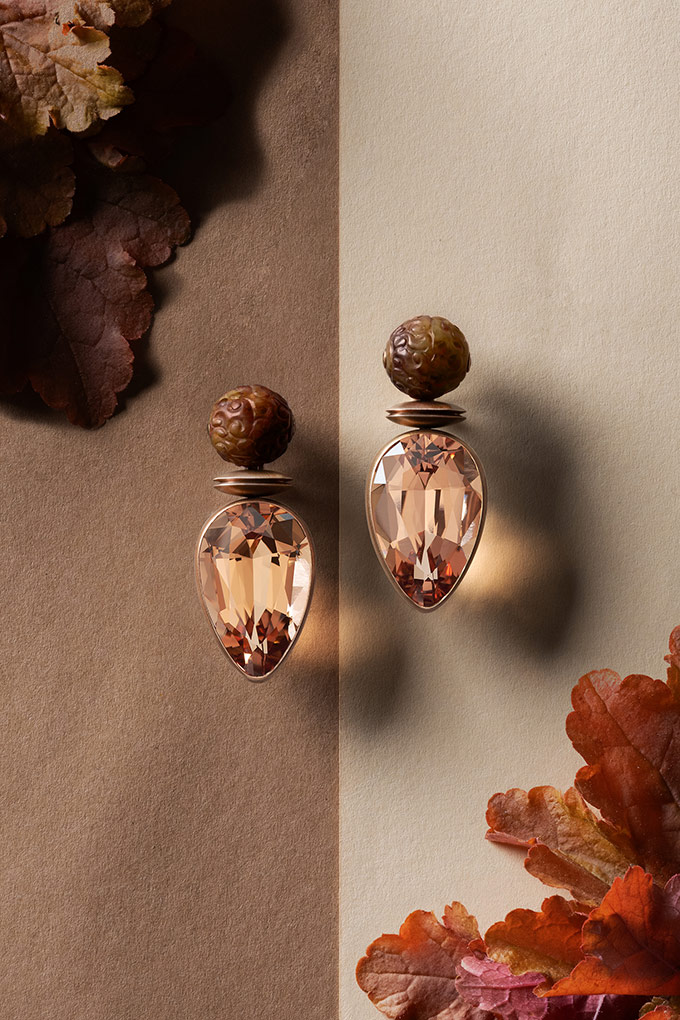
Bronze, aluminium, copper and wood. Do these sound like the rare, noble materials used in fine jewellery? Not usually; not unless, that is, you are the German house of Hemmerle. Through humble materials and a particular, unique perspective on jewellery design, this family-owned and run firm has become one of the most striking makers of fine jewels in the world and among the most collectible names around.
Hemmerle was originally founded in 1893 by brothers Joseph and Anton Hemmerle as a goldsmithing company that specialised in crafting medals and orders. Their clients included the Bavarian royal family, and in two years the Hemmerle firm was appointed purveyors to the Bavarian court, and gained renown for the jewels it crafted for King Ludwig III, the last King of Bavaria.
Such storied heritage and history, in the service of literal royalty, could have taken this house down a road well-tread by now. It might have been inherited by increasingly disinterested generations of the family, sold in the 1990s perhaps to a then-nascent and acquisition-hungry luxury conglomerate, expanded globally at speed, ridden the massive wave of European luxury goods exports, and perhaps even become a household name.


That, thankfully, was not the case. The Hemmerle brand has been inherited by passionate successors—today, it is run by fourth generation Christian and Yasmin Hemmerle, with the support of their predecessors Stefan and Sylveli Hemmerle. The brand’s headquarters and workshops are still located on the fashionable shopping boulevard of Maximilianstrasse in Munich—though it did relocate and move in 2025 to a new address down on the same avenue.
And while it has gone its own way, a house of jewellery makers with over a century of history could have easily stuck to the traditions of gold, silver, platinum, diamonds, emeralds, rubies and sapphires. Instead, a little but powerful revolution arrived at Hemmerle in the 1990s thanks to a challenging commission.
Third generation proprietor Stefan Hemmerle was tackling a tricky order. A collector was looking for a diamond for his wife. She, an art collector, had very particular tastes. It is said that she detested flashy, ostentatious jewellery, and in fact wore Berlin iron jewels.

For the uninitiated, Berlin iron is a rare, connoisseur’s white whale of collectible antique jewellery. Prussia in the early 19th century was fighting its War of Liberation against the conquering Napoleon, and the government made an appeal to its citizens to trade in their gold and jewellery in an effort to raise funds for freedom. In return, the treasury would trade them cast iron jewels, finished with black lacquer, and many engraved with the phrase “I gave gold for iron”. The meaning, patriotism, and symbolism of these Berlin iron jewels became hugely popular then, and mark a moment in history when jewellery was treasured in a culture not for the intrinsic or traded rarity and values of its materials, but for what it represented.
Back to Stefan Hemmerle. This tricky client inspired the jeweller to revive the Berlin style, and he had his workshop craft a diamond ring in a simple band of iron. The collector’s wife didn’t love or jump for that particular ring, but no matter. Other collectors were intrigued by this austere, unusual material, took notice, and an idea was born. With it came the road map for the creative concept, direction and identity that has come to assert Hemmerle as one of the most innovative, modern jewellers in the world.

The ‘modern’ style of Hemmerle jewels is most easily recognised by these signatures. A purity of shape, with silhouettes that emphasise simple geometry. A circle is a circle. Earrings are often two circles on each side. A ring set with a cabochon is a circle with a circle; one with an emerald-cut stone, a circle with a rectangle; and so on. Colour is bold and assertive—most pieces tend not to feature more than three colours, and designs are made with shades and hues in the same family. And, of course, materials that make you go “huh?”. Signatures include burnished copper; anodised coloured aluminium, and stately iron with austere finishes and textures that reject the high-shine, high-polish diktats of jewellery design.

It’s not a surprise, perhaps, that this version of Hemmerle was born in the ‘90s. That was the decade that saw the rise of high-brow minimalism, and the haute-alternative look that the firm introduced found its place in the world of fine art, antiques and avant-garde design cognoscenti. Think, perhaps, of the German designer Jil Sander, who rejected the term ‘minimalism’ and tended to describe her creative ethos instead as ‘purity’. Purity of form, colour and material, as it were.
Today, the Hemmerle firm continues to make jewellery in much the same way. Fourth-generation Christian and Yasmin Hemmerle continue this distinct vision set out three decades ago, and work, even while the designs have the look of high-minded modern design, in an old-fashioned way. They scour the world for rare, unique materials—micromosaics and faience from the ancient world, for example; and of course rare gemstones to pique collector’s interests. The jewels continue to be made by hand, and each one by a single craftsman, in the Hemmerle workshop in Munich. Production is limited and defined quite simply by how much time and work each piece needs. Because every jewel is one-of-a-kind, there is no mass production mold to follow. Hemmerle releases jewellery on its own time, and its creations are highly covetable collector’s pieces—art jewels that are said to be the antique treasures of the future.
Here, the Hemmerles let Vogue in on the secrets of their jewelled world.

How and why does something as simple as material make such a big difference?
Material fundamentally shapes the way a jewel is perceived. Each possesses its own colour, texture, weight and structural behaviour, all of which influence the final composition. Aluminium, for example, allows us to introduce lightness and colour in ways impossible with traditional metals. Bronze contributes warmth and depth, while copper offers richness through its patination possibilities. Materials are not neutral components; they carry emotional and visual characteristics that are central to the identity of a jewel.
The Hemmerle aesthetic we know today was created in the 1990s. How much of the brand’s history before that still influences what you do today?
More than many are immediately noticeable. While Stefan Hemmerle established the contemporary language for which the house is known today, it was built upon foundations laid by previous generations. Our origins as medal makers instilled a deep respect for craftsmanship, engineering and technical precision. The willingness to innovate, experiment and challenge established conventions also predates the 1990s. The visual language may have evolved dramatically, but the spirit behind it remains deeply connected to the house’s history. The knowledge passed down through generations, and the use of specific techniques which have developed over the whole span of our workshop’s existence are just a few such elements.

Hemmerle produces a very limited number of pieces out of its Munich workshop, and each is a one-off. With such quantities, what is the process of matching a creation with a client like?
It is less a process of matching and more one of discovery. Every jewel possesses a distinct character, and collectors often respond to pieces in ways that surprise us. We spend time understanding what excites them, whether that’s colour, materials, craftsmanship or collecting history. The most meaningful relationships emerge when there is an instinctive connection between the collector and the creation. In those moments, the jewel almost finds its own perfect home.
Before a creation even reaches that stage, there is often a long period of searching and sourcing. Finding the right gemstone, historical object, artefact or material can take months and sometimes many years. We are often looking for highly specific qualities of colour, shape, texture or character, and patience is an essential part of that process. Some jewels begin with a material or stone that we may have been waiting years to find.
Because each creation is unique and made entirely within our Munich atelier, the number of jewels we produce remains intentionally limited. This allows every piece to retain its individuality and ensures that each collector’s experience feels deeply personal. Ultimately, our role is not simply to sell a jewel, but to create the circumstances in which the right collector and the right creation can discover one another.
Which of these elements is the most important in the design of a Hemmerle jewel: colour, shape, or surface finish?
It would be impossible to separate them because they function together. If we had to choose a starting point, it would perhaps be colour, as it often provides the first emotional impression. However, colour only achieves its full potential through form and surface. Shape gives structure to colour, while texture influences how colour is perceived. The most successful creations emerge when all three elements are in complete harmony.

Jewellery craftsmanship has historically been heavily influenced by the French. As a German house, are there any techniques or signatures that Hemmerle uses that are different?
German craftsmanship has traditionally been associated with technical rigour, engineering precision and problem-solving, qualities that are deeply embedded within our work. Everything is made within our Munich atelier, where traditional goldsmithing exists alongside continual experimentation.
Tell us about some of Hemmerle’s more recent creations. Are there any new materials, techniques, or design concepts that the brand is exploring recently?
Our interests continue to evolve, but we remain particularly fascinated by materials and techniques that challenge expectations. We’ve recently explored a variety of historical artefacts, ancient glass beads and unconventional materials such as acorns whose individuality contributes to the narrative of a piece. We are especially interested in materials that carry a strong sense of character and invite a dialogue between nature, history and contemporary craftsmanship.

Technically, we continue to develop and refine techniques within the atelier, finding new ways to work with colour, texture and unexpected material combinations. More recently, we have completed works incorporating the historic Japanese Mokume-gane technique, which creates beautifully layered woodgrain-like patterns within metal through an intricate process of forging and laminating different alloys. We are particularly drawn to the organic quality of the resulting surfaces and the way the technique celebrates material transformation through craftsmanship.
At the same time, we continue to explore and expand our work with anodised aluminium, the revived Austrian knitting technique, historic artefacts and unconventional materials. The objective is never novelty for its own sake, but rather the discovery of new possibilities and new ways of expressing beauty.

There are a lot of winds blowing about in jewellery these days. The price of gold has gone up, and jewellers are either finding new materials or raising prices. I’m simultaneously seeing a renewed focus on classical investment-grade gems like sapphires, emeralds, rubies; and the rise of ‘new’ alternative investment gems like rubellites, Paraíba tourmalines and spinels. Because Hemmerle creates and operates more like art than commercial jewellery, it seems to sit in a strange space amongst all this change. Can you comment on that?
We have always approached jewellery primarily through creation rather than commerce. While material values and market preferences inevitably change, our focus remains on producing objects that possess lasting artistic and cultural relevance. Some collectors are drawn to exceptional classical gemstones, while others are fascinated by unconventional materials. What unites them is a desire for originality, craftsmanship and authenticity. Our responsibility is to remain faithful to the values that have guided the house for more than 130 years and to continue to evolve and expand our creativity in ways that excites us and our audiences.