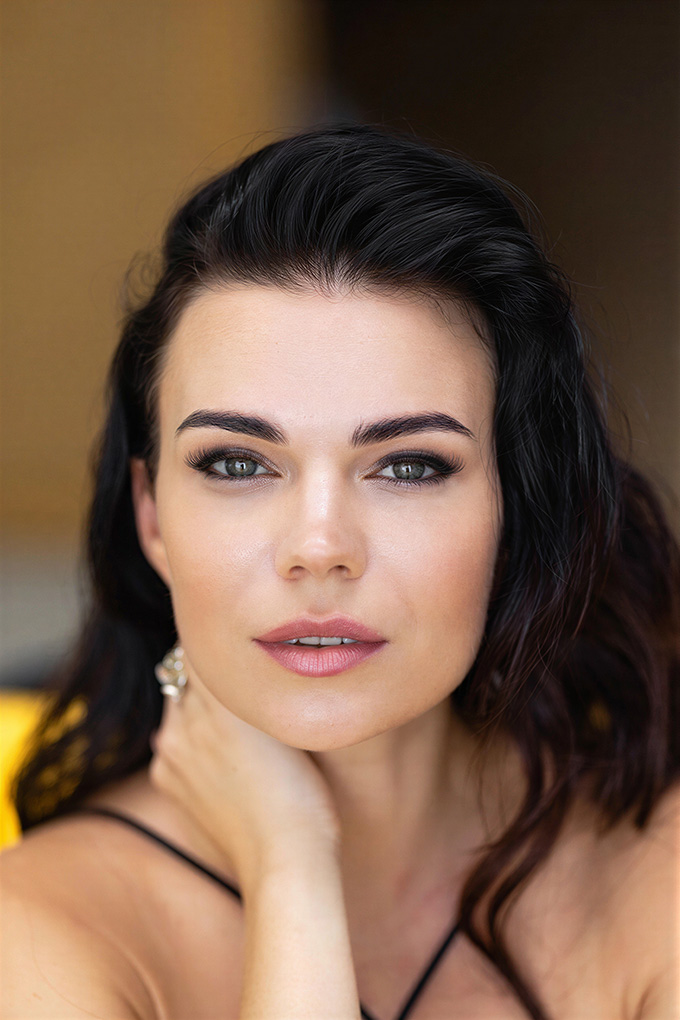
Acting has always been at the core of Kristina Pakhomova’s life. Her formative experiences on stage has carried her through every stage of her life, from being an actress to a writer and producer and now, an acting coach and entrepreneur.
Inspired by her own mother’s career as a performer, she began her creative journey in Russia, before pursuing her education in Singapore and staging plays across Asia. She soon swapped time spent in front of a crowd for a seat behind the camera, dabbling in production and filmmaking before establishing her very own KrisP. Production, a platform dedicated to original works in film and theatre.
That was only the beginning. Having written, produced and performed in several projects, her end credits took her to the global silver screen. Pakhomova’s debut short film Away gained recognition at the Cannes Indie Cinema Awards and X World Short Film Festival in Rome, clinching the Best Female Supporting Actress award.
Stepping away from the limelight, Pakhomova now spends her time as an educator, using acting and performance as a tool to empower others. She founded Authentic Transformation Academy (ATA), training corporate executives and leaders with techniques typically found on stage—working with breath, voice, body and emotions—to help them communicate authentically and effectively in their own professional spheres.
That’s where Pakhomova’s mission lies: authenticity. For the multi-hyphenate, an authentic voice and a deep connection with the inner self is what matters most. She opens up to Vogue Singapore on acting beyond the stage, empowering women in the male-dominated workplace, and what confidence and power really means.

How did your background in acting and performing lead you to start Authentic Transformation Academy?
Through acting, I had the opportunity to embody many different characters from different life paths, and that made me very empathetic and intuitive to other people’s pain, struggles, and intentions. As I got older, I realised that what fascinated me most was not the performance itself, but the human being behind it. For me, acting is the deepest study of human behaviour.
The shift to executive training happened during COVID. Theatres were closed and I couldn’t perform, so I began teaching acting lessons. At first, I worked with actors, but soon non-actors started joining: entrepreneurs, executives, and people from completely different industries. What struck me was how powerfully these tools worked for them too. It became a way to understand themselves on a deeper level. That’s how Authentic Transformation Academy was born. It’s a space where we don’t teach people how to perform but how to reconnect with themselves.

How do you use acting methodologies to transform the way people speak, move and express themselves?
What I’ve noticed over the years of teaching is that most people try to improve communication from the outside. They focus on how they sound, what they say and how they look. In doing so, they lose touch with themselves. They become overly focused on social judgment and become self-conscious, thinking about how they’re perceived rather than being present in the moment. But communication is about presence, and it all begins internally.
I’m currently in the midst of launching my first online course, based on a methodology of my own. It sits at the intersection of professional acting techniques, psychological and emotional awareness, and nervous system regulation. It is tailored around five core elements: energy, emotions, body, breath and voice. Understanding how they work in tandem with one another builds powerful communication and confident expression, before ultimately becoming a natural extension of yourself.
What are some lessons you’ve learned from using the principles of acting and performing beyond the stage?
One of the biggest lessons is that we are all performing, in a way. We have roles at work, in relationships and in society. We tend to forget who we are underneath these roles. As a result, we try to maintain an image rather than being present. But you don’t need to be perfect, you need to be present. People don’t connect to perfection, they connect to something real. Acting teaches you very quickly that people don’t always remember what you say but they won’t forget how you make them feel. I think this applies to instances in life even outside of acting, from leadership and communications to relationships. Truth always lands stronger than performance.

Many corporate workplaces are traditionally male-dominated. How do your workshops empower women in the workplace?
I work with many women who are incredibly capable, intelligent and accomplished, and yet, I find there is often something holding them back. They will come with requests to ‘fix’ themselves—wanting to be softer and gentler, believing they’re too strong, direct or intense in the workplace. They believe that is what prevents them from building meaningful relationships.
Over time, they learn to adapt as they try to fit into systems that weren’t necessarily designed for them. Many women disconnect from their natural strengths in that process. This is where my workshops step in—helping them reconnect with themselves. When a woman is grounded in her own body and trusts her own voice, everything changes. She no longer feels the need to prove herself, and becomes clear, present and impactful.
Femininity is not only soft and gentle. It also knows when to say no and when to stand ground. It can be powerful, expressive, and unpredictable. Femininity is a whole spectrum, and women should have access to all of it, not just the acceptable parts. When it is integrated instead of suppressed, it becomes a strength.
What does confidence and power mean to you?
To me, confidence is simply the ability to stay connected to yourself. It is accepting yourself in the present moment, even under pressure or when things feel uncomfortable. You don’t become confident by performing confidently—you become confident by connecting with yourself. Power, on the other hand, is about alignment, when your emotions, body and voice align with one another. There is a calm strength that lies within. The moment you shift your focus from yourself to the audience and what you can give them, everything changes.