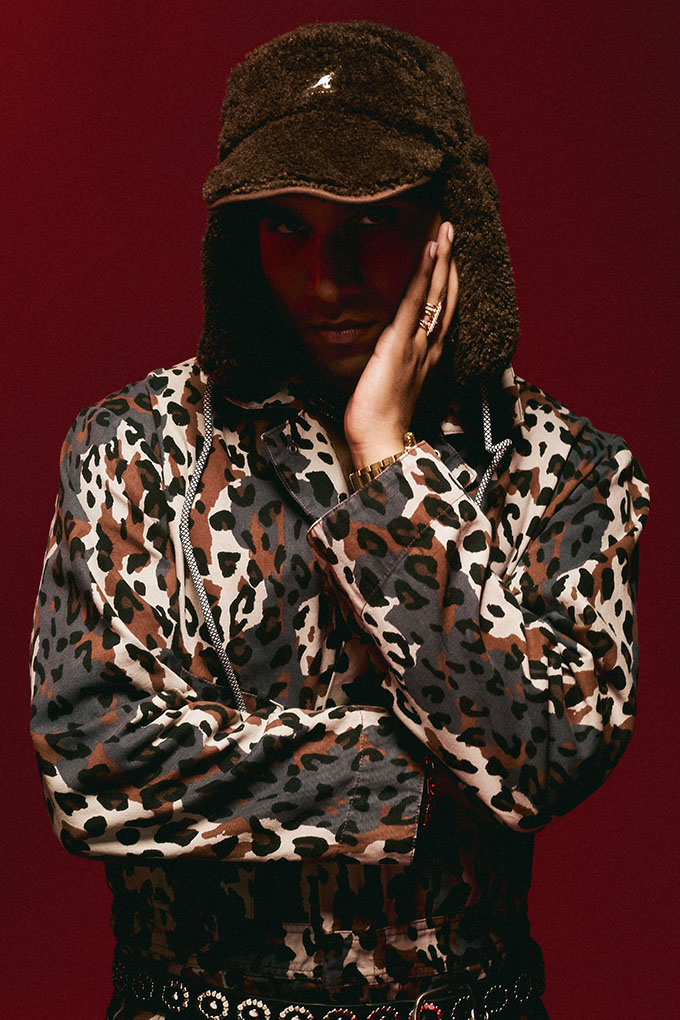
Yung Raja is not here to pull any punches. The local rapper has been a staple of our music industry since he stepped onto the scene in 2018. It feels like an age ago since his first single, ‘Mustafa’, hit the airwaves, but Raja hasn’t slowed down in the slightest.
After that initial release, he was signed as one of six inaugural artists to join Def Jam Southeast Asia, a career milestone that signalled his place in the fabric of regional hip-hop. The subsequent years saw his music—an arresting blend of witty insights and swaggering flow borne upon bursts of Tanglish lyrics—connect with audiences around the world.
Singapore is hardly known for being kind to musicians, though. So while Raja, of course, knows what it means to have edge—it’s part and parcel of the flavour of hip-hop he has always championed—more than that, he knows what it takes to persevere. In a country where the cultural mandate to put our nose to the grindstone is baked into our collective DNA, Raja’s creativity continues to push boundaries.

A new era of the rapper’s career is upon us, one that has been slowly, but surely, coalescing over the years. He now finds himself at a crossroads facing a trifecta of creative opportunities—and he’s not backing down.
He has collaborated with Jay Park ahead of an upcoming body of work that looks to expand his musical horizons; his partnership with local fashion label Pharaoh’s Horses has brought him to Paris Fashion Week and back; and after a lifetime away from the set, he’s returning to his childhood roots as an actor.
The creative pipeline is clearly packed, but Raja is confident the payout will be worth it. To find out more, Vogue Singapore sat down with the rapper to learn how he plans to navigate these brave new worlds.
“Momentum is key. Greatness takes time. To build something that has a legacy is the work of a lifetime.”
What does being a multi-hyphenate mean to you in this new era of Yung Raja?
What it means to me is legacy. As I turn 30, I think about my goals and aspirations, and I know I’m nowhere near done. I have big ambitions, and legacy is everything. It’s the future, the life that my kids are going to live. To make the best of my circumstances, I’ve learnt to put my eggs in different baskets and to juggle that successfully requires authenticity. I’m always thinking about what feels real and authentic to me in terms of my passions.
What’s the common thread uniting your love of these creative pursuits?
Self-expression has always been front and centre in my life. When I was as young as four years old, my family realised that I enjoyed being the centre of attention. I was the class clown, the guy making people laugh, the one who talked too much. Now, that self-expression is being exercised as part of my work in music, fashion and acting.

You’re juggling a lot. Who’s inspiring you to keep pushing through it all?
Every time I feel like I’m working too hard, I always think about my dad, who moved to Singapore on a whim with three daughters, his wife and my late grandmother. When I think about what he must have gone through, the difficulties and hardships that he must have faced, it puts things in perspective. As an only son born to elderly parents, I’ve had a vision of responsibility since young. That vision keeps me going.
I’m grateful for how far I’ve come, but I know I have to push past all these layers of comfort that you might look at as a reason to settle or slow down. Momentum is key. Greatness takes time. To build something that has a legacy is the work of a lifetime.
Your single with Jay Park, ‘Missed Call’, is a massive hit. How did that come about?
In the last few years, I started feeling a bit uninspired by the music that was out there. I felt like I needed to find a new energy. So Riidem (my producer) and I locked ourselves in a place far away from Singapore for six months. We made 50 songs just to understand how we could get back to the love of making music. ‘Missed Call’ was one of the few songs that moved us.
We made it in one sitting. I think it was one hour of creating the beat and recording it all, and then we were done with the demo. It was magical, capturing a moment that felt fresh and new. Then Jay Park, whom I’ve been friends with since 2018, reached out to me to perform on the Singapore leg of his world tour. The timing was just crazy.
I sent him the track and he sent his verse back in a day. I didn’t discuss anything with him in terms of writing direction. He just asked for my lyrics and the translation. To my surprise, he opened his verse with a bunch of Tamil words that I sang for the chorus. It wasn’t planned but ended up becoming a cultural crossover unlike anything we’ve seen, between Korean and Tamil. A God-given moment.

Creativity and entrepreneurship are two sides of the same coin. In that vein, what does your partnership with Pharaoh’s Horses mean to you at this stage in your career?
It’s been a long, long time coming, but working with Feroze McLeod on Pharaoh’s Horses has been a dream come true. Since we partnered up, we brought the brand to Paris for Fashion Week, where I was able to gift some of the pieces to artists like Nas, Kehlani and Jackson Wang.
I’ve only been able to do that because I see Pharaoh’s Horses as a natural extension of my creativity. This goes for all my other ventures, too, whether that’s Disrupt, the marketing agency I’m part of, or Octav Sound, the recording studio and artist distribution platform I run with Omar Kenobi and Riidem. They’re different parts of my creative universe and different aspects of my DNA as an artist.
What does it feel like to return to acting as an adult with all this breadth of professional experience?
It feels like a major full-circle moment. Since I was a kid, my biggest dream was to be the lead actor in a drama, to be at the top of the call sheet. Before rappers, some of the Tamil actors that I watched growing up, like Rajinikanth, were my first superheroes. While I got to star in minor roles in different productions over the years, there weren’t that many projects that I could get myself involved in, since I had school. Then music came around and that changed my life. Now that I’m back, I couldn’t be happier. We have a brand-new drama that is premiering in September on Vasantham that I cannot wait to share more about when the time is right.

You’re a local artist who, for better and for worse, knows what needs to be done in order to keep the engine churning, to push boundaries and grow in a culture that, historically, has been resistant to that mindset. Where do you see that culture in the next few years?
I see the culture evolving. People are becoming more receptive to the idea of breaking outside Singapore. They’re not thinking that the only way is to move to another country. In the past, that’s been the most common way of thinking, to point to what JJ Lin or Stefanie Sun did. But I never felt that way.
Singapore is home. I’ve never entertained the idea of leaving because I take care of my parents and I’m very close to my family. This country’s small, but that doesn’t mean you need to ditch the pursuit of a global footprint. You can do it here. The world’s so connected now, borders and boundaries are getting blurred. There’s no real separation anymore. It’s just about whether you’re comfortable with putting in the work.
Thankfully, more and more Singaporeans, especially younger artists, are being inspired by the idea of being a Singaporean who is also global. That’s what I stand for. I hope more of us can feel proud of the fact that we’re Singaporeans. It’s an exciting future ahead of us.
Pre-order your copy of the Vogue Man ‘Pursuit’ issue online or pick it up on newsstands from 15 April 2026.