At just 21 years old, Stéphane Rolland was appointed artistic director of Balenciaga—the youngest ever in Paris—following an apprenticeship under Cristóbal Balenciaga himself. At 30, he was recruited to the House of Scherrer to revive its haute couture division; and so he did, a mission he accomplished over the following decade as he won back the maison’s clientele. At 40, he established his own eponymous haute couture maison.
This legendary run by Rolland is one of the rarest in recent history for a creative director. By the time I meet the couturier—two decades after the last of those milestones, and just days before his haute couture fall/winter 2026 presentation in Paris—his career has already spanned nearly five decades. Marked by a painter-like stroke of the hand and an architectural fixation on volume, Rolland has surpassed the point of needing to say something in his collections. Instead, he simply seeks to further a singular narrative, one he tells me is his “dedication to women”.
View this post on Instagram
Rolland found his calling to fashion at just four years old, designing garments on paper. He attributes a large part of his training and current design ethos to what he learned growing up sitting next to his mother, who worked at the renowned black-and-white photography studio Pictorial Service; carving his flair for contrast, movement, silhouette. As an adult, Rolland honed his savoir-faire from his masters in Cristóbal Balenciaga, Oscar Niemeyer, and Constantin Brâncuși. Today, his illustrious client roster includes the likes of Beyoncé, Rihanna, Teyana Taylor, and Queen Latifah among those who have personally selected Rolland to dress them. JLo has already jumped on his haute couture fall/winter 2026 collection for her personal birthday celebration, a mere day after it was shown in Paris.
And yet, for all the name-dropping, very little is known about the French designer, who has remained largely out of the spotlight. “I don’t have a big ego to prove that it’s my creation, that I have designed something,” says Rolland. “My goal is to make women powerful and happy, and the rest is not very important.”
View this post on Instagram
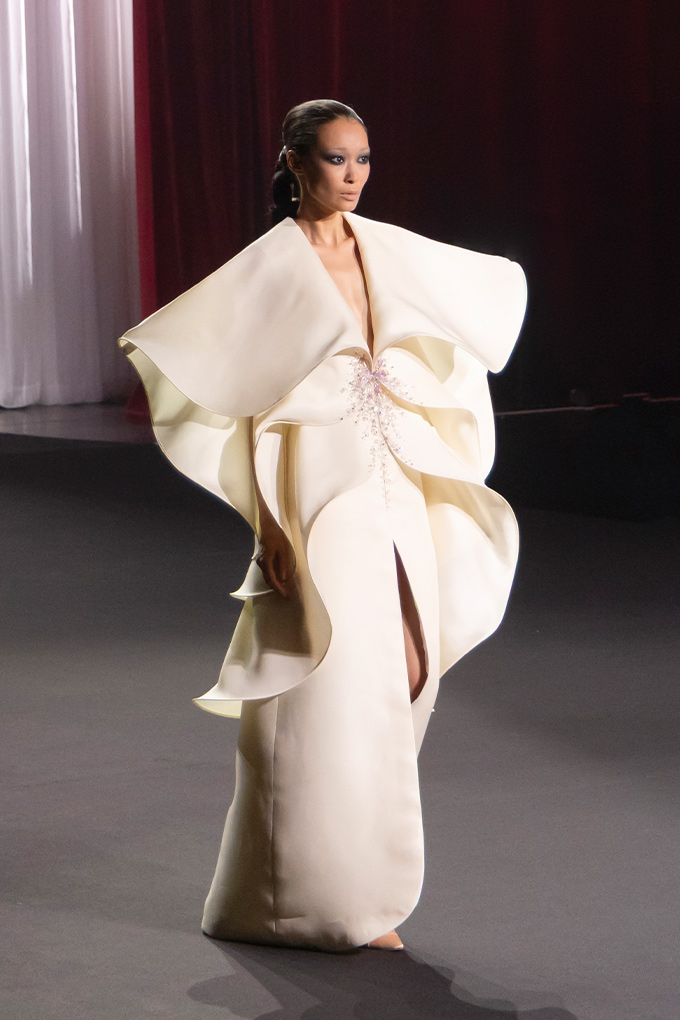
For fall/winter 2026, Rolland turned to the enduring French icon Dalida, whose legacy embodies strength and vulnerability, four decades following her death. Born in Cairo, and shaped by Mediterranean, French, and Italian influences, Dalida embraced her dual Middle Eastern-French identity long before cultural diversity became a celebrated value, leaving her body of work surprisingly contemporary. What is most remarkable is Dalida’s conviction in the face of it all; withstanding the scrutiny faced by her contemporaries surrounding her heritage, she turned to fashion as a means of resilience upon her comeback show at Olympia Hall, where Rolland held his presentation.
“It was that unique way great performers stood before an audience, exposed and invincible at once,” writes Rolland, in his collection notes. “Dalida instinctively understood the power of clothing. That idea remains at the heart of my work: creating garments that reveal the individual rather than erase them.”


Rendered entirely in white, the collection captures Rolland at his core: his lifelong pursuit of purity as a design principle, an absence of colour in favour of silhouette, and obsession with the gazar fabric—which was originally created for Cristóbal Balenciaga, and has accompanied Rolland’s journey since he was a 21-year-old designer at the house.
In conversation with Vogue Singapore, Rolland dives into designing like a “therapist” for women, his reasoning behind each fabric choice, and the inspirations behind his haute couture fall/winter 2026 collection.

At 20, you became the artistic director of Balenciaga. At 30, you became one of the youngest designers at a couture house for House of Scherrer. At 40, you founded your own haute couture maison. Looking back now, what has remained steadfast in your philosophy?
To be curious, humble, and keep my feet on the floor. I never fly too much. I observe the world in a very realistic way, to observe with humility—to understand the economy, to understand life. By understanding how the world is evolving and its philosophies, I can find my vision for the future. When you understand all of this you have the key, and you can start to make your own decisions. This is my philosophy. We are like little powder in this world, and we’re just here for a while, and what I want is to give the maximum I can.
There’s something you’ve mentioned before that I’m curious about: “Nothing could be worse than noticing the dress before the woman.”
I don’t have a big ego to prove that it’s my creation, that I have designed something. My goal is to make women powerful and happy, and the rest is not very important.
Ultimately, I don’t want a woman to buy a dress because it’s the dress of the season. There is nothing worse than to see the dress before the woman. That is terrible. When the people say, “Oh my god, the dress so beautiful,” I know that they want to say to the designer that the dress is good, but I know that they are also talking about the woman—and I want people to say, “Oh my god, look at this woman, she’s amazing.”
At the recent Cannes Film Festival, I dressed Joan Collins, an icon of English and American cinema. I’ve known Joan for a long time, she’s 92 and she has nothing to prove, nothing. At Cannes, everybody saw Joan—rather than Joan with the dress, and it was spectacular. No embroidery, no sparkles. The dress revealed the beauty of Joan at 92 years old. It was pure. She appeared in a new light.

Purity seems to be the thread through everything that you have done. How do you view purity? Is it an emotion or simply a matter of restraint?
Both. When you’re talking about purity as minimalism, it’s very difficult to grow and not repeat yourself after so many seasons. I’ve been designing for a long time now, and when you want to be minimalist, it’s great, but it’s the most difficult thing, because you always have to show something new, something creative, and with a pure line, and not repeat yourself. It’s a very big challenge, very big.
The key to answering this challenge is the partnerships with—and this is a treasure for me—the artists, sculptors, and brothers, musicians. Everybody who can help me and share their art. It’s super important to be surrounded by artists.
View this post on Instagram
In staying in your DNA, you return often to gazar, duchess satin, and silk crêpe. What qualities do you find in these fabrics that continue to challenge and inspire you?
Every fabric has a reason. The gazar is an animal, with very wild movement, you cannot capture the gazar. The crêpe falls and reveals the shape; the chiffon is flying, creating yet another kind of movement. Where the crêpe gives sensuality, the chiffon provides fragility. Velvet is very important for the deepness of the colour, to reveal the jewellery, like the box of jewels. When you have a beautiful black or red velvet dress, and you put a brooch or a necklace, the diamonds are revealed completely.
Would gazar be the one fabric that has shaped your design language?
Definitely. It’s really like a sculptor choosing a particular marble, and having his favourite block of marble. Gazar is mine. It was a revelation. I had met the people at the factory who created the fabric back in the 80s, and they explained how the gazar fabric was created for Mr. Cristóbal Balenciaga himself. When I discovered this fabric at age 20, I touched it and immediately said, “Oh, what is this?” I had never touched something like this before.


Your work is very architectural and structured, yet there’s a remarkable fluidity every time you see the dresses finally moving on stage. How do you reconcile structure with such emotive movement?
You cannot live without emotions. I find a theme each season to tell a story, like a film director. Maybe it’s not an obligation, I do it more for people to understand where I want to go.
Claude Lelouch, the iconic French director, is another example. He’s now 87 years old. We are close friends, and I have a huge admiration for him. He has a vision of life that I completely share. For one of his movies—Un homme et une femme (“A man and a woman”)—he did it with no budget, black-and-white, and unpaid actors. He directed that movie with nothing, and yet it remains one of the most iconic movies I have ever seen, because emotion was at the core of it. He captured every single moment with just the expression of the eyes, the lips, the movement of a hand. Every minute was important. It’s exactly the same way I want to express the sensitivity, the feelings in my collections.
View this post on Instagram
That being said, what story are you telling with your haute couture fall/winter 2026 collection? Were you drawn to any particular fabrics, techniques, or narrative tools?
This show is dedicated to the icon, the singer Dalida. Born in Egypt, she arrived in Paris in the 60s, and became one of the most iconic and popular singers in France. It’s the 40th anniversary of her death this year, and even now, the new generation is dancing to her music—but they don’t know the Dalida of the ’70s. People see her now as a disco queen, but at the time, she was everything but. When you understand the life she had, she was such a deep person, and very sensitive, very emotional.
There is just a touch of red on one dress, because the first dress worn by Dalida in the Olympia Hall was a red velvet dress. Otherwise, everything is white, to show the cut, the shapes, the volumes, the attitude, the femininity, and the richness of the embroidery. All the embroideries are made of precious stones. A lot of rock crystal, amethyst, quartz. Many different stones, and new techniques. I’m super proud of my embroiderers this season, because they made something exquisite, absolute treasures.

What drew you specifically to Dalida in your new collection, and capturing this moment of the white dress?
You have to see the image of Dalida in the white dress when she returned to the stage in Paris, with the red curtain behind her. Everyone in the show business wanted her to fail—they were saying that she was finished. She was hated at that moment.
And yet, she arrived as if she were naked—just in a plain, white dress, which could be boring, you know. And yet, she arrived with a white ray of light on her blonde hair, the pure, clean shape of her white dress, and the voice showing her fragility—and in that moment, she won, and received a standing ovation. She went from having everyone wanting to kill her to becoming the queen. I started to draw looking at this photo of her at this moment, and it became the reference for this collection—this image revealed all the joy, the sadness, the trauma of her life.
When it came to expressing the colour of white, what drew you to embroidery this time?
I don’t embroider just to embroider. To make it more rich or more “haute couture”—no! I embroider where I need to put a light. It is like the moment where you observe the sea at sunset, and the reflection of the sun on the water makes the wave shine. It’s exactly the same. I want to put the reflection of light on my clothes.
When I was a child surrounded by photographers, they taught me how to work with the light and the shadows, the yin and the yang. This is why I don’t use many colours in my collections, because what I want is to go straight to the point and to sculpt. There are many different ways to express yourself, even if it is with one shade of colour.


After a lifetime in haute couture, what have women taught you about beauty in ways that fashion never could?
When the women are selecting me, they put their personal life and problems on the table. There is a lot of trust. My goal is to help them to answer their problems, and when I understand who they are, what they want, and where they want to go. I can advise them if they are wrong or right, if they made the right decision. I’m here like a therapist, in a way. I just work on the envelope, not the inside. When the envelope is good, it’s good for the inside, good for the brain.
Women teach me everything. From my childhood, each woman in my life has put one more stone to build my tower, and that’s why I’m dedicated to them.