When I was in my early to mid-20s, on the cusp of adulthood, it suddenly hit me that the people in my family who knew how to cook the dishes passed down to us for generations wouldn’t be around forever. My grandaunt, whom I called yi-po, had always run Chinese New Year like a general; she decided what dishes we would have and who would visit at what time. One of my favourite dishes on our table was Hakka Abacus Seeds—yam-based dumplings stir-fried with dried seafood and mushrooms. I still remember in the week leading up to Chinese New Year, I’d come home from school and find my grandaunt, grandmother, and our Filipino helper who I fondly address as jie jie in the kitchen prepping, and I would join in. I used to help roll the abacus seeds; that’s how the dish started. With repetition. With rhythm. With presence. Years later, when my yi-po began stepping back from the preparations, it became apparent that I was the only one who could carry this tradition forward. My mother doesn’t cook, not really. She’s exceptionally good at braised pork belly and duck, but Chinese New Year was never hers to manage. That was always my yi-po. So when she took a backseat, I felt the void. I very quickly realised that if I didn’t figure out how to make this dish, it would truly be gone forever. There was no recipe to begin with. No one had written anything down. But there were memories, fragments of instructions, leaving the dish to imagination. I tried several recipes I found online and tweaked them again and again. I adjusted the starch, the seasoning, and the ratios. I asked my family for feedback and got some vague advice and impossibly high standards in return. My grandmother said, “It doesn’t taste like when my mother made it,” but I’ve never met her mother, my great-grandmother, so I don’t know what it tasted like! There was a lot of trial and error, but I kept going. It mattered too much to me to give up. It took me three or four years of trying before I landed on something I felt was truly mine. And now that I have it, something I’m happy with, I’m the one who makes it every Chinese New Year. Every time I roll the abacus seeds, it brings the same memories back.

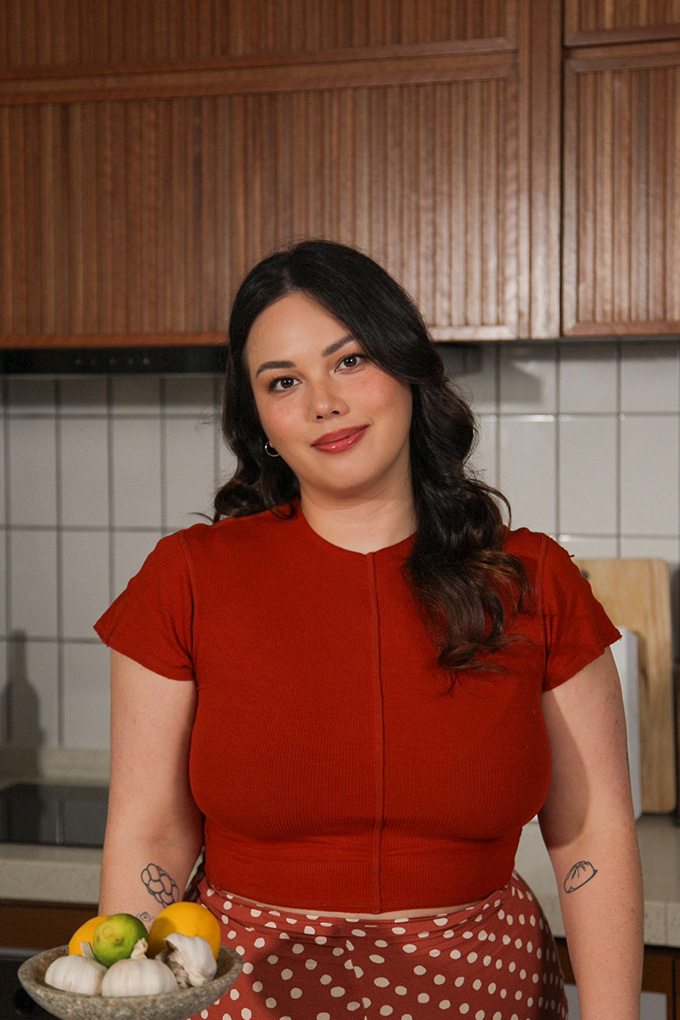
Growing up, the food on our table was very mixed. My dad is Welsh—he’d make roast lamb and potatoes. My mother is Singaporean Chinese, and our household consisted of my grandmother and grandaunt, who influenced what we ate. But the person who cooked for me regularly was our Filipino nanny, who was with us for over twenty years. She would make crème caramel on special occasions, and a salted egg and tomato salad, which I still think about to this day. My food heritage is all of that—Chinese, British, and Filipino. But for the longest time, it felt like I was not allowed to claim any of it fully. Growing up mixed, people often told me I wasn’t really Singaporean, that I was ‘ang moh’, an outsider. So when I started hosting TV shows, I was asked to represent Singapore, it felt like a massive responsibility because my relationship with being Singaporean took a long time to develop. I stuck to the basics. Chicken rice. Peranakan classics. The ones everyone agreed on. However, the more I researched, the more I cooked, and the more I understood that there is no single version of Singaporean food. We in Singapore tend to codify what constitutes Singaporean flavours or cuisine, but as Singapore changes and evolves, how much room do we make within that food culture for these new additions? It’s essential to celebrate what food heritage means to each person. Filipino food, for example, is rarely mentioned when we talk about our country’s culinary identity. And yet, so many of us were raised on it. Several families were shaped by the women who made those dishes. That deserves to be acknowledged as well. Over time, I’ve come to believe that food isn’t important because it tastes good. That’s too shallow a way to think about it. What tastes amazing to one person might taste awful to another. That’s not the point. What makes food matter—truly matter—is that it tells stories of people, families, and cultures. Cooking is one of the most human things we do—no other species cooks. And we don’t just cook for nourishment—we cook for meaning.

These dishes we inherit are meaningful because we assign meaning to them. We cook them because they anchor us. And in a place like Singapore—so young in the grand scheme of things, so constantly evolving—food is how we figure ourselves out. I think that’s why people here care so much about food. Because it helps us make sense of who we are. But we need to start treating home-cooked dishes like the family stories they are. What we eat at home isn’t something you can replicate outside—not in a restaurant or a hawker centre. And if we don’t try to preserve them, they disappear forever. If I’d waited even a few years longer to start figuring out the abacus seeds, I wouldn’t have had the chance to share it with the people who made it first. My grandaunt and my grandmother tasted my version while they were still alive. They gave it their stamp of approval. That matters deeply to me. Because if I ever have a child, that dish won’t just be mine—it’ll be a thread that connects generations. When people ask how they can preserve their family recipes, I tell them to just start and not to worry about failing or getting it perfectly right, but most importantly, to make it their own. The goal isn’t to recreate it perfectly but to make something that carries that legacy forward. I was overwhelmed the first time I cooked the abacus seeds for my extended family. I wanted it to be perfect. It wasn’t. Some people said it tasted different. Some questioned my choice of ingredients. But my cousins—all of us from the same generation—told me they loved it, that they liked it even more than our grandmother’s. That’s when I realised: it doesn’t need to be the same. It just needs to hold the same memories—the same feeling. So, now when I cook the Hakka abacus seeds, I feel the presence of the women who came before me. And that’s what I’m trying to hold on to; that’s how familial stories live—not just in words but through taste, smell, and memory.