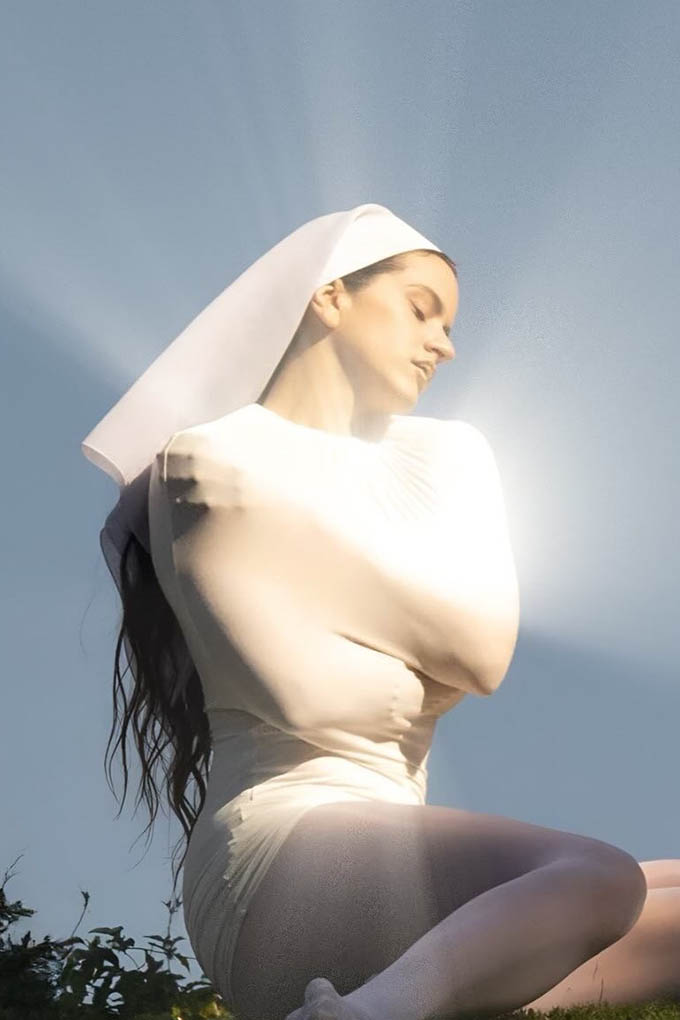
At the National Art Museum of Catalonia, a woman lies among a spread of white fabric in the centre of the room. The cloth spills out around her in soft folds, catching the light from above so it seems to ripple like mist. She is completely still, as if she were floating on a pale cloud. Her face is turned away from some nine hundred people in the crowd, unsure if they should approach. Then they realise who she is. It’s Rosalía.
This was the scene at Rosalía’s exclusive listening party on Wednesday for her album Lux. Hundreds of people sat in quiet awe, captivated by the spectacle before them and carried away by the melodies that drifted through the room. As the album played, it became clear that this experience was more than just listening. Like the scene unfolding around them, Lux feels like drifting into slumber and awakening in a divine world where Rosalía transcends genres to deliver otherworldly artistry.

Her latest album marks a bold departure from Motomami, which leaned heavily into reggaeton-pop and propelled Rosalía into mainstream stardom. Even then, it was clear that she offered something rare in today’s pop landscape. While Motomami was definitively pop, with hits like ‘Bizcochito’ climbing the charts, tracks such as ‘Saoko’, which featured a jazz piano breakdown in the middle of a reggaetón song, offered an early glimpse of her experimental streak.
With Lux, the visionary singer-songwriter pushes boundaries even further. The 15-track album includes a song cycle in four movements inspired by the lives of various female saints, intertwining 13 different languages and accompanied by the thunderous London Symphony Orchestra.
Each language on Lux brings its own rhythm, shaping the atmosphere of every song. On ‘Berghain,’ she moves from German to Spanish to English with such ease that the transitions feel almost invisible. The same can be said in the album; her voice resonating in each language seamlessly—operatic in the opening of ‘Berghain,’ tender and intimate in Catalan on ‘Divinize,’ haunting in Arabic on ‘La Yugular,’ fierce in Ukrainian on ‘De Madruga,’ and lyrical in Italian on ‘Mio Cristo Piange Diamanti.’ The result is a listening experience that feels so fluid, as if the album itself exists beyond the confines of any single language.

The lyrics on Lux draw on Rosalía’s own experiences with love and fame while taking inspiration from the lives of female saints. She has said that each language she sings in is linked to a different saint—singing in French evokes Joan of Arc, in Hebrew it draws from Miriam, in Ukrainian from Saint Olga of Kyiv, and elsewhere from Saint Rose of Lima and Saint Teresa. Through these stories, the singer reflects on her place as a woman and an artist, conflating it with the role of women in Catholicism, and considers the distance between divinity and human love, while revealing her frustration with the material world.
Musically, the album mirrors this emotional range. ‘Mio Cristo Piange Diamanti’ is a song of exquisite pain, with Rosalía delivering a breathtaking falsetto before the piece collapses into the operatic dying fall. ‘La Perla’ is a sentimental ballad about an untrustworthy lover, carried by sweeping strings. In it, she calls him an “emotional terrorist” and quips, “His masterpiece is his bra collection,” blending sharp humour with equally poignant emotion.

Even without analysing every lyric, Lux is a fully immersive masterpiece. Each song commands attention, packed with memorable musical moments: the sudden glitchy rhythm that cuts through the string arrangement in ‘Reliquia,’ the frantic, restless energy of the piano ballad ‘Sauvignon Blanc,’ and the dramatic surge and key change midway through ‘De Madrugá.’ The drama of the album, deliberate.

With Lux, Rosalía is canonised as the saint of pop. Every detail of the album demands attention in an age where everything moves too fast to notice. It offers a masterclass in artistry and reveals the untapped possibilities of mainstream music. In the singer’s own words, “artists aren’t giving you what you want, they’re giving you what you need.”