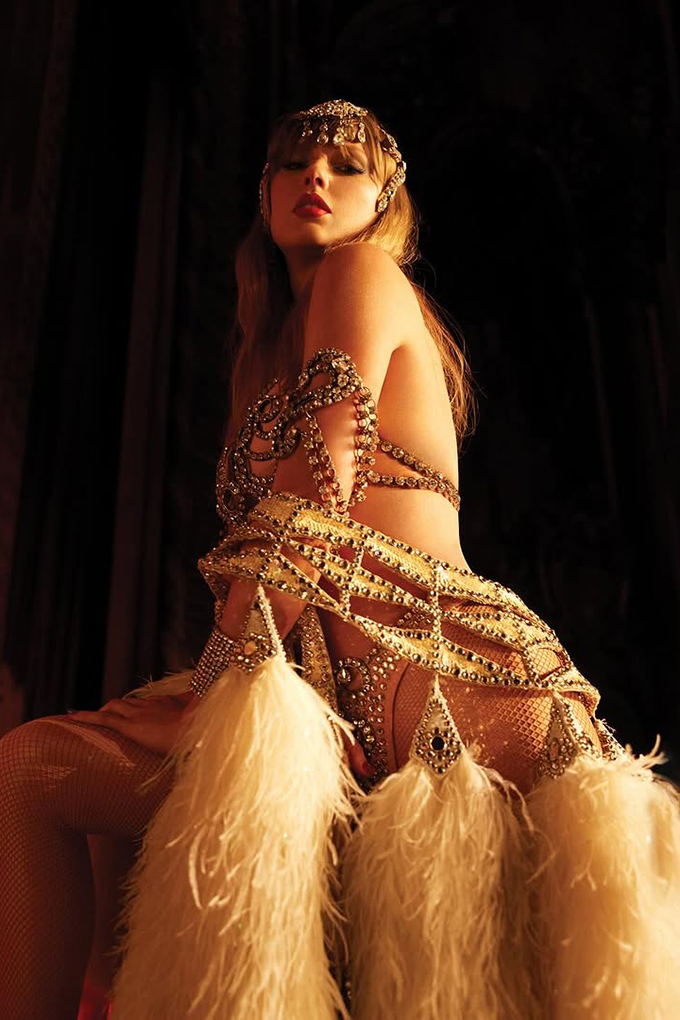
When Taylor Swift announced The Life of a Showgirl on the New Heights podcast, theories spread instantly. Many assumed the album would centre around her fiancé, Travis Kelce, with fans envisioning a new era of sequinned bodysuits and opulent headdresses. After all, Swift can still make the whole place shimmer.
The Life of a Showgirl marks her first album release since wrapping her record-breaking Eras Tour in December—the highest-grossing tour in history. In true Swift nature, the number of pre-saves The Life of a Showgirl broke yet another record: surpassing five million pre-saves on Spotify. At 12 tracks, it stands as one of her shortest albums to date, but The Life of a Showgirl sees Swift returning to pop with renewed focus—one she worked on with longtime collaborators and producers Max Martin and Shellback.
Despite the anticipation, when the album cover dropped, some were left puzzled. The image of Swift submerged in a bathtub with her smudged makeup and damp hair felt raw, intimate and unexpected. She may be wearing a diamond-encrusted bodysuit, yet the mood gleaned was far from the glitzy aesthetic the album title seems to evoke.
However, upon the first listen, it all clicks. Glamour might be woven through the album, but its heart lies in vulnerability. Beneath the synths and soaring melodies is a portrait of the showgirl not just as a star, but as a woman under the harsh spotlight of fame and scrutiny—something one might pick up immediately with the track ‘Elizabeth Taylor’, a direct reference to the known private life of the famed Hollywood actress, as tragic as it was famous.
Naturally, there were dreamy love songs that nodded to Kelce. But much of the album leans introspective—exploring the challenges of being a woman in love, referencing a Shakespearean tragedy in one, and the ghost of a late lover in another. With each track, Swift pulls back another layer.
Here’s everything you might have missed on your first listen of The Life of a Showgirl.

1 / 5
'The Fate of Ophelia'
The opening track of The Life of a Showgirl is an ode to Shakespeare’s Ophelia, a woman who laid in a shallow pond, letting the water fill her lungs as madness consumed her. Despite the tragedy tied to its namesake, ‘The Fate of Ophelia’ reimagines the story with a hopeful twist.
Some fans have called the track a direct counterpoint to ‘Lavender Haze’, her earlier song dedicated to ex-partner Joe Alwyn. In which she voices the emotional disconnect of a fading relationship with the lyric, “you don’t really read into my melancholia.” In The Fate of Ophelia, however, the line “I might’ve drowned in the melancholy” marks a quiet but powerful shift. Where ‘Lavender Haze’ spoke from a place of feeling unseen, ‘The Fate of Ophelia’ acknowledges the same emotional weight—only this time, she rises from it.
As the lead single, the track sets the tone for an album that emphasises holding onto optimism even in the face of adversity.

2 / 5
'Elizabeth Taylor'
On the second track, Swift references old Hollywood, name-dropping Elizabeth Taylor—and the reference is anything but random. Elizabeth Taylor, known as much for her iconic screen presence as for her eight marriages, lived a life under intense public scrutiny. But behind the dazzling engagement rings and violet eyes was a woman plagued by heartbreak.
The lyric “Oftentimes it doesn’t feel glamorous to be me” pulls back the curtain on the emotional cost of living in the spotlight. Throughout the track, Swift questions the permanence of love. The recurring line, “I’d cry my eyes violet, Elizabeth Taylor / Tell me for real, do you think it’s forever,” captures the quiet exhaustion of someone who has repeatedly loved with intensity, only to be left in the end. “All the right guys promised they’d stay / Under bright lights, they withered away,” she sings, drawing a parallel between herself and Elizabeth Taylor—both women whose private love lives have been subject to constant scutiny, underscoring the difficulty of maintaining intimacy when the world is always watching.

3 / 5
'Ruin the Friendship'
The track opens with soft, nostalgic synths and playful beats, setting the stage for what first appears to be a lighthearted tune about a high school crush. But as the song unfolds, seeming teenage innocence gives way to something more sombre. In the final verse, Swift sings, “But I whispered at the grave, should’ve kissed you anyway,” revealing the tragic circumstances of the song’s muse.
Many fans were quick to connect the lyrics to Jeff Lang—Swift’s high school crush whom she previously referenced in ‘Forever Winter’. The subtle shift from sweetness to sorrow feels unexpected, but it serves as a quiet reminder not to hold back in love—even at the risk of regret. It’s a sentiment Swift has long embraced, both in her lyrics and in life.

4 / 5
'Eldest Daughter'
“Every eldest daughter was the first lamb to the slaughter / so we all dressed up as wolves,” is the defining lyric of this track—a quiet, devastating reflection of the emotional burden that comes with being the firstborn daughter. As the eldest daughter in her family, Swift surfaces the pressure to appear strong and independent even when it means suppressing her true desires. She confesses to pretending she didn’t want what she secretly longed for, singing, “When I said I don’t believe in marriage, that was a lie.”
The track sings of how the eldest daughters are often raised to be self-sacrificing, and emotionally impenetrable—forced into a mould that doesn’t allow space for vulnerability. But here, Swift sheds that armour, admitting that wanting tenderness, and love doesn’t make her weak. It makes her honest.

5 / 5
'Actually Romantic'
Ironically, the only track on the album that explicitly touches on romance is rumoured to possibly reference a complicated dynamic between her and fellow pop star Charli XCX, with whom she allegedly shares an ambiguous relationship with.
In a The Life of a Showgirl track-by track breakdown for Amazon Music, Swift explains that ‘Actually Romantic’ is about “realising that someone else has kind of had a one-sided, adversarial relationship with you that you didn’t know about. You’ve been living in their head rent-free and you had no idea.” Likewise, the playful beats and upbeat production on the track flirts with the ambiguity of being on someone’s radar—one Swift seems to find curious as she sings, “It sounded nasty, but it feels like you’re flirting with me,” blurring the line between criticism and fascination. Diss track or not, it suggests power in not taking things too seriously at times.