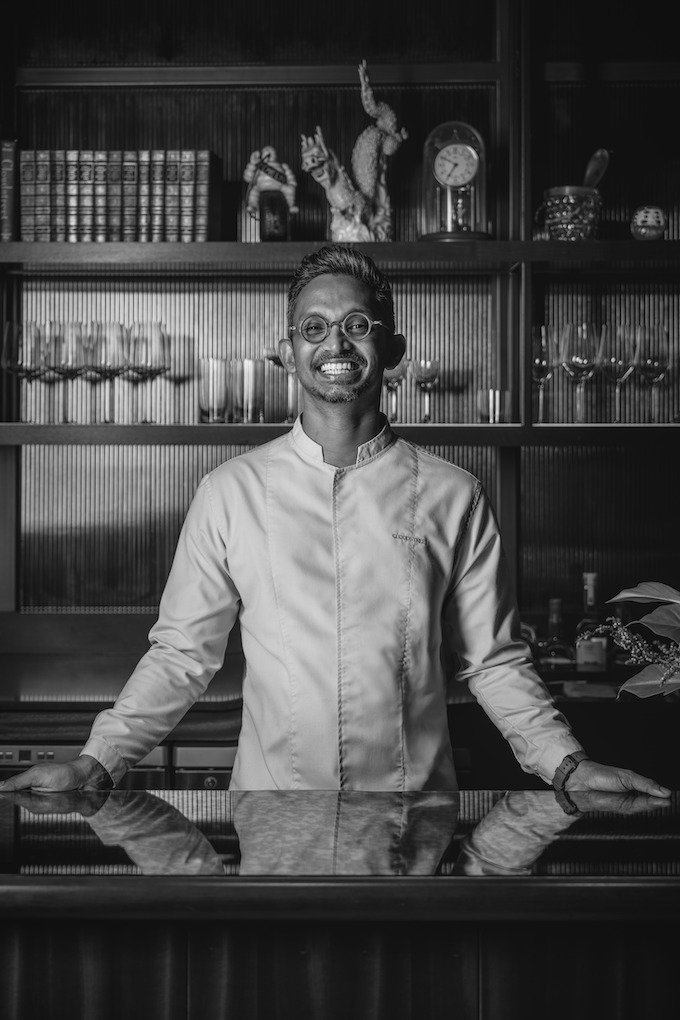
When Cheek by Jowl received a Michelin star in 2017, chef Rishi Naleendra made history as the first Sri Lankan recipient in the guide’s history. Nearly a decade on, the Colombo-born chef-restaurateur is one of the most prolific figures in Singapore’s dining scene. At the heart of Naleendra’s portfolio—spanning the two-Michelin-starred Cloudstreet, vibrant Kotuwa and the newly launched Station by Kotuwa—is a throughline of narrative depth reflecting personal heritage with a touch of irreverence. A deep commitment to community, whether through long-time regulars or close collaborations with his team and artisans, anchors his work. Every space he creates is as considered as the food itself, shaped by a playful curatorial eye and penchant for vintage finds and unique knick-knacks.
Tell us your origin story. How did you first fall in love with food?
I grew up in a family that was very much involved in the food industry. My parents used to do catering, and my mum was a very, very good cook. My dad used to bake quite a bit and my older brother got involved in the business when he was very young. But as a kid, that was the last thing I wanted to be part of. My ultimate dream was to become a pilot. But for medical reasons, I found out that I couldn’t. I have a condition called mitral valve prolapse.
My second love was design and architecture. I moved to Australia to study architecture—it was a complete turn. But at the time, my family was going through financial difficulties and I didn’t want to pay eight years’ worth of school fees. My decision to study hospitality was incidental, but from the first day of school and work, I felt like I could actually make a life out of hospitality. I started my career as a dishwasher in Melbourne and slowly worked my way up to chef. That’s when I really got serious about food.
How has your relationship with the culinary industry evolved over the years?
I’ve been very lucky to have the career I’ve had in the hospitality industry. From being a dishwasher, a cook, a chef to now owning multiple restaurants—it’s been an eye-opening journey. Being in the kitchen and running businesses are two completely different worlds. Sometimes, I don’t feel like a chef in the way I used to, at least not in certain areas. But it’s still nice to be involved in the creative process and to be in the kitchen when I can. What I enjoy now is getting creative not just with cooking, but also with the business side of things.
“Mentorship and building community have been at the core of our business and our success.”
What is the biggest challenge you have faced throughout your career and how did you overcome this?
There are always ongoing challenges in the industry— staffing, rental, all the usual issues. But I don’t necessarily consider those the biggest challenges as they’re just part of the job. COVID-19 was a completely different kind of challenge. And then the post-pandemic era, when the dining scene in Singapore started changing and the financial and economic landscape shifted, that brought on a whole new set of difficulties.
What has been key is how we’ve adapted and learnt to pivot. During COVID-19, we had to figure out how to do takeaways. Then, when the market shifted again, we had to evolve without losing our identity or the essence of our concepts. The launch of Station by Kotuwa is a great example. Fool Wine wasn’t working for us, so we transitioned it into Station in a seamless way—and that’s been working really well for us.
As a leader in the scene, what do you think is the importance of mentorship and building a community?
I think that’s been the core of our business and our success. Mark, who is now the head chef at Cloudstreet, was one of the first people I hired. He was my first sous chef at Cheek. Then there’s Shah, the other head pastry chef at Cloudstreet. Those two have stayed with me for almost eight or nine years now, and if not for that consistency, I don’t think I would’ve come this far. Jay, who is now the head chef at Station, was with me for six years before he left to try other things, and then came back to open Station with me. That kind of loyalty, that kind of team—having people I could mentor and bring up to the standard I believe in—has helped so much.
Even with our front-of-house staff, most of them tend to stay with us for two to three years now. That’s a big change from before, when people stayed maybe six months to a year. But I was also learning how to be a mentor and run a business back then. So, you have to change and adapt. And I think that’s been the real key to our success. Staff retention has been the most important aspect of what we’ve built.
Looking forward, what is one change you hope to see in the culinary scene in Singapore and how does this align with your vision for the industry?
I hope to see more young chefs with real drive and resilience coming through the ranks. I was 29 when I moved to Singapore, and even at that age, I was already looking up to see who was at the top and I wanted to get there. I wanted to go above and beyond, even as a young chef. I’d love to see more of that kind of energy in the next generation. Especially here in Singapore— it’s about that resilience, that drive to keep going and not give up halfway through. It’s hard work. That’s the difference I want to make: to inspire and help shape that next generation. That completely aligns with my vision: keeping the momentum going, building something lasting and constantly evolving the scene.
Pre-order your copy of the Vogue Man ‘Gold’ issue online or pick it up on newsstands from 13 June 2025.