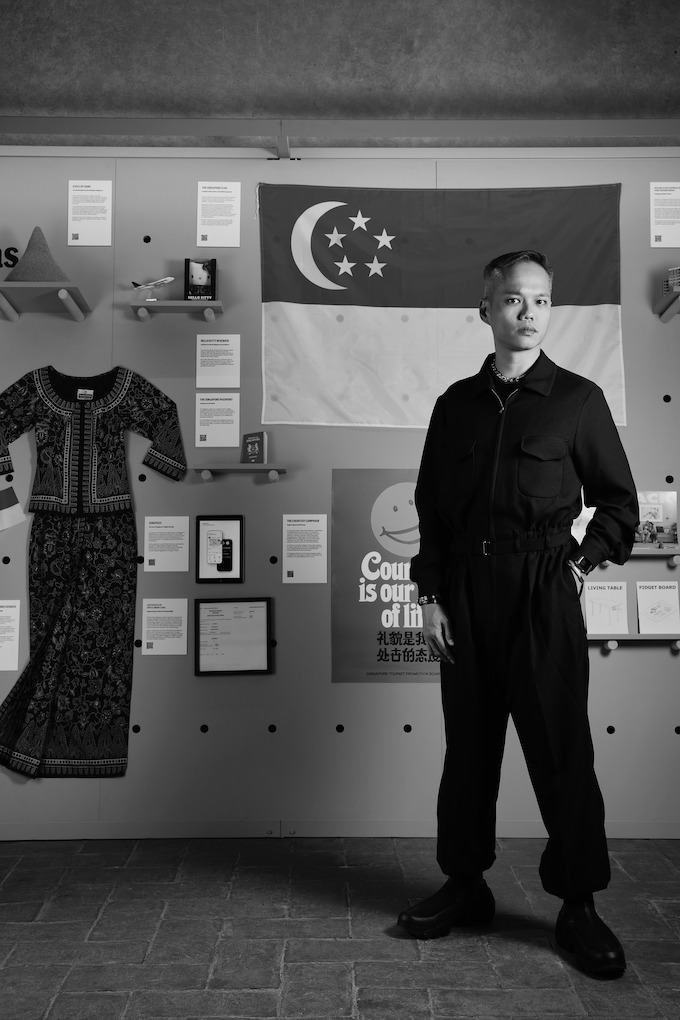
When DesignSingapore Council brought the third iteration of its Future Impact showcase to Milan Design Week this year, the exhibition saw the involvement of a Singaporean co-curator for the first time. As the director and co-founder of internationally renowned Singapore-and Milan-based creative studio Lanzavecchia + Wai, Hunn Wai is a prominent name in the design world—a designer, educator and thought leader in the field. Spotlighting future-forward works dreamt up by rising Singaporean creatives in response to today’s important global challenges, the exhibition is a reflection and extension of Wai’s belief that the most vital designs of all are meaningful ones shaped by intention, authenticity and thoughtfulness.
Tell us your origin story. How did you first fall in love with design?
I must’ve been five or six when I declared that I wanted to be a car designer. Even then, I wasn’t just interested in how things looked. I was fascinated by why they looked a certain way, and how colours, proportions and forms came together logically and beautifully. Art became a core part of my identity, but pursuing art or design was seen as uncertain and less stable then. I was all set to pursue architecture—what felt like the ‘acceptable creative profession’—when I saw that NUS (National University of Singapore) was offering industrial design as a brand-new degree. In my first year there, something clicked. I discovered that design had the vocabulary, the frameworks and the tools to help me make sense of everything I was curious about, from engineering and anthropology to psychology and aesthetics. That was the moment I truly fell in love with design, not just as a profession, but as a philosophy and a way of understanding the world.
How has your relationship with design evolved over the years?
A pivotal moment came when I pursued my Master’s in the Netherlands, at a time when the Droog design movement was making waves globally. Droog, which is Dutch for ‘dry’, was less about designing for utility and more about embedding narrative and wit into everyday objects. As my practice matured, I sought to combine the two worlds of critical, story-rich design and grounded, user-centred industrial design. In the last 12 years, my connection to design has evolved even further through teaching. I now see design not just as the creation of products, but as the shaping of people: of mindsets, values and ways of seeing. Today, my relationship with design is less about creating more objects, and more about enabling deeper thinking.
“Too often, innovation is framed around metrics, but I believe we also need to design for the spirit of society.”
What is the biggest challenge you have faced throughout your career and how did you overcome it?
One of the biggest challenges is the ongoing tension of how to make sense of it all while wearing many hats and still staying true to myself. As a designer, studio co-founder, educator, cultural contributor and now curator, the gear- shifting can be creatively energising, but also deeply draining. What helped me begin to overcome this wasn’t a single breakthrough, but a series of shifts in mindset and practice. I stopped designing to prove something and started designing to contribute something. I began designing my life with the same care I would apply to a product—protecting deep focus hours, making space for reflection and building teams where strengths complemented each other. Teaching has played a big role in this evolution. Mentoring younger designers reminded me that design isn’t just about output. It’s about mindset, process and intention. Often, the challenges we face become the tools that make us better collaborators, better thinkers and more grounded human beings.
As a leader in the scene, what do you think is the importance of mentorship and building a community?
Mentorship is incredibly important to me because the path of a designer is rarely straightforward. It’s not just about having a portfolio or a process. It’s about how you navigate ambiguity, align your values with your work and sustain yourself emotionally, mentally and creatively through it all. When I mentor, I try to share not just the polished highlights, but the real behind-the-scenes journey which includes messiness, doubt and pivots. As for community, it’s everything. Design isn’t a solo act. A strong community multiplies intention, energy and impact. It also creates a shared culture where we feel less alone, where we can learn from each other’s stories and support each other’s growth.
Looking forward, what is one change you hope to spark in the design scene in Singapore and how does this align with your vision for the industry?
To bring more humanity into the innovation we create in Singapore. Too often, innovation is framed around metrics—productivity gains, KPIs, scale—but I believe we also need to design for the spirit of society. In a world that’s rapidly flattening, this kind of cultural nuance and emotional resonance becomes not just valuable, but essential. I want to see more humanistic solutions—those that might make someone pause and say: ‘Yes, this reflects who we are’ or ‘That helps me live more beautifully and thoughtfully’.
To make that shift, I believe we need to reinvest in the arts, culture and the social sciences. The future won’t be short on technology. But what’s at risk of being neglected (because it’s harder to measure) is our imagination, emotional intelligence and sense of purpose. My hope is to help shape a design culture in Singapore that values both technical excellence and soulful expression—a culture where innovation is not just about what’s next, but about what’s meaningful.
Pre-order your copy of the Vogue Man ‘Gold’ issue online or pick it up on newsstands from 13 June 2025.