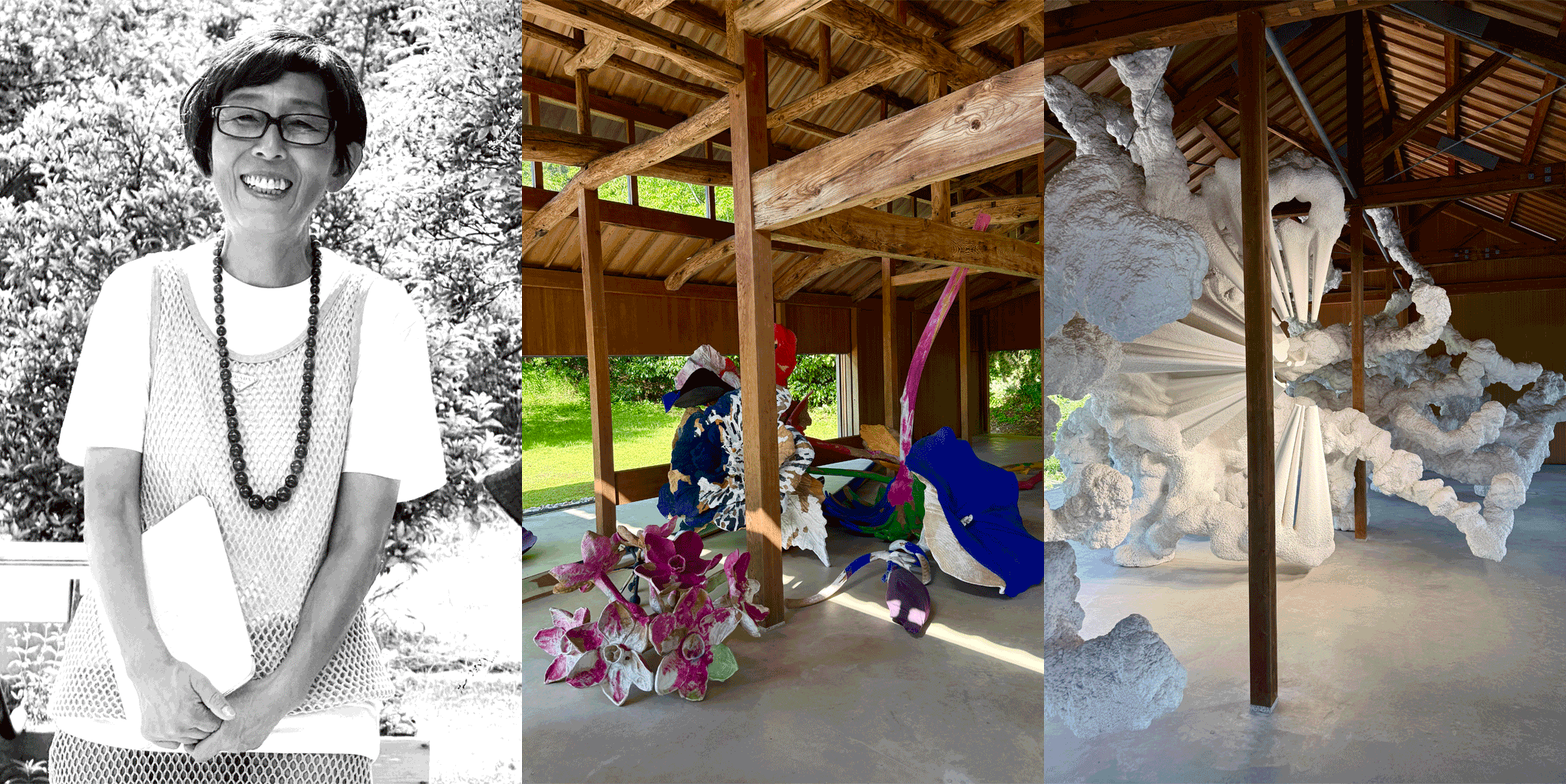
Prada Mode is a cultural social club founded in 2018 with the aim of bringing together art, culture and storytelling through the lens of travel. This year, it ventured into uncharted territory crossing continents as guests journeyed from Osaka to Naoshima and were ferried across to Inujima. There, they experienced firsthand how a remote island off the coast of Okayama Prefecture, home to just 21 inhabitants, has quietly evolved into a vital hub for contemporary art.
This transformation is largely thanks to renowned Japanese architect Kazuyo Sejima, who has dedicated 17 years to the Inujima Art House Project. With Prada’s support which includes the donation of a permanent pavilion at Inujima Life Garden, guests were invited to immerse themselves in a rare, deeply moving journey where a single boat ride shifts not just location, but perception. Much like the mythical Shangri-La, this voyage underscores the importance of physical experience—of being present in a space where culture, memory and imaginations are shared.

Throughout this unforgettable journey I had the privilege of speaking with Sejima and not only did I gain invaluable insight into the mind behind curating spaces, but I also came away with a deeper understanding of our responsibility, as global citizens, to uphold culture through the nurturing and cultivating of the arts. Here Sejima speaks to Vogue Singapore about the collaboration, her designs ethos and creative process.
How did you feel when you first received the call from Prada for this collaboration?
This collaboration happened two years ago in Tokyo when I was invited to be part of Prada Mode. I was serving as the director at Teien Art Museum and even though I might not be well-versed in fashion—being an architect—I really wanted to challenge myself and see how I can bring people together through well-curated spaces. And because Teien means Japanese garden, I decided to bring the conversations, the workshops and the performances outdoors— where it allows for guests to interact with the environment.


Did you extend that concept to Osaka and Inujima?
Yes, because while Osaka offers a more straightforward outdoor setting, Inujima—being a much smaller island—presents a completely different set of dynamics. There, the environment plays a pivotal role in shaping how we foster community through the exhibits. I hope for the two sites to be in dialogue with one another, each responding to its context yet contributing to a shared narrative. Ultimately, I want the experience to leave visitors with a sense of responsibility—not just to the art, but to their own communities. I think this is very important.
Let’s talk about design—from the iconic Aoyama store in Tokyo to the one in SoHo, New York and the now-legendary Prada Marfa installation in the Texas desert—Prada’s retail spaces are often both a boutique and art gallery. Do you see a connection between that visual language and your own design philosophy?
I was in awe when I first saw the store in Aoyama. But when it comes to my designs, I like to find a bit of fun in the way we do things. Take the rabbit chairs found at the Inujima Life Garden for instance, maybe not the most comfortable (chuckles), but they were created to achieve a certain look and feel—which aligns to the way I approach design and how it allows for interpretations.


Glass, for instance, is featured prominently in many of your works. Do you typically approach a space with a specific material in mind, or does the site itself dictate the material palette as the process unfolds?
It’s very much dependent on the environment. In Inujima, for instance, the roads are extremely narrow, so the logistics of transporting materials must be carefully considered. Anything beyond a certain size becomes nearly impossible to move, and because of that, we work closely with the environment, letting it guide many of our decisions. In fact, the sheds that house these large-scale installations often have their frontages completely removed, leaving only the bare structural frame. This not only opens up the space but allows the viewer to experience the artwork in tandem with its surroundings, inviting a deeper appreciation of the island’s natural beauty. Harmony is key for me when designing from within a landscape.
Miuccia Prada is known for pushing her creative boundaries—often choosing to work with materials, ideas or stereotypes that she actively resists. Have you ever similarly challenged yourself to go against your instincts or preferences in your own creative process?
Oh really? I didn’t know that! [laughs]. Well, honestly, I just love working with things I genuinely enjoy! But in all seriousness, I think it really depends on the space and the environment I’m working with.


Minimalist spaces often invite open-ended interpretation, while maximalist ones tend to present a more defined narrative. Do you agree with this?
Of course, I appreciate minimal spaces. However minimalism doesn’t automatically equate to freedom. A richly decorated space can be just as engaging. For me, when it comes to creating environments, I’m drawn to the idea of a park—an open, communal space that brings people together regardless of age, gender or social background. That’s very much the spirit behind Prada Mode: to create a space that is inclusive, open-ended and ultimately left to one’s own interpretation.
And finally, what’s your idea of a happy place?
I think when people get older they get happier. And wherever that place may be, it will always be a happy place.
For more information on Prada Mode Osaka, visit Prada.