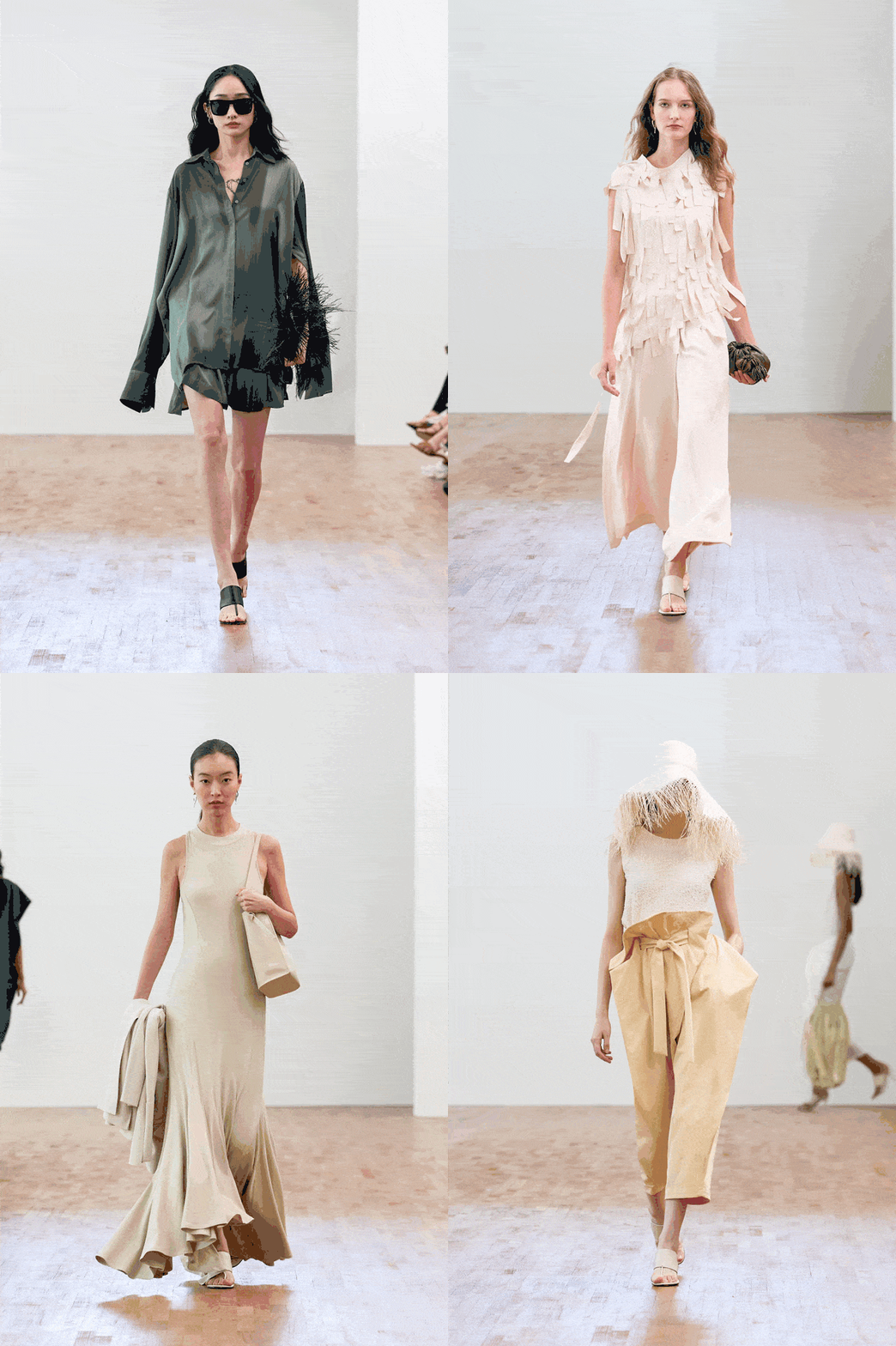
There is something so inexplicably simple yet pristine about the way In Good Company has always operated. Since its inception into the local market over a decade ago, the brand has slowly built its base, letting precise craft and immense attention to detail speak for itself.
Over the years, the four friends who first founded the brand—Sven Tan, Kane Tan, Jaclyn Teo and Julene Aw—have found like-minded folks to work alongside and collaborate with. The artisans they have been longtime collaborators with for example, are run by a close-knit family in Taixing. A modern cottage industry cultivated from a quiet farming community in Jiangsu Province, the family trains their workers with a keen eye and deft hand—all to ensure that every In Good Company garment can be replicated in exacting quality. Be it draped gowns or technical cuts of fabric, each piece is given the care akin to a luxury house’s production standards.
It is precisely this time-honoured, diligent understanding of design—one with a story to tell—that has earned the brand its repute today. Constantly evolving, experimenting, expanding. One might say that In Good Company has always been playing in a field of its own making. The intention has long been made clear. “We have always strived to remain true to ourselves,” reflects creative director and co-founder Sven Tan, on the brand’s evolution since day one. “Maybe what has evolved, and it’s not just about this particular runway collection, is our approach to design,”—he pauses, ruminating deeply—”it’s gotten a lot more honest. The industry is very different from how it was when we first started, and there are a lot more brands which also focus on ideas of simplicity and modernity in their DNA.”
“Our focus is still working on elevated, everyday classics but we are pushing the boundaries of what a new minimalism can be. A lot of it boils down to construction, to fabrications, to the core of what makes a garment work,” he stresses. Again, leading with intention.
This remarkable approach to garment-making takes front and centre stage at In Good Company’s first solo runway show, held at National Gallery Singapore. Where a capsule collection of 70-something looks came marching out to the beats of local musician duo Hejira, their live soundscape divinating one shared sentiment felt by everyone in the room—the afternoon was a celebration of In Good Company’s past, present and future.

“It’s been in the works since January,” Teo tells me. I am in the homegrown label’s Atelier, together with two of its co-founders, Sven Tan and Jaclyn Teo, just ahead of the landmark runway presentation, which also celebrates 10 years for the brand’s longstanding ION Orchard outpost. With only a couple of days to go, the design studio is abuzz with preparations for the big day, but the team feels oddly calm, self-assured almost.
“A lot of people have been asking me if this was going to be a retrospective. I said no, that was a big no for me—it had to be forward-looking for us. We see the show as a form of celebration, but also as a form of renewal.It’s about what you can expect from us in the future,” starts Tan, who shares the initial vision for the show.
“When we think of form, we think of structure and fluidity. When we think of light, it refers to texture, and it refers to movement.”
“During my initial conversations with Kane, we thought of designing a collection that combined tropical resort looks with an urban attitude. It sort of resonated with our position, being an independent brand in Singapore—that’s what our roots are.” Then came the National Gallery, a space which also influenced—and perhaps completed—the essence of the brand’s runway capsule.
“We wanted it to be a daytime show and when we saw the space at National Gallery, it’s got such a beautiful roof that allows the light to stream through. I think it even inspired Sven and Kane for some of the signature pieces. It was part of the inspiration; light, shadow and form,” shares Teo.
Hence, the title of the collection. “In between light and form speaks to us as a space where clothing comes alive. When we think of form, we think of structure and fluidity. When we think of light, it refers to texture, and it refers to movement,” Tan adds. “When me and Kane design, we think about a lot of things, but we always think about movement. When Kane drapes, he is always thinking about fluidity. How do you make a dress within a single seam and show the garment in its purest form? It’s something that is quite signature to us.”
It’s clear that a unique perspective on craftsmanship is integral in the atelier. As I sieve my way through the first floor where the full capsule has been all lined up, some pieces drew me in instantly. Others required a second glance; what is hanging on the rack seems worlds apart from how it is supposed to be worn—and lived in. A model is practicing her finale walk; a soft, billowing cape dress you can almost imagine for the minimal bride. A butter yellow blouse dressed in strips of triacetate, Tan tells me, has been precisely positioned strip by strip to ensure a harmonious effect, such that the fringe would fall effortlessly from the garment. A draped, asymmetrical knit skirt seems unassuming at first—but come runway day, it shines in the way it is worn: in perfect hang and rhythm. Some of the most labour-intensive pieces can also be found in the brand’s menswear range for this capsule too—particular favourites of Tan’s being a shirt and jacket that both utilise a specific interweaving technique.


“We kept close to our design ethos, but we still added something quite exciting for the show. Noticeably, throughout the collection, elevated, unexpected approaches to knitwear is a clear focus. We travelled up to our knit factory, and we had to explain to our artisans on how to execute it. The other focus would be tactility—because we wanted the fabrics to, in a way, catch and release light. We had these handcrafted fringe details that would react to movement and light—and all of it has been tediously hand stitched one by one,” Tan explains.
Like puzzle pieces slowly fitting together, plenty of other elements also came into play to make the show a success, such as the brand’s collaborations with Days of Ever or Studio Karyn Lim for some wire mesh accessories.
“In the vein of collaborations, choosing who would be doing the music was tough for us too. We wanted to see how we can work with local musicians, and decided to work with Randolf Arriola,” mentions Teo. Arriola, who is together in a band called Hejira with percussionist and drummer Mohamed Noor, is known for creating sonic environments using live looping—where the music is recorded live and then layered on top of each other as it goes along. With their alternative and craft-like approach to music, it’s easy to see why they were a perfect fit—to fill the art gallery with a sound that never ceases to evolve, whilst In Good Company filled it with clothes designed for people whose rhythm of life changes everyday.
“It’s a form of artistry in itself, and I think that’s what Sven really liked about it too,” offers Teo. Yet at the core of their decision, it demonstrated a sentiment that was as clear as water: In Good Company was always about togetherness.
So I ask about the way forward: what does it look like? “I would hope that someone who’s watched today’s show will walk out of it in awe of how an independent brand from Singapore was able to pull such a feat off, despite the limited resources and challenging market here,”—he concludes, after much pondering—”but beyond that, the show is also the product of the work of so many other local creatives; it’s the idea that together, we can make a difference.” True to their name, as always.
See some of the best looks from In Good Company’s runway capsule collection, below.

1 / 19
Look 1

2 / 19
Look 6

3 / 19
Look 7

4 / 19
Look 8

5 / 19
Look 10

6 / 19
Look 13

7 / 19
Look 22

8 / 19
Look 23

9 / 19
Look 29

10 / 19
Look 33

11 / 19
Look 37

12 / 19
Look 43

13 / 19
Look 46

14 / 19
Look 51

15 / 19
Look 55

16 / 19
Look 62

17 / 19
Look 64

18 / 19
Look 68

19 / 19