The question of local heritage comes up often—what it is, what it constitutes. We seek out old buildings that seem like time capsules to parts of our culture no longer accessible to us; we contemplate more contemporary means of wearing our traditional garb; we reminisce about the hawker hotspots we used to frequent growing up. So much so that when we want to build a home that teems with local sensibilities, we’re caught off-guard. We aren’t imagining shophouses, but spaces connected by meaning and memory.
“Local heritage is the lived memory of the place. It is not limited to buildings and objects of historical significance, it includes the rituals, practices, materials, crafts and trades that shape our landscape. What is local does not always have to be nostalgic. It can live amongst the everyday and pedestrian,” elaborates architectural designer Natalie Cheung, who is also a ceramicist and co-partner of her own interior and architectural design practice, Medium Specific.
This might manifest in the use of tiles in our public benches and tables commonly seen in our void decks or even more informal spaces like our local markets and bazaars, according to Cheung. It could even be as simple as the inclusion of belongings that hold special meaning to one’s own lived history. For designer and visual artist Hafi, for example, this might mean the draping of batiks that once belonged to her late grandmother or paintings of old family portraits. The idea is that heritage is personal, and should a home wish to reflect that, it shouldn’t have to feel like a monumental task.
Below, a judicious range of tips for any present or future homeowner, from both @hahahafi as well as architectural designer Cheung, for how to approach the making of a home into something that feels in tune with one’s local culture and heritage—without compromising on the functions of everyday life.

1 / 6
Context is key
“Heritage isn’t merely a set of motifs or a style of visual identity, it is how we make sense of what came before us—it transpires in the practices that inform our everyday life, and is shaped by the stories that we inherit,” explains Cheung. As architectural designers, responding to context—which denotes circumstance, living conditions and the surroundings that give meaning to certain items or pieces—is what is important, if you’re planning on building a home that is moulded around your identity.
Begin by asking yourself: what are the stories, rituals or traditions tied to your sense of belonging? Are there pieces of objects, furniture or art that you would like to bring into your home? That’s your starting point, advises Cheung.

2 / 6
Do your research
Once you get a good grasp of the above, dig deeper. It might even be important to think about how to host festive gatherings or if there’s a need to make space for small worship areas. Communicate these concerns to your interior designer, if you have one.

3 / 6
Get in touch with the personal
Think about sprucing up your home by creating spaces around objects that hold special meaning to you. What are the personal narratives of these furniture or pieces of art?
According to Cheung: “It is possible to foreground a piece of furniture or work of art without isolating it from its environment by giving consideration to the texture, materiality, scale and proportions of its surroundings. For example, a wall of heritage tiles could be balanced with a simple, unadorned surface or perhaps, a bolder reflective material that amplifies its presence.”
Starting simple is a good way to go. In Hafi’s home, the paintings of old family portraits were important for memory’s sake. Once archival photos that offered her a glimpse into the lives of her paternal family who once lived at Kampung Tempeh (between Sixth Avenue and Coronation Road West in the Bukit Timah area), these photographs ended up being points of conversation between herself, her grandaunts and father.
“I decided to paint these photos—particularly the ones with my late grandmother and her sisters in them because she suffered from dementia. Often times I would look through the photos with her and she would recall the colours and textures of the baju kebaya and baju kurung that she wore in the photos. I tried capturing the colours and stories through illustration. It started with one painting, and ended up turning into a series.”

4 / 6
The old and new can co-exist
“Tradition doesn’t have to be antagonistic to the present. It is not a static identity, but a set of knowledge and practices that have been honed through craft, and withstood the test of time. There is plenty we can bring forth from traditional in our application to modern and contemporary design,” Cheung advises.
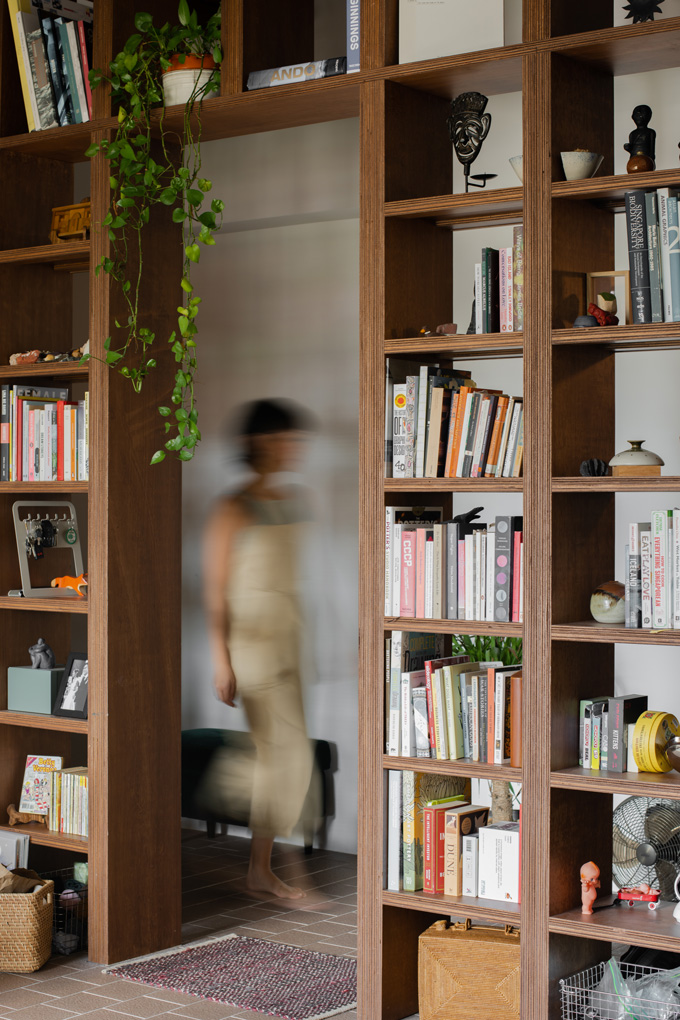
Take one of Medium Specific’s home projects, Picnic Room, for example. To refurbish a 30-year-old top floor Joo Chiat apartment, the design of the home thoughtfully preserved the structural artefacts of the original building, like a wrought iron spiral staircase that retains its sense of old world charm. Meanwhile, the defining feature of the home—a double-sided bookshelf—was purposefully built with widened vertical cross-sections, meant to align with the original ceiling battens. An old home, made anew.

5 / 6
Materiality matters
In building a personal space that feels ‘localised’, the materials chosen matter more than we think. To suit our tropical ecology, the materials chosen for Picnic Room are also woods that have been engineered to be moisture-resistant, as well as terracotta which is known to regulate temperatures.
This could translate to the imbued textures of a home. Hafi’s infusion of batik cloths into her abode for example, is a superb use of a textile so culturally-rooted in the family and her culture. “It has many uses besides being a fabric that is used to wear with baju kurung, baju opah or baju kebaya. Most of the batik pieces that I have in my possession were passed down to me from my late grandmother who was of Javanese descent. I’ve set aside a handful for special occasions and festivities like Hari Raya but have decided to display some of them in my home. A prominent one being a piece that I used to carry with me when I was a baby.”

6 / 6
We're building a home, not a museum
“When it comes to incorporating heritage pieces into a home, the goal isn’t to recreate a museum-like setting where the objects are placed in a vitrine with no room to move, breathe or be touched. Ideally, you would want to strive for a thoughtful and intimate environment where these narratives and traditions are not only reminders of the past, but part of the rhythms of living,” adds Cheung. What matters is how the pieces fit into your life, not the other way around.
If you’re building a home that means something to you, it shows. “Sometimes objects might not have such a great significance on others but if you are able to find meaning and connection to its stories, it should have a place in your home,” concludes Hafi.
So most importantly? Be curious about your own culture. Interact with it. Relive old memories. That’s how you build a home that matters.