It was in mid-February that I received an email invitation to take part in the Asia Pacific Defender Media Experience. Still reeling from my trip to Bhutan, where clocked close to 20,000 steps a day, I found myself unexpectedly open to something entirely new, simply because I’ve always lived by a simple mantra: to try everything at least once. Thrown a set of coordinates and tasked to figure out the route? Sure. Hammering through rugged terrain while solving puzzles in an Amazing Race–style challenge? I’m in.
Truthfully, I had no real idea what I had signed up for until about a week before the trip, when the schedules were finally released. Even then, the line-up remained deliberately vague. Like the 24 high-profile adventurers and off-road enthusiasts vying for a place at the Defender Trophy Global Final in South Africa, the experience was designed as an embrace of the impossible, full of suspense and the unexpected. None of the obstacles were revealed upfront. The aim was clear: to push teams to weld fast and think on their feet.

But first, the grand reveal: the new Defender 110 Trophy Edition in Deep Sandglow Yellow or, in fashion terms, sunflower yellow. Among others, Gloss Black accents on the bonnet and wheels, combined with Trophy decals, signalled a deliberate callback to the iconic Camel Trophy Defenders that once tore through deserts, jungles and riverbeds in that same ochre hue.
Originating in 1980, the Camel Trophy stood as the ultimate test of teamwork and endurance. What began as a modest German expedition quickly evolved into a global challenge, with teams navigating thousands of miles across some of the planet’s harshest terrains. The Defender Trophy now exists as the brand’s own take on the iconic legacy format, a recognition of endurance as a deeper sense of purpose. This aligns with Defender’s long-standing partnership with Tusk, a conservation organisation focused on protecting wildlife and supporting translocation efforts across Africa. Perhaps the most tangible expression of this partnership lies in the field: Defenders deployed as working vehicles, enabling wildlife rangers to carry out anti-poaching patrols and community outreach across regions where terrain is unforgiving and infrastructure remains limited.

With a bit of history folded into our morning coffee, expert automobile journalists, digital writers, veteran lifestyle editors and I were split into groups of six—and that’s where things truly began. First up: the Wide Load station. A lightweight beam was fixed to the rear of the car, turning a simple drive into an exercise in precision. The task was straightforward in theory—to rely on a newly assigned teammate to guide one through the course without clipping a single cone—but far more exacting in practice. Of course, I clipped everything in sight so that was not a great start.
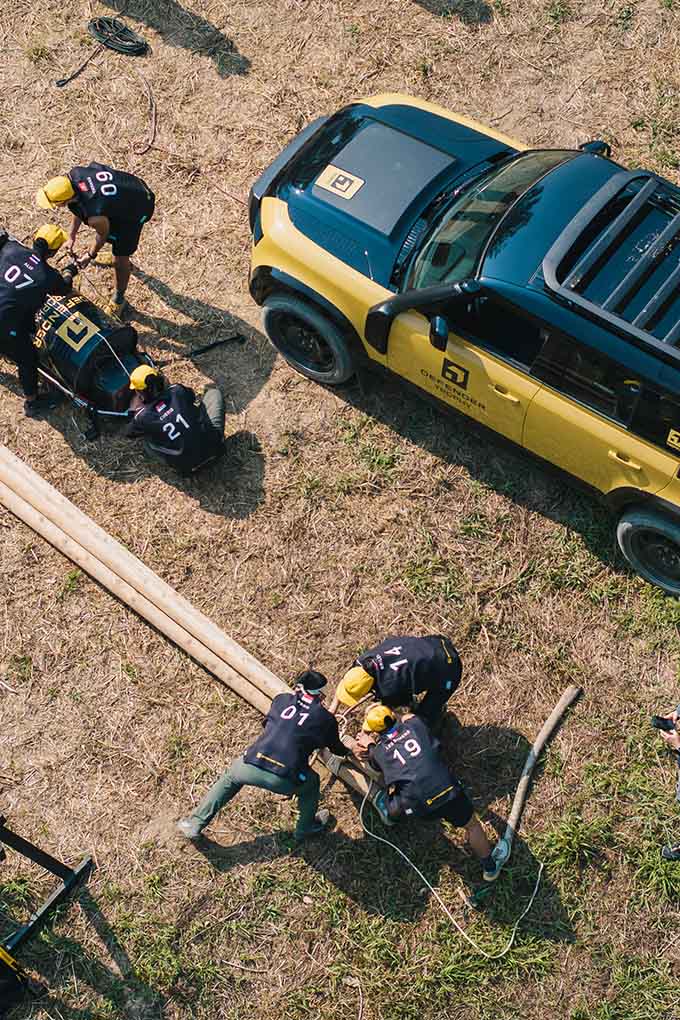
Then came the Peak Performance obstacle. Using a pulley system rigged between two vehicles, we split into roles: drivers, guides and load coordinators. It looked deceptively simple, but quickly proved gruelling. The test wasn’t just about communication, complex obstacles, but patience and the ability to move as where teamwork and one cohesive unit. From there, we found ourselves standing before a technical off-road course. For the thrill of it, I volunteered to take it head-on.

As someone who is very much a point-to-point driver back home, it was mind-blowing to see what the machine could do. With just a few swipes on the built-in driver display, the vehicle shifted seamlessly into Terrain Response, adapting instantly to the task at hand. From mud and ruts to rock crawls and the newly introduced wade mode—where we drove through 900mm of water—the system recalibrated everything in real time. Too fast and you risk flooding the engine; too slow and you lose momentum. Wade mode manages that balance automatically, raising the chassis via air suspension while maintaining control through the water, which I thought was pretty darn cool.
By this point, I was also feeling exceptionally confident behind the wheel, partly because the Defender 110 is built like a tank on the outside, yet within its quiet interior, it drives with remarkable precision and composure. Its features are at home in the rest of the Defender line-up as well, manifesting across form and function—from revised exterior details boasting new front and rear light signatures to immersive interior designs like the large 13.1-inch touchscreen display, as well as technologies like the Adaptive Off-Road Cruise Control. All this makes negotiating challenging terrain more intuitive than ever before.
Soon, the intensity gave way to a more leisurely off-road drive, carrying us through the scenic heart of Chaozhou township and Zhongcuo village, just south of Kaohsiung in neighbouring Pingtung county, where the terrain softened and the rhythm of the drive became almost meditative. Of course, what we experienced was only a fraction of the actual competition. Clips of contestants navigating far more complex scenarios—some unfolding deep into the night—brought back flashes of my time in the army.

That said, there were, inevitably, traces of raging testosterone, fuelled by the endurance-heavy nature of the challenge and the unspoken code that no team member is left behind. But what lingered most was something far more considered: a distinctly human-centred proposition that places community at its core, shaped by shared purpose, collaboration and the instinct for collective survival.
As the newly crowned Asia Pacific Defender Trophy qualification finalist Ron Ng aptly puts it: “This is truly a coming together of enthusiasts. We learn not only to look out for one another in the harshest of times, but to trust that the machine, in turn, will take care of us.” And perhaps that is the point entirely. In the end, it was never just about the machine, but what it reveals in us when the road disappears.