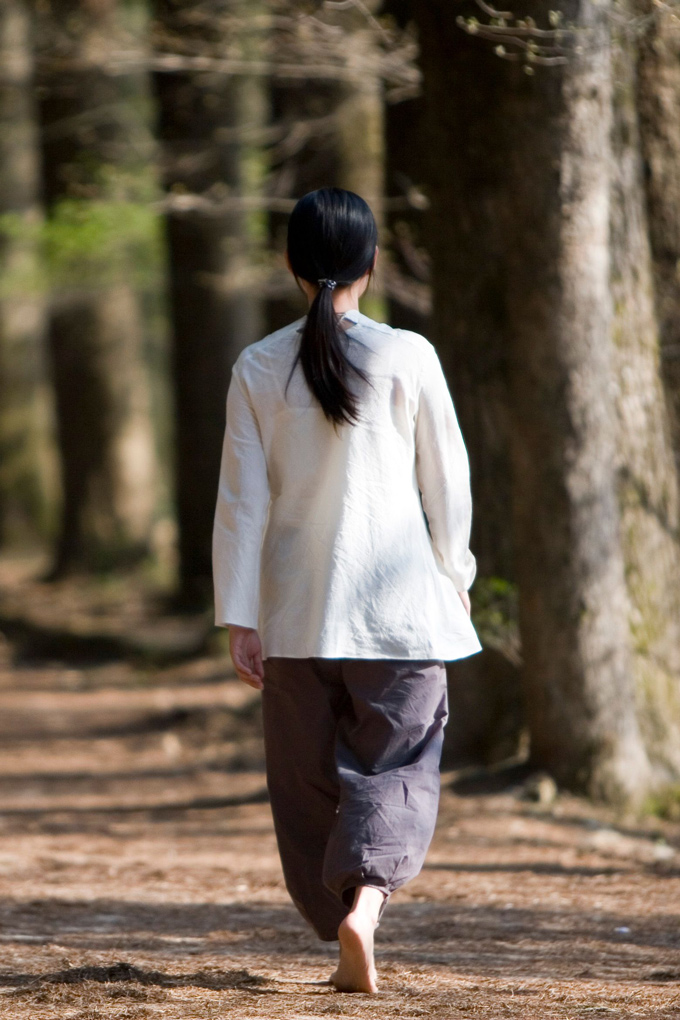
Picture this: lush green fields, soft white sand, and moist brown earth. The common denominator? They’re the perfect places to reconnect with yourself and the earth. Grounding, or earthing, is the practice of walking barefoot on such surfaces.
Proponents of the technique hypothesise that direct contact with the earth reduces anxiety and stress, regulates your body’s circadian rhythms and eases your nervous system. Science says that due to the Earth’s negative charge, an exchange of electrons occurs when you come into direct contact with the ground. These electrons work as antioxidants to neutralise free radicals in the body, reducing oxidative stress and inflammation; regulating your nervous system; balancing your energy and easing your nervous system. But if you’ve got your self-care routines down pat, consider stepping out for more than just a mental refresh. Grounding extends into the realm of physical benefits, and also improves your foot health.

Strengthening your muscles
Wearing shoes—especially heels and trainers with cushioning—isolate your feet from their surroundings and provide cushioning that you might not need. Although they protect your feet from potential hazards, they also leave the smaller muscles, tendons and ligaments in your feet underused and neglected. This group of muscles, known as the intrinsic foot muscles, are mostly layered along the sole of the foot and act as the core muscles within the foot. These muscles have a myriad of functions: absorbing shock, supporting the natural arch of the foot, stabilising the foot and controlling toe movement. Walking barefoot allows you to train and strengthen these muscles, just as you would for any other part of the body—this leads to reduced strain on the larger extrinsic muscles in your feet, ankles and legs. As the intrinsic muscles grow stronger, the extrinsic muscles no longer need to overcompensate, and the risk of injury decreases. Your ankle’s stability and mobility will improve as well, allowing your feet to better absorb harsh impact.

Think of grounding like doing pilates for your feet. You’re paying attention to the muscles you don’t really get to work on in a usual training programme, slowly building up their endurance and ability to support larger muscle groups.
Building balance and stability
As you walk barefoot, you might also realise that you’re not walking as smoothly as you’d like to be—this might be because your feet struggle to perceive the terrain you are walking on.
This unconscious spatial awareness and ability to sense movement is due to a process called proprioception (the ‘sixth sense’, if you will). Proprioception allows your brain and body to understand your body’s position in space without relying solely on your vision. Proprioceptors located in your muscles, tendons and joints are sensors that detect aspects of movement such as stretch, tension and pressure, and fire signals to the brain in a feedback loop to help maintain balance and stability while moving.
Grounding allows your feet to practice proprioception, translating into better balance and stability as you walk. Take for example, an uneven gravel path—walking down this path with improved coordination, balance and agility would be a direct result of grounding. If you’re prone to clumsy falls and tripping over your feet, working on your proprioception through grounding might just help you out.

Improved circulation and a natural gait
With the increased muscle activation and signal-firing taking place in your foot, you’re inadvertently improving blood flow and circulation. As the muscles, tendons and nerve endings are stimulated, peripheral circulation to the legs and feet are greatly improved and a greater supply of nutrients and oxygen are delivered to the tissue in your lower limbs.
Your gait will begin to self-optimise and feel more natural as well. Walking in shoes often leads to a harsher heel strike—our body subconsciously registers the shoe as a barrier to protect the heel when we walk. Walking barefoot leaves our heel exposed and we naturally fall into a more soft, relaxed heel-to-toe gait. This opens the gateways of benefits to other parts of the body: improving spinal alignment and posture, preventing back pain and strengthening the core muscles that support our lower back.
So if you’re looking for a peaceful way to improve your balance and stability, you may want to consider grounding—you’ll wind up benefitting your body in a myriad of ways for the long-term.