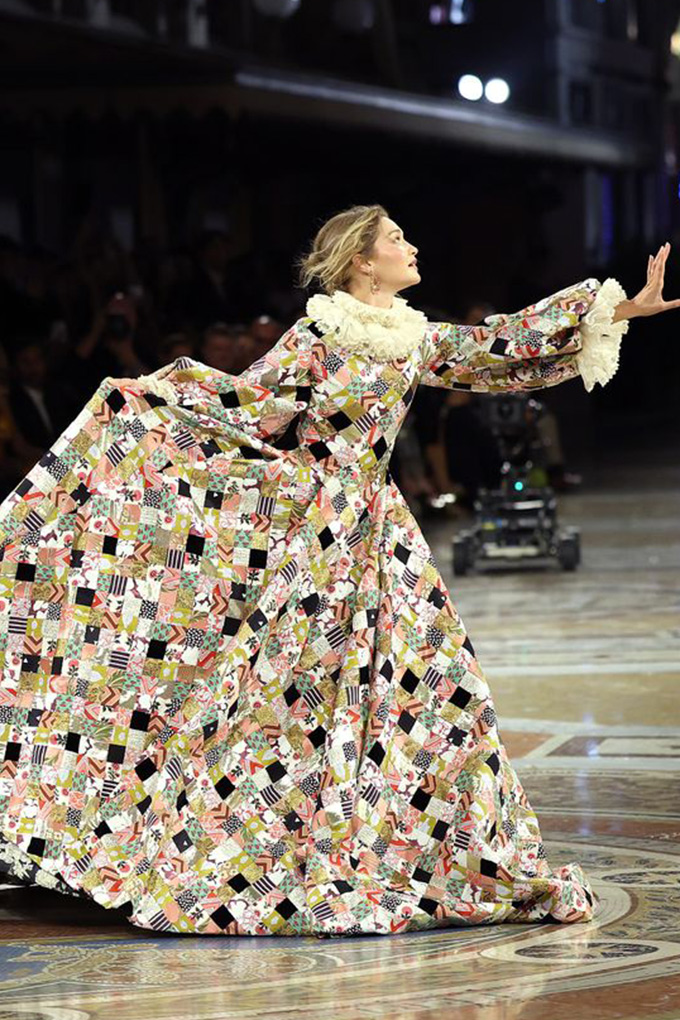
After travelling across the globe and making pit stops in New York, London, Paris, and Los Angeles, Vogue World officially lands in Milan this evening.
Taking place in the iconic Galleria—a bustling retail thoroughfare in the heart of the city—the night promises a feast of fashion spectacles whose archival, current, and custom runway designs pay homage to the fashion capital’s enduring history of artisanal craft, cutting-edge textile technology, and forward-thinking ideas—not to mention a special collaboration with the Teatro alla Scala Chorus. “This extraordinary event offers a unique opportunity to celebrate with a global audience the timeless story of Made in Italy, a story of genius and craftsmanship,” Francesca Ragazzi, Vogue Italia’s head of editorial content, said in a statement. “It feels particularly meaningful to do so at this moment in time, in the era of artificial intelligence.”
“In the creative industry, it’s an enormous conversation at the moment,” says Vogue World Milan’s creative director, Juan Costa Paz. “Getting into that space for this year felt like the right thing to do. Especially being in Milan, it’s such a hub for craftsmanship—Italians have always been the leaders of craft. The idea of the show really has been to create a narrative in which we can see these conversations expressed through fashion.”
Opening the show is a trio of craftspeople, presenting the objects they helped create: a model of the Duomo, a celestial sphere, and a loom. These were commissioned by fashion historian and the show curator Judith Clark, who explains that the idea was to represent “artisans celebrating history, translating references from one material to another. It is what fashion does all the time.”
This idea is at the very foundation of the Galleria. As Clark says, Vogue World: Milan, “was always conceived as drawing attention to the precious artisanal heritage associated with Italy, but also to the revolutions that allowed hand and machine to be combined. I felt it also needed to be tied to the Galleria itself and its famous mosaic floor—and that the emblems at its centre represent four cities: Florence, Torino, Roma, Milano. It felt like a wonderful beginning: Florence (Renaissance), Torino (the Industrial Revolution, we all think of the Fiat Factory), Roma and La Dolce Vita, and the films coming out of Cinecittà, and finally the fashion industry and smart textiles of the north and Milano.”

The Duomo:
“As early as the Renaissance, wooden models were used by architects to illustrate their designs and obtain approval from their patrons, who could then easily visualise the final appearance/design of the structures,” says Clark. This scale model, then, represents the Cathedral as it might have been completed in the 19th century, with all its pinnacles and the four small spires around the dome all of equal height, unlike the building that exists today. This miniature is made using the fretwork technique, requiring a total of 4,500 hours of work.
The Celestial Globe:
This handmade wonder represents the 88 constellations. “The map is printed from hand-etched and engraved copper plates onto fine Italian handmade paper, hand-coloured with natural pigments, with each star individually gilded in gold leaf,” says Clark.
The Loom:
This object, Clark explains, “symbolises the art and craft of fashion and textile in Italy. The loom, associated with such an early technical revolution of hand and machine, shows the persistence of care invested in the garments we are celebrating—from textile to embellishment. The loom, instantly recognisable, is a historic model, meticulously scaled down to balance the globe and Duomo [created] for Vogue World: Milan’s trio.”
“The first act is the artisanal revolution, which has to do with everything that comes before electricity and before industrialisation,” Costa Paz tells Vogue. “It was the time of kings, queens, and popes, and through that, we’re seeing fashion that’s handcrafted.”
Vogue World: Milan by the Numbers: The trio is followed by 18 artisans representing 15 Italian houses, all attired by Loro Piana. The six hooded figures are in custom velvet capes by Etro.


Act I: The Artisanal Revolution
A candlelit procession brings Renaissance-inspired textiles to life. Rich brocades, lace, ornament, and hand-worked surfaces evoke an era when artists, artisans, and inventors worked across disciplines, laying the foundations for Italy’s enduring culture of craftsmanship.


“The first act is the artisanal revolution, which has to do with everything that comes before electricity and before industrialisation,” Costa Paz tells Vogue. “It was the time of kings, queens, and popes, and through that, we’re seeing fashion that’s handcrafted.”


Archive Deep Cut: Roberto Capucci
Not only did a 1961 newspaper article describe Roberto Capucci as “Italy’s Boy Wonder,” but it revealed that “Romans call him the ‘little Balenciaga.’” By that time, the Roman designer, who founded his business in 1951, was known for his architectural approach to fashion. Now 96, Capucci reportedly sold his first dress when he was 18 to none other than Marcella Rossellini. His gowns were so voluminous that in a 1989 Vogue article by Joan Juliet Buck reported that Mirella Petteni, a model turned Vogue editor, had “two closets in her Venice house for two Capucci evening gowns—one to a closet.”
Archive Deep Cut: Romeo Gigli
Romeo Gigli, the son of booksellers, was an avid traveller and self-taught. The designer arrived in fashion in a big way during the ’80s. As Lee McQueen, once an assistant designer at the brand, told SHOWstudio, “There was nothing going on in London and the biggest thing at that time was Romeo Gigli—he was everywhere. I thought, ‘This is the only person I want to work for.’” Often described as fashion’s poet, Gigli—who is now designing furniture—had a great sensitivity to fabrics and was able to convey opulence and androgyny with cocoon shapes and softly elongated lines. As Vogue put it in 1987, Gigli represented “another sensibility, another voice in fashion.”


“Glenn from Diesel designed 50 boiler suits,” Luca Galasso tells Vogue. “I wanted them to look very industrial, very uniform. We’re giving them shoulder pads so they look very strong, very powerful. And they all have Diesel combat boots.”
Act II: The Industrial Revolution
The intimacy of the artisanal workshop gives way to the rhythm of industrial production. Torino, the heart of Italy’s automotive and manufacturing industries, inspires a world of tailored silhouettes, monochrome fabrics, and precisely produced woollen textiles.

In fashion, the Industrial Revolution led to the sudden streamlining of clothing production. Ideas like the everyman’s suit came into sharper focus and were able to be replicated on a mass scale.
“I think there’s obviously a craft to tailoring, but there’s also dressing the working man,” says Costa Paz. “And also, the Industrial Revolution speaks to the birth of the fashion designer as a persona. Here, we’re referencing a lot of Giorgio Armani being probably one of the first superstar designers in modern history.”


ACT III: Made in Italy
Colour and print explode onto the stage in a celebration of Made in Italy and the cinematic mythology of La Dolce Vita. Inspired by Federico Fellini and the golden age of Italian cinema, this act celebrates the emergence of the Italian diva—an enduring symbol of glamour, sensuality, and style.
Prints and Patterns

“Italy is a country of so much emotion, and so much colour and pattern, and yet every part of Italy is unique,” Vogue World: Milan’s Fashion Director Lady Amanda Harlech says. “And I think that’s what I find so fascinating, the difference between Florence or Rome or Milan or Venice. I mean, it’s so rich and profound, and they have not lost it, and it hasn’t been swept underneath a kind of sea of McDonald’s. It’s still holding onto its integrity. That’s what I love.”


Archive Deep Cut: Prada
Miuccia Prada explored “the good taste of bad taste” in her vibe-shifting spring 1996 collection. With clashing patterns and an “off” palette seemingly inspired by ’70s kitchen appliances, it was a thought-provoking display of the designer’s ability to reframe long-established fashion norms. “If I have done anything,” the designer said later, “it is to make ugly appealing.”


Influence of Cinema


“Today you talk about a ‘Dolce Vita’’ character and you know who that person is, Monica Vitti and all these incredible, Italian women,” says Costa Paz.


A Day in the Life of the Galleria


Intermezzo

Vogue World: Milan by the Numbers: Four opera singers in costumes from La Scala’s archive. Dancers in Ferrari.


Act IV: The Age of Intelligence
Craftsmanship and technology converge as fashion enters the laboratory. Intelligent and sustainable textiles respond to temperature, movement, performance, and the demands of the environment. Milan takes centre stage as a hub where research, manufacturing, design, and creativity meet.


“When you think of Italian tech fabrics, it’s often linked to sports,” says Harlech. “You think Moncler, Prada, all of them, whether it’s Diesel or Ferrari, they all have the leading ability to create great fashion that is extraordinarily sporty.”


Costa Paz adds, “[It’s] this moment where men and machines start working together, and the way that that is expressed in fashion is through innovation in fabrics and textures. It’s kind of like that middle ground between sportswear and fashion as well.”


Four conductors, the men dressed by Kiton, the women by Genny. Benetton made the uniforms—bib shirts, red tie, black pants, and cummerbund—for the 103 choristers from La Scala Academy.


Act V: The Imagination Revolution
The final chapter transcends place and belongs entirely to a speculative future. Italy’s extraordinary heritage becomes material for invention and transformation as we imagine what fashion might become next.

From left: Elsesser wears Fendi Couture by Maria Grazia Chiuri. Model Stella Hanan wears Valentino Vertigineux Haute Couture by Alessandro Michele. Kendall wears Giorgio Armani Privé by Silvana Armani. Boscono wears Ferragamo by Maximilian Davis. Model Abény Nhial wears Bottega Veneta by Louise Trotter. Model Betsy Gaghan wears Gucci by Demna. Model Bianca Balti wears Dolce & Gabbana Alta Moda by Domenico Dolce and Stefano Gabbana. Ethan James Green
“When I was researching for this show, I got really hung up on this concept of the Imagination Revolution, explains Costa Paz. “A lot of technologists and scholars from around the world say that, when AI and all of these radical moments that we’re living right now, the ultimate human capital is creativity. There is something about the role of human creativity as a mediator of these things that is something that you cannot let go of.”


Memory Dresses


“We were really moved by the stencilled handprints discovered in a cave in Indonesia,” says Harlech. They were 68,000 years old, and yet they were really modern. And so the idea of a future-facing thing would be something that somehow has an echo of the past. So we asked the leading creative directors of the major houses if they would create a custom memory dress or an echo chamber dress that really is a sounding of the iconic melody of each house.”
Creative
Creative Director Juan Costa Paz, Convoy
Head of Editorial Content, Vogue Italia Francesca Ragazzi
Run of Show Director Jen Green, Genevieve Productions
Choreographer Charm La’Donna
Movement Director Stephen Galloway
Fashion
Global Fashion Network Director, Vogue Virginia Smith
Deputy Director, Global Fashion Network, Vogue Laura Ingham
Fashion Director Lady Amanda Harlech
Styling Director Peter Aluuan
Special Performers and Cast Fashion Director Luca Galasso
Show Curator Judith Clark
Production
Executive Producer, mode and the moon Marie Julie Craeymeersch
Executive Producer Balich Wonder Studios
Backstage Operations WITHOUT Productions
Hair & Makeup
Makeup Pat McGrath
Hair Cyndia Harvey
Nails Eri Narita
Music
Music Direction Gaspard Murphy
Music Direction Thomas Roussel
Executive Music Production Ivan Striga
Lighting
Lighting Design ARF&YES.com
Livestream
Live Director Becky Garner
Director of Photography, Livestream Brett Turnbull
Executive Producer, Si Fi Productions Simon Fisher
Livestream Si Fi Productions
Livestream Graphics Feed The Animals
Special Performance
Performance Consultant and Principal Dancer Roberto Bolle
Choreographer, Roberto Bolle Intermezzo Laccio
With thanks to the entire Vogue editorial teams globally, and all the Condé Nast teams that have helped make Vogue World possible.
Events Sache Taylor, Sammi Tapper, Maria Elettra Esteri, Rose Carlisle, Jessica Rose, Chloe Zoller, Leslie Ann Nunez
Fashion Ariel Camara Bretas, Honey Sweet Elias, Naomi Elizée-Blue, Marta Oldrini
Talent Casting Sergio Kletnoy, Ignacio Murillo, Liana Weston, Morgan Sensei, Daniela Ravaglia, Martina Amadori, Irene Manicone
Video Thespi Guatieri, Traci Oshiro, Lauren Brenner, Tara Homeri, John Callanta, Joshua Fleming, Rahel Gebreyes, Linda Gittleson, Dennis Guilbault, Horst Lehner, Massimiliano Lombardo, Cecilie Norsgaard, Oliver Scott, Mitchell Stewart, Daniel Taveras, Romy van den Broeke, Marco Viganò
Communications Jill Weiskopf, Alessandra Chiacchiaretta, Bernie Torres, Marta Romanati
The event is held under the patronage of the Municipality of Milan and Camera Nazionale della Moda Italiana with the artistic contribution of Teatro alla Scala and Accademia Teatro alla Scala.
Select fashion and accessories are sourced from eBay, Vogue’s official vintage and pre-loved vintage partner.
The event is held under the patronage of the Municipality of Milan and Camera Nazionale della Moda Italiana, with the artistic contribution of Teatro alla Scala and Accademia Teatro alla Scala. Vogue World: Milano is made possible by presenting sponsors Alo, eBay, Eli Lilly and Company, and Meta Glasses. Additional support is provided by FedEx and OpenAI.
Vogue would like to thank Benetton, Campari, Davines, Eataly, Fiat, Galvanina, La Perla, Manucurist, Museo Nazionale Scienza e Tecnologia Leonardo da Vinci, Novelty, Palazzo Giureconsulti, Rai Teche, Santa Maria Novella and Teatro alla Scala. Vogue World: Milano hospitality partners include Casa Brera, a Luxury Collection Hotel, Milan, Château Monfort, Mandarin Oriental Milan, NH Collection Milano Touring, Palazzo Cordusio Gran Meliá, Rosa Grand Milano–Starhotels Collezione, Residenza del Cardinale Meliá Collection, Straf Hotel and Vik Retreats.