If you look on the undersides of the newest jewels from State Property, you’ll spot a charming little detail. Stamped on every piece from its The Story of Everything collection is a doodled signature, the mark of Mika, the four-year-old son of founders Afzal Imram and Ruiyin Lin.
The Story of Everything marks 10 years of State Property, the contemporary fine jewellery brand that has, in a low-key manner, become one of Singapore’s great design success stories. It’s easy to name the A-list celebrities who have worn its designs—Nicole Kidman, Michelle Obama, Rihanna, Lady Gaga, Taylor Swift, Gigi Hadid, Robert Downey Jr, among them. But what’s more interesting is the story behind this brand, which has a uniquely fulfilled and distinct perspective on jewellery design.
Founders Ruiyin and Afzal come from creative backgrounds. The former studied jewellery design at Central Saint Martins, and the latter industrial design at the National University of Singapore. “We got to know each other through friends. We were in design school, doing different things in different countries. But we somehow just always connected on design,” recalls Afzal. Their friends at the time, says Ruiyin, were doctors and medical students, so the shared passion was a point of difference. “We knew we wanted to work with each other after school,” says Afzal.

When Ruiyin had graduated from Saint Martins, she called Afzal and the two decided that it was now or never to start something new. “It was really ground-up. Design students who don’t know what to do, don’t know how to start a business,” describes Ruiyin of the earliest days of their partnership. They began with design consultancy Proper People—it remains the registered company that State Property operates from—where they worked on branding, that mainstay source of income for designers, for other businesses.
They started an unbranded bespoke jewellery service, but quickly ran into a directional wall. “What we saw,” says Ruiyin, “was that a lot of clients were asking us to replicate Tiffany pieces or pieces from the big houses.” They realised, adds Afzal, that they needed their own collection for people to understand their point of view.

The point of view which would become State Property is sophisticated and takes sidelong, highbrow references. There is a collection that translates the tension of literary narrative reveals— the anticipation and uncertainty of how stories can play out— into pearls thrillingly set into the ends of ovals and arcs of gold. Another collection draws from the architecture and mosaics of the Byzantine empire, turning its splendour into pieces that thrum with a mystical, arcane symmetry. Yet another collection draws from the precisely ordered beauty of grand gardens like Amrit Udyan in Delhi and Generalife in Granada to form radial hedges from emeralds, diamonds and enamel.

It’s a conundrum of Singapore design. The field here, and its official position taken of late by the DesignSingapore Council, can be stiflingly pragmatic. We want design that solves a problem and sells—beauty, so intrinsic to the seductive aspect of jewellery, sometimes takes a back seat. These kinds of blinkers and parameters can stop us from recognising something astoundingly obvious: design talents in Singapore are highly learned and cultivated. Ruiyin, for one, remembers having to adjust when she returned to Singapore from London. The art-school mode of jewellery was anti-commercial, intended for galleries, and questioned things like context and value. “I was glad that we didn’t go straight into State Property,” she explains. “Because I had to, in a way, rehabilitate to what the reality [of the market] actually is.”
The name of the brand is a wry, knowing wink to those who’ve lived in Singapore. It took a lot of arguments, they say, but they knew what they didn’t want in a name. “We didn’t want to name it after ourselves. We wanted a name that was a contemporary reflection, something permanent, that observes the world. As compared to naming it ‘Afzal and Rui Jewellers’ or whatever. Immediately you fall into a different category. Harry Winston or Cartier, those are family names.”
Serendipity came on a drive one day to Changi Village for lunch. While arguing in the car, Ruiyin drove headfirst into a sign that said ‘state property’. Few things are more omnipresent, permanent and watchful in this city than that. An earlier idea was to name the brand after a fabled tree. Shares Afzal of the thought: “We were researching and Changi was named after a tall tree–”
“–that got cut down,” Ruiyin finishes. So much for that. “Living things shouldn’t be so permanent anyway.”

Afzal describes the first State Property collection, of about 10 to 15 pieces, as “pure, but in a way a bit naive”. They knew how to design a collection, but not quite yet how to sell it. The core of the look, however, was already in place. “The first collection was about exploring the body, so there was a lot of negative space and frames,” explains Ruiyin, who has for a decade now virtually single-handedly helmed the brand’s design. “The silhouette and the language of the rings have stayed the same,” she says of a key example of this DNA. “The signet ring with the pavé line on the front and side. Things have moved on from then, and they may look more commercial, but they’ve all kind of stayed the same.”
What’s changed since then is confidence and assurance in their work. Pricing was one of the earlier sticking points. The most expensive pieces from that first collection in 2015 went for around $3,000. Today—though inflation and ballooning gold prices play a part—their rings start from above that. “Asking someone to pay $3,000 for our work? Who wants to spend that here?” says Afzal of their thought process at the time. It’s sure to be a familiar refrain for many young creative practitioners and makers—comfort with placing value and a price on one’s work comes with experience. But those pieces from the first collection, if you can still find them, represent a kind of distilled essence of the brand’s design language. “In fact, we just sold one of the original pieces this year,” he shares with pleasure. “It was with a retailer, and when we got the sales report, we were like, this one finally made it, guys.”

The environment of the 2010s didn’t help things much, with no model to emulate or infrastructure to fall into. There were two main avenues to get work out there. “When we first started, the multi-labels like Surrender and Kapok were still around,” says Ruiyin. These, much the same as international multi-label retailers like Colette or Opening Ceremony, are now a thing of the past. The other was fairs like Public Garden and Boutique Fairs, where independent brands and makers sold their work. The audience for such fairs, however, are more used to affordably priced tchotchkes bought on a casual weekend afternoon. Not, in the case of State Property, 18-carat gold and diamond fine jewellery. They realised, says Afzal, that they couldn’t retail past a certain price point. The closest points of reference were established private jewellers like Simone Ng and Caratell—though even those brands operated in a different way, with their own boutiques or private salons. “We looked up,” he says, “and felt really alone.”
A pivotal moment came in 2017, when State Property won the Emerging Accessories Designer of the Year category at the Singapore Fashion Awards. Tina Tan-Leo, a grande dame of the fashion industry who in her past as a retailer brought countless international luxury and designer brands to market in Singapore, was one of the judges. Tan-Leo brought much needed perspective. Afzal remembers the encounter well. “She basically said, ‘Guys, your stuff is good to go international. Why aren’t you there?’ And we were like–”
“–are you sure?” Ruiyin says, emulating a younger incredulity. Tan-Leo would go on to mentor the brand for six months, connecting them with the right people, laying out processes and reworking pricing. Most crucially, she introduced Afzal and Ruiyin to a wider, international world of independent designer jewellers who were working in a similar fashion. There was a scene out there in the world, even if they were the only ones in Singapore. “She was the key for us to put State Property on this trajectory,” says Afzal of this turning point.
View this post on Instagram
One other crucial development in the story of State Property is the opening in 2022 of a flagship boutique in Takashimaya Shopping Centre. After the worst of the COVID-19 pandemic had passed in 2021, Afzal roped in his brother, who had returned from Indonesia, to join the company as a business controller. “He pushed us to do this mall thing because the rent scared us,” says Ruiyin.
It paid off. “The foot traffic is… there’s no substitute for it. No matter how much we spend in digital marketing, in the end, people coming across the products in real life, being able to come in, try them, speak to someone from the brand—there’s no replacement,” says Afzal. About three years ago, State Property had a fairly even split in how much of its jewels sold locally and overseas. These days, there’s a strong growth that favours Singapore.
The team at State Property numbers around 10 today. Afzal’s sister-in-law has joined the company too, and she looks after its commercial and retail partners. Ruiyin recruited a friend from primary school to supervise manufacturing. “It’s becoming a family business, actually,” she observes.


But design, the heart and soul of the brand, remains the work of Ruiyin. When I ask how big the design team or studio is, she raises her hand with a smile. “She’s more than capable of handling the whole department,” Afzal says—part warm admiration, part matter-of-fact. By Ruiyin’s admission, though, State Property had for a couple of years fallen into a prescriptive lane as a jeweller that only does art deco. That had to do with an assertion of identity. But a larger reason was the reality that international retailers carrying State Property needed a stylistic lane to slot the brand into so as to better organise and categorise its offerings for their clients. “After COVID, we had to break it up and revamp ourselves,” explains Ruiyin. “To still have the State Property aesthetic, but slowly morph.”

The result of that is The Story of Everything, a collection that marks a significant stylistic evolution for the brand. This new line marks not just the 10th anniversary of State Property, but also the inaugural creative involvement of the youngest member of the family: four-year-old Mika.


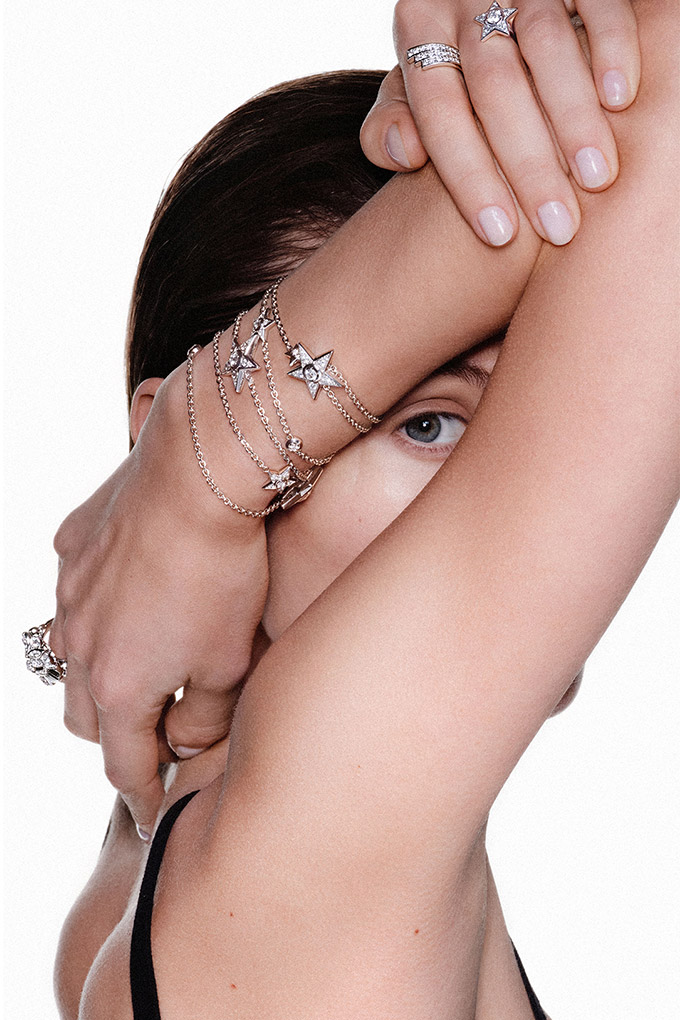
The collection is made up of three naïf motifs—toadstools, eggs and train tracks— drawn from bedtime stories that Mika made up. The pieces bear signature State Property details like vibrant coloured enamel and domed bombé silhouettes. The rings are designed with signature sculpted ribbing with flush-set diamonds on the side. What’s especially gorgeous are the new Railroad designs which dot the middle tracks with baguette diamonds, subtlety and luxury wrapped in a loop as a bracelet or a ring. Playful, light-hearted and chic at the same time.
Perhaps what’s unspoken is that the ‘everything’ of the collection is, in fact, family. Afzal and Ruiyin started State Property as 20-somethings with a first collection of ‘naive’ jewels that set the tone. It’s poignant that a decade on, having grown the brand, recruited family members, become parents and more, they cap their first 10 years with a renewed look of naïveté. Here’s to 10 more.
Photography Shawn Paul Tan
Styling Nicholas See and Lance Aeron
Hair Grego Oh
Make-up Sarah Tan
Photographer’s assistant Chay Wei Kang
Stylist’s assistant Nurul Firdousee
The October ‘Kinship’ issue of Vogue Singapore is available online and on newsstands.